

All systems go
How Walter Evans, BSEE ’41, left a lasting mark on control systems engineering — and everyday electronic systems in use today — with the creation of a method called root locus
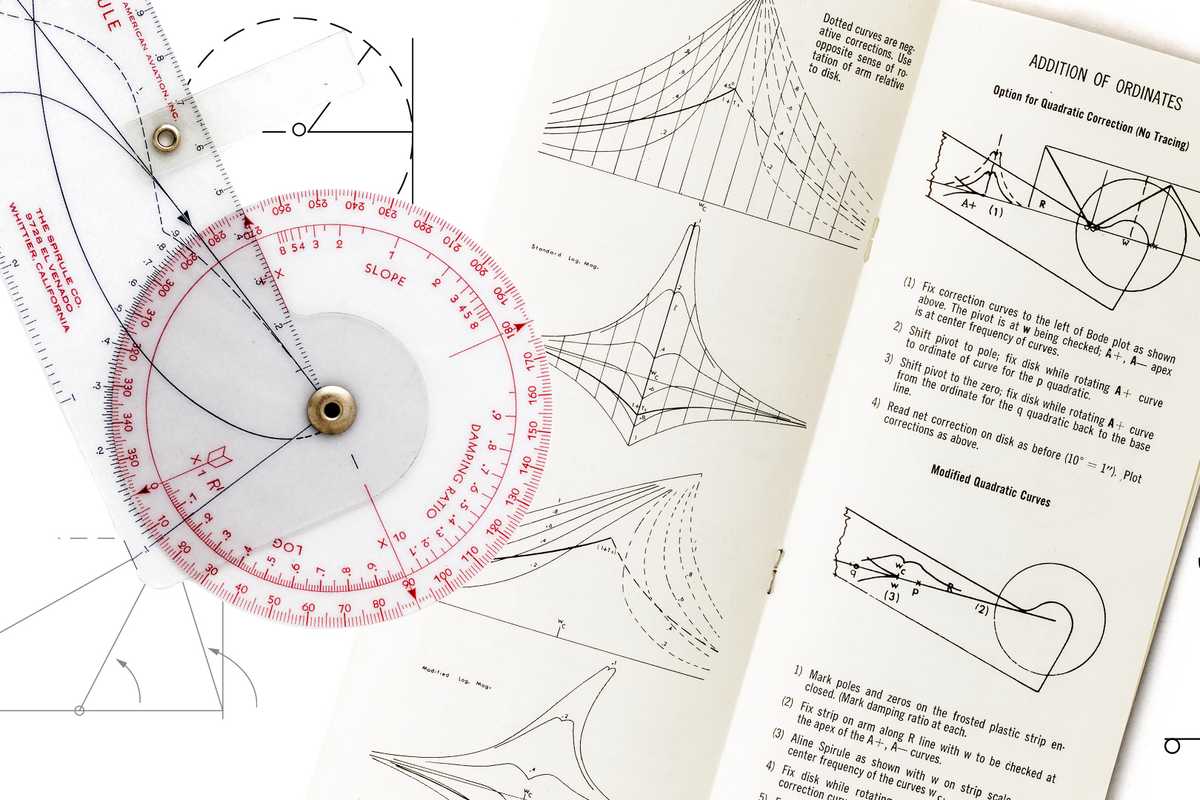
“This,” engineer David Peters says, “is how we went to the moon.”
Peters, BS ’69, MS ’70, the McDonnell Douglas Professor of Engineering, is in his Jubel Hall office on WashU’s Danforth Campus gushing with excitement. He is being asked to explain root locus, a concept few outside of engineering have even heard of, much less comprehend.
So Peters is starting with relics of systems engineering’s past.
On his desk sits a Friden mechanical adding machine — a rather large device for a desktop that resembles a manual typewriter, except it’s rectangular and displays only numbers. There’s also a curious hybrid plastic gadget called a Spirule, which looks like a ruler with an attached wheel at one end, lined in 360-degree increments.
“Engineering in the 1940s and ’50s didn’t have electronic calculators or computers,” Peters says. “They didn’t exist.”
What did exist, Peters says, were mathematical concepts and, later, specialized tools like the Spirule. These devices aided in solving problems that engineers — in a crucial, post-World War II period in our nation’s history — could not yet solve in closed form but somehow had to account for.
The field of control systems engineering involves designing systems that can react to unexpected external changes. This basic problem — the need to respond to continuous feedback — had to be addressed in order to design Cold War technologies: a rocket thrusting into space, for example, or an unmanned vehicle being sent to the magnetic North Pole. Everyday systems, too, like a stoplight adjusting for traffic or a heating and air conditioning thermostat adjusting to a fluctuating temperature.
Before computers, how did an engineer account for outside factors that influence the reliability of a system? At the heart of it was root locus and its creator, WashU alumnus Walter R. Evans, BSEE ’41.
Evans is the man who not only came up with root locus, he helped guide the invention of a mechanical tool, the Spirule, to map it out — thus revolutionizing control systems design. Root locus, says Peters, shaped “the methodologies taught in classrooms and employed by engineers worldwide.
“There’s not a control systems engineering textbook in the world that doesn’t have a chapter on root locus,” Peters says. “Everybody uses this: mechanical engineers, aerospace engineers, chemical engineers, electrical engineers, industrial engineers.”
Read the full story here.
Click on the topics below for more stories in those areas
Back to NewsFaculty in this story