McKelvey Engineering students build new aerospace design team
WashU VTOL focuses on autonomous vertical take-off and landing aircraft
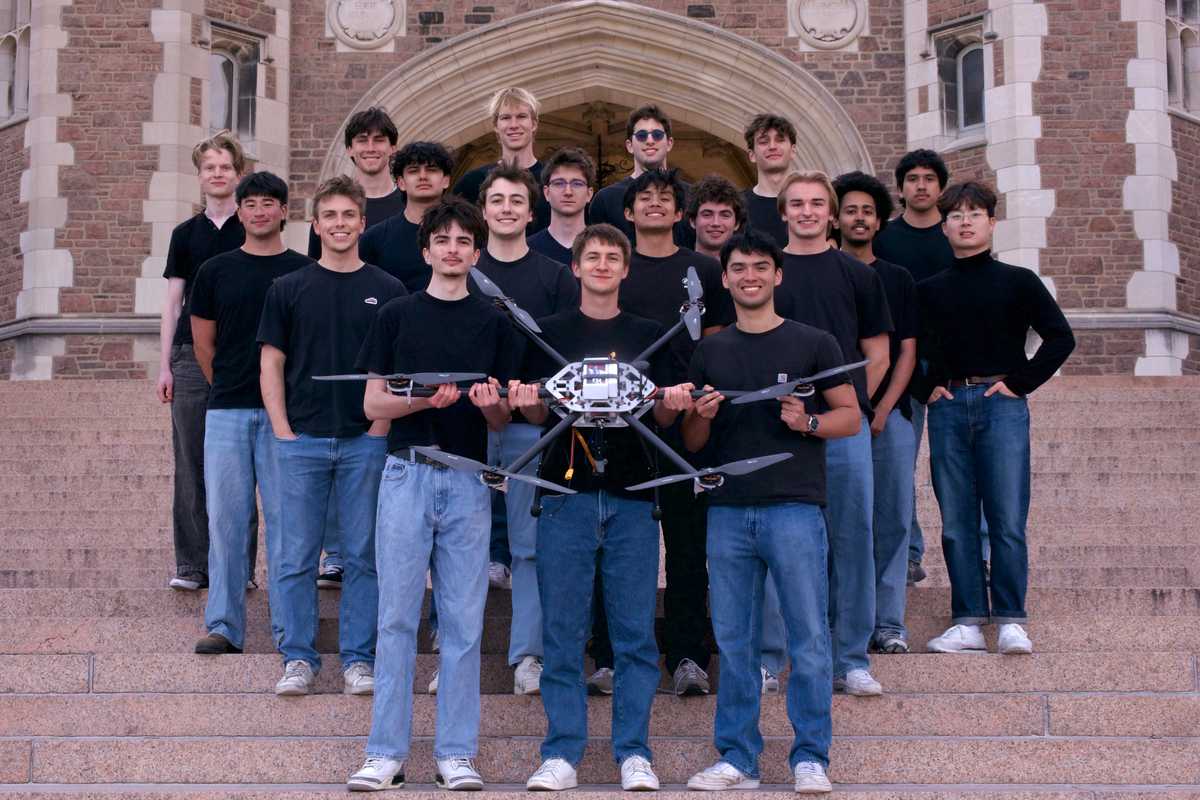
WashU students interested in gaining experience with aerospace design have a new option thanks to two engineering students with a shared vision.
Junior Ethan Stewart and sophomore Diego Perez, both students in the Department of Mechanical Engineering & Materials Science in the McKelvey School of Engineering, met while participating in the University Rover Challenge with WashU Robotics. The two soon discovered a shared interest: VTOL (vertical take-off and landing) aircraft.
VTOL aircraft can take off, hover and land vertically without the need for runways, while also transitioning to conventional forward flight. They combine helicopter versatility with airplane efficiency, enabling operations from confined spaces like rooftops or ships.
“While there are other aerospace groups at WashU, none are dedicated to autonomous VTOL aircraft,” said Stewart, president of WashU VTOL. “That’s where we saw an opportunity for this group.”
As a new student design team within McKelvey Engineering, WashU VTOL seeks to promote hands-on engineering, innovation and aerospace design within the WashU community by designing, building and testing VTOL aircraft. The organization provides students with opportunities to explore advanced aeronautical systems, collaborate across disciplines and gain experience through technical projects and competitions.
“Our team brings together students across mechanical engineering, electrical engineering and computer science to work on real-world applications of autonomous flight such as wildfire response,” Perez said. “It’s important that our members get to apply classroom knowledge to the real world.”
Perez said the complexity of the aircraft makes close collaboration across disciplines essential, especially when designing key systems like the fuselage and integrating avionics.
Stewart said the team has been “busy not only building the aircraft but also managing the administrative work required to launch a new student group.” In its first year, the team has grown to more than 25 members, secured funding through McKelvey Engineering and the Engineering Project Review Board, and developed a fully functional aircraft through a complete design-build-test cycle.
Beginning with the group’s appearance at the fall Activities Fair, Stewart says the group has seen increased student interest.
“Other design teams are more manual, whereas we focus on the autonomous and software side, allowing the aircraft to control itself in real time as if a pilot were flying it,” Stewart said.
Another appeal is the flexibility of the aircraft design process.
“We have a lot of design freedom,” Stewart said. “We can choose a different VTOL airframe type each year. We’re not constrained to strict competition parameters.”
The group also offers opportunities for professional development. Recently, an engineer from Pivotal joined the group via Zoom to consult on the aircraft build and offer interview advice.
“We think it’s important to build something you can be proud of today, while also recognizing how the experience can shape and support your future,” Perez said.
Their first year, however, has not been without obstacles.
“We started in the Spartan Light Metal Products Makerspace in Jubel Hall, which was great and gave us a lot of resources,” Stewart said. “But we were limited in working hours and aircraft storage.”
These limitations became more evident this semester, when the group progressed from making prototypes to building the aircraft.
“As the build came together this semester, we actually were having to deconstruct and reconstruct it after meetings,” Stewart said. “Each time someone was having to take it back to their dorm.”
The group recently moved its workspace to Hugo & Ina Champ Urbauer Hall 110, where they expect to continue growing in the space previously occupied by WashU Satellite.
As the academic year winds down, WashU VTOL is finishing strong with presentations to the National Council April 17 and the Maker Showcase May 1.
They said they look forward to building upon what they were able to accomplish this year and ultimately competing on a national stage at the Vertical Flight Society Design Competition in 2027.
“We have built a strong foundation for the club to grow in the future, and we’re just getting started,” Stewart said.
Follow WashU VTOL on Instagram (washu.vtol) and LinkedIn (WashU VTOL) for more information. Students interested in joining can also email WashU VTOL, Ethan Stewart or Diego Perez.
Click on the topics below for more stories in those areas
- Undergraduate Students
- Computer Science & Engineering
- Mechanical Engineering & Materials Science
- Electrical & Systems Engineering