Raman named Dennis and Barbara Kessler Professor of Biomedical Engineering
Barani Raman developing ‘electronic nose’ with applications in medicine, homeland security

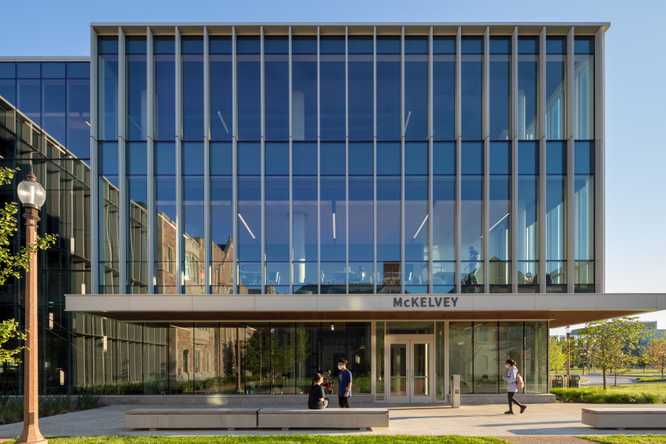
Barani Raman, a renowned expert in systems neuroscience, machine olfaction and bio-inspired computing, has been named the Dennis and Barbara Kessler Professor of Biomedical Engineering in the McKelvey School of Engineering at Washington University in St. Louis. He will be installed March 4, 2026.
A faculty member in the Department of Biomedical Engineering since 2010, Raman leads the Systems Neuroscience and Neuromorphic Engineering Lab, which combines theoretical and electrophysiological approaches to study how the relatively simple insect brain processes complex sensory signals and to identify fundamental principles of neural computation. In parallel, Raman is also involved with developing novel neuromorphic devices, such as an “electronic nose,” and algorithms that have potential applications in biomedical, homeland security, robotics and human-computer interaction domains.
More recent work in Raman’s lab has focused on using insect-based biorobots and cyborg systems for chemical sensing. Through the Center for Cyborg and Biorobotics Research (CyBoR), of which Raman is the founding director, he and his collaborators hijacked a locust’s olfactory system to both detect and discriminate between different explosive scents — all within a few hundred milliseconds of exposure. They took advantage of their knowledge of the insect olfactory system to develop a biorobotic sensing system that uses the neural responses in the locust brain to detect and recognize odors. Using this ‘canary-in-a-coal-mine’ approach they demonstrated the feasibility of using the insects’ sense of smell to determine the presence or absence of several different explosive chemical species.
“Barani Raman’s work has significant implications for a wide range of societal problems ranging from security to health which can be addressed at the intersection of biology and engineering," said Aaron F. Bobick, dean and the James M. McKelvey Professor. “His visionary development of neuromorphic devices has earned him a much-deserved reputation as a pioneer in his field, and his commitment to advancing biomedical research reflects the priorities with which Dennis and Barbara Kessler established this professorship.”
Raman’s work has been funded by the National Science Foundation (NSF), Office of Naval Research, Air Force Office of Scientific Research and the Defense Advanced Research Projects Agency, among others.
He is the recipient of the Wolfgang Gopel Award from the International Society for Olfaction and Chemical Sensing, the National Science Foundation CAREER Award and the Institute of Electrical and Electronics Engineers (IEEE) Donald G. Fink Award.
Raman serves as an editorial board member for Scientific Reports and Frontiers in Neural Circuits. He is a member of the Society for Neuroscience and IEEE.
Prior to joining WashU, Raman was a joint postdoctoral fellow at the National Institutes of Health and the National Institute of Standards and Technology. He earned a bachelor’s degree at University of Madras, and a master’s degree and doctorate at Texas A & M University.
Dennis & Barbara Kessler
In 2001, Dennis and Barbara Kessler made a commitment to establish this professorship to encourage activity in biomedical engineering. They are particularly interested in this field, which combines medical and biological engineering, because of its expected contributions in genetic medical research; they have a son who has a neurological genetic disorder called dystonia.
The Kesslers are both graduates of WashU. Dennis Kessler earned a bachelor’s degree in industrial engineering in 1960 and a master’s degree in engineering administration in 1964; Barbara Kessler earned a bachelor’s degree in sociology in 1963. Dennis spent 34 years in management at Fel-Pro Inc., which manufactured and distributed gaskets, engine parts and industrial chemicals in both the original equipment and aftermarket in the automotive industry. Fortune magazine ranked Fel-Pro fourth on its list of the best companies to work for based on the creative and numerous benefits offered to employees of this privately-owned company. Dennis was co-president in 1998 when the company was sold to Federal-Mogul Corp.
Following his time at Fel-Pro, Dennis served as founder and president of Midwest Family Business Advisors, which provides strategic planning, succession planning, consensus building and board governance for family businesses. Dennis specializes in helping families to overcome the challenges inherent in mixing business with family.
Barbara Kessler also worked for Fel-Pro, writing the company magazine and planning special events. She has served as president of her congregation, as president of the Highland Park Associate Board of the Art Institute of Chicago and as president of the Family Alliance Foundation.
The Kesslers have been supporters and board members for the Dystonia Medical Research Foundation for over 40 years. Dennis served as president for nine years and continues to serve on the foundation’s board. Barbara is the organization’s vice president of awareness and education.
Dennis Kessler is an emeritus member of the McKelvey School of Engineering National Council. He received the McKelvey Engineering Alumni Achievement Award in 1999.
The couple serves on the Chicago Regional Cabinet and also supports the Scholars in Engineering program.