WashU AI Racing in high gear for its first year
New student group offers experiences in AI, robotics and autonomous driving
Dayan Parker, a senior majoring in electrical engineering, founded WashU AI Racing (WUAIR) after studying abroad for a year at Trinity College Dublin, where he participated in Formula Trinity, the school’s Formula Student AI (FSAI) team. Starting without prior robotics knowledge, Parker met the former president of Formula Trinity, who encouraged him to join the team. There, he learned about robotics and software development within large-scale teams, eventually applying that knowledge to create a new method for planning optimized racing paths — an achievement that earned him the Most Valuable Team Member award. Beyond technical skills, Parker said he found a "family" within the team, finding connection through late-night debugging sessions spent poring over a single computer screen and a shared excitement for collaborative creation. After this experience, Parker’s interest in robotics solidified as the core of his academic focus. Feeling he had more to contribute to the field of autonomous racing, he founded WUAIR to give other students the chance to compete, master robotics and find a community of their own.
Learn more about WUAIR from Dayan Parker below.
What is the club’s mission?WUAIR is a dynamic organization dedicated to providing students with hands-on experience in AI, robotics and autonomous driving. Our mission is to collaborate with a diverse and creative team to design the most robust and performant software stack possible. We aim to push students to solve real-world engineering challenges within a large, structured and professional team environment.
While rigorously engineered, complex software is the core of WUAIR, an equally important pillar is creating a sense of community. We all spend plenty of time underground in the basements of the McKelvey buildings; WUAIR balances that by providing a tightly knit social environment.
What makes WashU AI Racing Club unique?
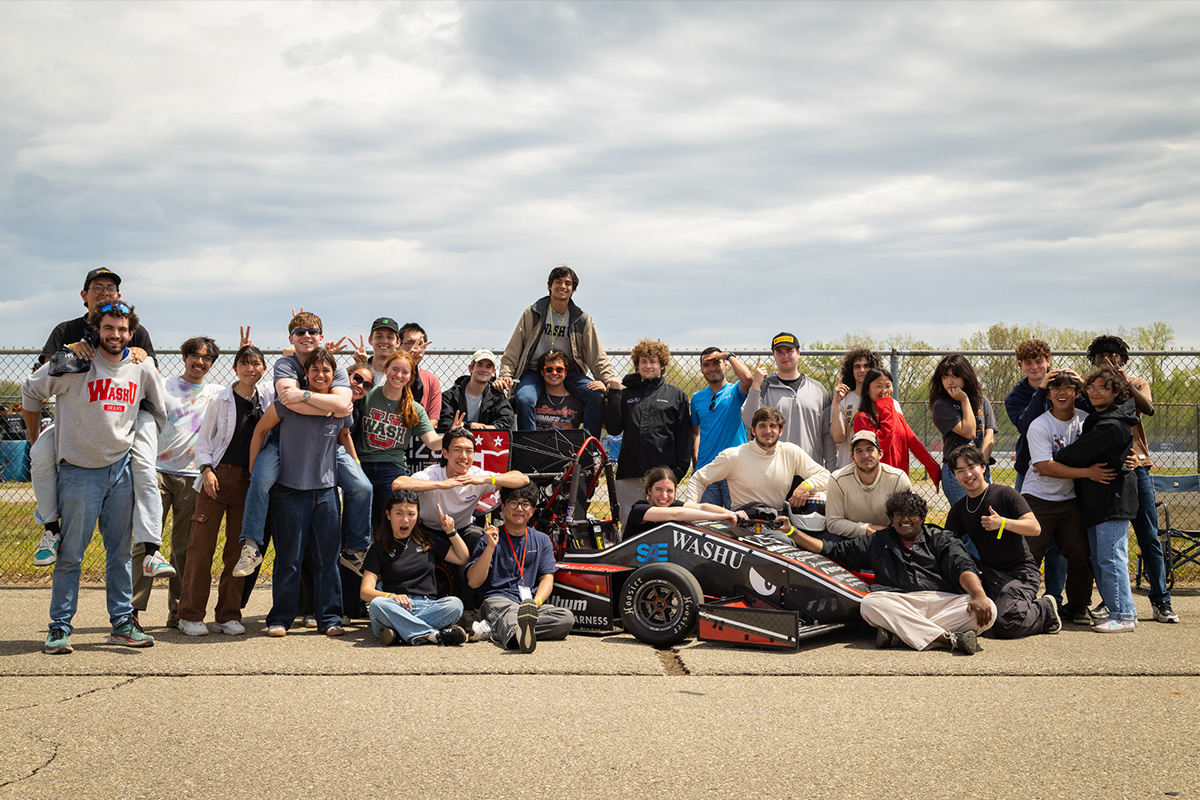
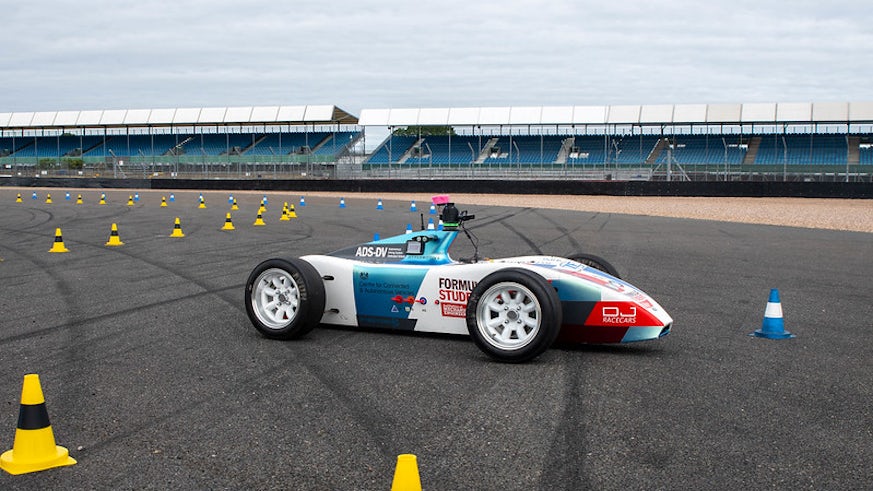
WUAIR participates in Formula Student AI (FSAI), an autonomous driving competition held at the Silverstone Track in the UK. Unlike traditional Formula Student competitions that require teams to build a car from scratch, FSAI provides each team with a race car capable of reaching speeds over 80 mph. Our role is to design and implement the sensor suite and software stack that allow the vehicle to navigate and race autonomously as quickly and safely as possible. We tackle complex problems in computer vision, environment mapping, race line planning and autonomous vehicle control.
WUAIR is a uniquely software-oriented club with a singular, strict mission: to build the fastest possible combination of sensors and software to race an electric car. While other clubs might juggle multiple disparate projects, we are united by this one goal. This focus enables rapid engineering and allows students to dive deeply into robotics and their specialized sub-teams, gaining high-level skills and creating truly innovative systems.
What challenges have you encountered?
As a new club, we have faced a mountain of challenges. Developing a full software stack from scratch, creating a team infrastructure and securing funding from grants and sponsorships is a massive undertaking. In this year alone, WUAIR has evolved from an idea shared by me and my co-founders — Amelia Hines, Eugene Joo and Mario Rodriguez-Montoya — into a McKelvey-recognized group with over 30 members spanning four engineering teams and a business marketing team.
This rapid expansion required us to think carefully about how to effectively and equitably train new members and structure our coding projects so that everyone is ready to contribute. From an engineering perspective, the vehicle requires bleeding-edge performance. We use a sensor architecture based on the fusion of RGB cameras, stereo-depth cameras, GPS and inertial units.
To process this data, we use four distinct software teams:
- Perception: Processes visual data using a mix of machine learning and traditional algorithms to identify track borders.
- State estimation: Creates a map of cone positions and accurately locates the car within that space.
- Path planning: Finds the optimal path and speed through the mapped cones, pushing the car to its limit without skidding or crashing.
- Control: Converts those planned speeds and directions into physical instructions the car can execute.
What do you have planned for the spring semester and beyond?
The grind is on! We are currently in the full swing of software development, training and fundraising. With the FSUK competition in July, we have a hard and rapidly approaching deadline. Reaching the finish line will take significant hard work and many hours in the lab, but the team is ready.
WUAIR is recruiting motivated students interested in AI, robotics, control systems or logistics. Fill out an interest form online.
For more information about becoming a sponsor, visit the WUAIR website.
Click on the topics below for more stories in those areas
- Undergraduate Students
- Mechanical Engineering & Materials Science
- Electrical & Systems Engineering
- Computer Science & Engineering