WashU Design/Build/Fly recognized for teamwork at annual AIAA event
Group honored for collective effort to overcome slew of adversities
Imagine spending months designing and building a small plane only to face a tornado warning, hail, wind, power loss, an emergency landing, a crash, signal interference, a damaged motor, not having replacement parts, and loss of control when it is finally time to fly it in competition.
The WashU Design/Build/Fly (WUDBF) team doesn’t have to imagine it, because its team members lived it at the 30th annual American Institute of Aeronautics and Astronautics (AIAA) Design/Build/Fly Competition in Wichita, Kansas, April 16-19. The competition challenged teams to design, build and fly a banner towing bush plane, including a flight with passengers (ducks) and cargo (pucks). WUDBF spent months designing and building their plane, the Psyduck, in preparation for the event.
“I have fond memories of the DBF competition from when I participated in it 25 years ago,” faculty adviser Ed Whalen, professor of practice in the Department of Mechanical Engineering & Materials Science and director of the Master of Science in Aerospace Engineering program, said. “It was wonderful to see this team living the energy and excitement of the event. I’m so proud of them for rising to the challenge and competing until the end."
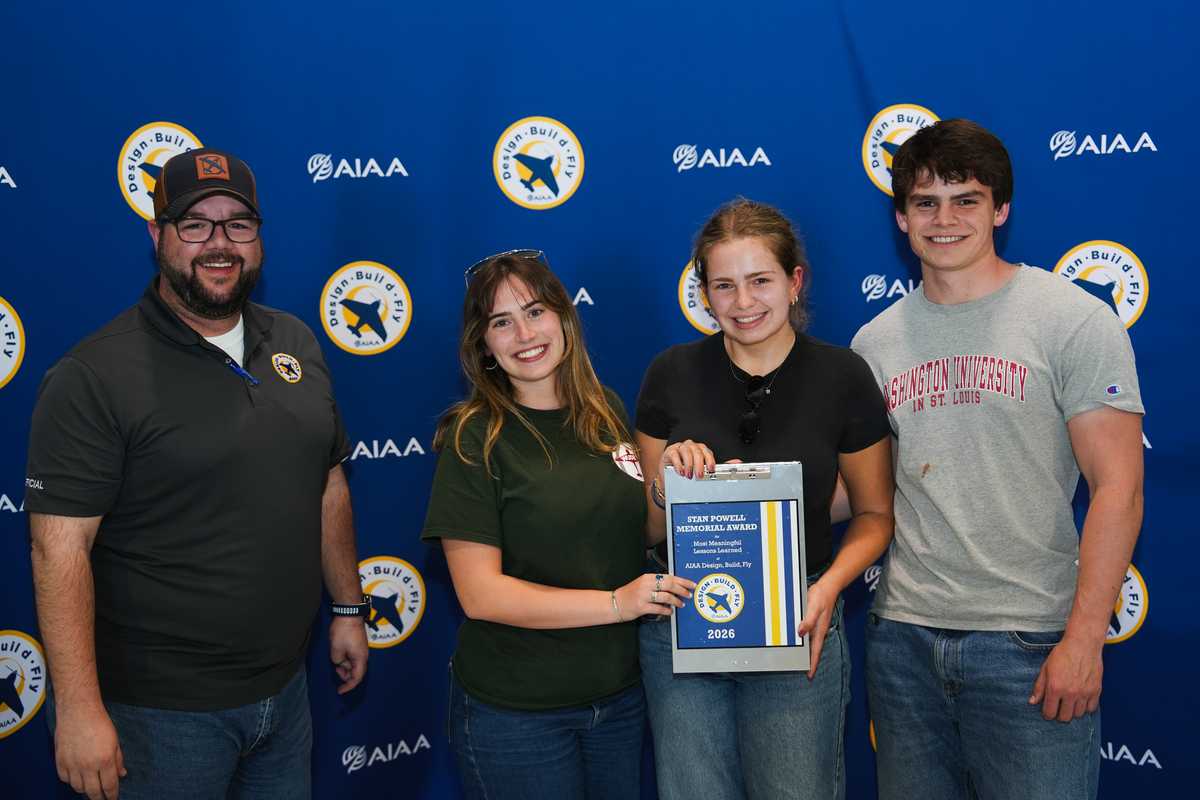
Below, Samantha Feldman, administrative president of WUDBF, explains how the team prepared for the competition — and worked together when they experienced unexpected difficulties, which earned the team the Stan Powell Memorial Award for Most Meaningful Lessons Learned.
On the first day, we passed tech inspection after an hour and a half, with Julia (Peppe) and Sarah (Donner), technical president, representing our team. Passing on the first attempt gave us a valuable advantage, allowing us to be eligible to fly the next day. That evening, we attended a social event at the local aviation museum.
On the second day, we were in the flight order but uncertain whether to fly due to extremely windy conditions. We ultimately decided to proceed, but experienced unexpected power loss during the flight. Our pilot executed a quick emergency landing after one lap of Mission 1. Later that day, a tornado warning and expected hail caused the flight order to be cut short. After extensive testing and consultation with other teams, we determined that the issue was a damaged motor, likely caused by a rough landing during a prior test flight. We replaced the motor in preparation for the next day.
On the third day, we attempted Mission 1 again. During the third lap, the pilot lost control of the elevator, and the plane nosedived. The crash caused significant damage to the front of the fuselage, and the wings and tail were no longer usable. After returning to tech inspection, the inspectors, along with our avionics and manufacturing leads, determined that a tail linkage had failed, possibly due to fatigue. Although we had brought partially completed spare wings and a tail, we did not have an extra fuselage.
At that point, Julia, our avionics lead, and Preston (Gee), our manufacturing lead, made the decision to rebuild the aircraft that same day to complete at least one successful mission on the final day of competition. This sparked a full team effort. We reached out to other teams for supplies, gathered materials from any available sources, and sought advice and support through the AIAA DBF Discord. We were even able to use a laser cutter from another team to rebuild the fuselage using laser-cut wood and Monokote. Everyone contributed, including team members who had not previously worked directly on the aircraft. Most of the team worked through the night, and by morning, the plane was complete.
We brought the rebuilt aircraft back through tech inspection, where it passed quickly. However, during testing outside, we encountered connectivity issues. Even after replacing the receiver with one borrowed from another team, the control surfaces and motor were still not responding properly. After further testing in the parking lot, our avionics team determined that the issue was signal interference from other teams.
When our turn in the flight order came, we successfully completed Mission 1. The team was ecstatic. Many other teams celebrated with us, having supported us throughout the process, whether through shared supplies, advice or lighthearted interactions on Discord. We then completed the ground mission efficiently and returned in high spirits.
At the awards ceremony, prizes were given for the top 10 rankings, Best Design Report and Most Meaningful Lessons Learned. This marked the first time we received an award outside of a top 10 placement. The recognition reflected our resilience, communication, reliance on the broader community and strong team spirit throughout the competition. We left the event proud of what we had accomplished together.