WashU launches doctoral program in neuroengineering
The program, to begin in 2027, is among only a few in the United States

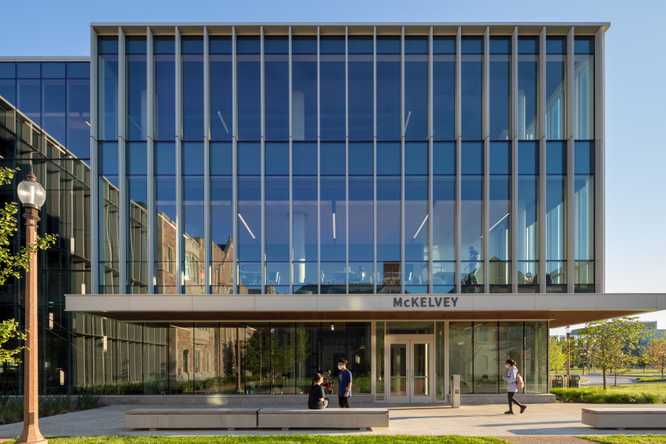
The McKelvey School of Engineering at Washington University in St. Louis, in collaboration with WashU Medicine, plans to launch a doctoral degree program in neuroengineering in fall 2027 to train students who will drive new technologies and methods to study the brain and its complexities.
The fully interdisciplinary program will train technologically and quantitatively oriented students with backgrounds in engineering, computer science, physics or neuroscience for careers in academic research or industry with a special focus on innovation and entrepreneurship. The program will expand the boundaries of neuroengineering to include both clinically motivated technologies, but also emerging domains such as neuromorphic computing and organoid-based therapeutic platforms.
ShiNung Ching, chair of the Preston M. Green Department of Electrical & Systems Engineering, and Barani Raman, the Dennis & Barbara Kessler Professor in the Department of Biomedical Engineering, will head the program, which will include faculty from McKelvey Engineering, WashU Medicine and the College of Arts & Sciences.
“With its strong history of leadership in neuroscience, engineering, interdisciplinary research and graduate education, WashU is an ideal institution for neuroengineering training,” Aaron Bobick, dean and James M. McKelvey Professor, said. “Our contributions to neuroscience and engineering date back to foundational discoveries in brain imaging technology to newer advances in neural prosthetics. Establishing a PhD program in neuroengineering will build on this tradition of excellence and position WashU as a leader in doctoral-level training at the intersection of engineering and neuroscience.”
The launch of the new academic program is driven by the emergence of neuroengineering as an independent academic discipline, with a high demand for experts trained in neuroengineering reflected in government policy and funding opportunities.
“This program will advance a new category of engineering-neuroscientists into the workforce, helping to grow the local and national economy in neurotechnology, translational neuroscience and brain-inspired computing,” Ching said. “Aligned with these goals, we envision fluid cross-disciplinary interaction between academic partners and a close relationship with industry.”
Neuroengineering is an interdisciplinary field that applies engineering principles to measure, model, interface with and manipulate the nervous system and associated neurologic diseases. Advances have led to groundbreaking applications such as using focused ultrasound to improve the delivery of therapeutic agents to specific, targeted brain regions for conditions such as Parkinson’s disease and Alzheimer’s; implantable electrode arrays to restore movement in paralyzed individuals; cochlear and retinal implants; and noninvasive neuroimaging techniques that enhance the understanding of brain dynamics and computations.
Importantly, the field has grown to include key directions such as brain-inspired computing and AI that take insights from the brain and translate them into new technologies. In this vein, neuroengineering integrates knowledge from neuroscience, electrical and biomedical engineering, computer science, medicine and mathematics.
Key areas of neuroengineering include brain-computer interfaces (BCIs), neural prosthetics, neurostimulation devices, neuromechanics, biomaterials, neuromorphic engineering and computational modeling of neural systems. Beyond clinical applications, neuroengineering also plays a crucial role in advancing neuroscience research and human-computer interaction. The field intersects artificial intelligence, where biologically inspired models inform machine learning architectures, and neuromorphic computing seeks to replicate neural processing in hardware.
“Neuroengineering requires a deep skill set in the fundamentals of the brain and nervous system and an integrated knowledge base that spans a variety of disciplines relevant to quantitative analysis, modeling and technology development,” Raman said. “This knowledge and skill foundation, along with the ability to formulate and answer challenging questions related to interfacing with the nervous system, represent distinguishing characteristics of a neuroengineer.”
As one of few programs of its kind in the nation, the WashU neuroengineering program is expected to attract top students from various disciplines, supporting research at the school and accelerating the growth of St. Louis as a neurotechnology hub. Applications for the program will begin to be accepted Sept. 1, 2026 for the Fall 2027 semester.
Back to News