
Brothers build solid foundation at WashU
Justin and Troy Ruths leave lasting impression
Although brothers Justin and Troy Ruths came to Washington University in St. Louis at different stages in their academic careers, they agree that their time at the school helped shape their successful careers.
Troy was the first to arrive on campus in 2004, after carefully weighing his options to pursue a bachelor’s in computer science while continuing a basketball career that had made him a highly sought-after recruit nationally.
“The size of the school was right, and the academic strength was well known,” he said. “Receiving the Langsdorf scholarship also played a huge role, but it really felt like the right fit, both for academics and basketball.”
When Justin Ruths followed in 2006, it was not “just to keep an eye on Troy,” he said jokingly. “We trust each other’s judgment quite a bit, so a positive experience holds a lot of value. I think the prospect of doing something with a brother has enough extra bonus that such an option often wins out over similar options without a brother.”
Justin Ruths
DEGREES
BS, Physics, Rice University, 2004
MS, Mechanical Engineering, Columbia University, 2006
MS, Electrical Engineering, WashU, 2008
PhD, Systems Science and Applied Mathematics, WashU, 2011
CAREER
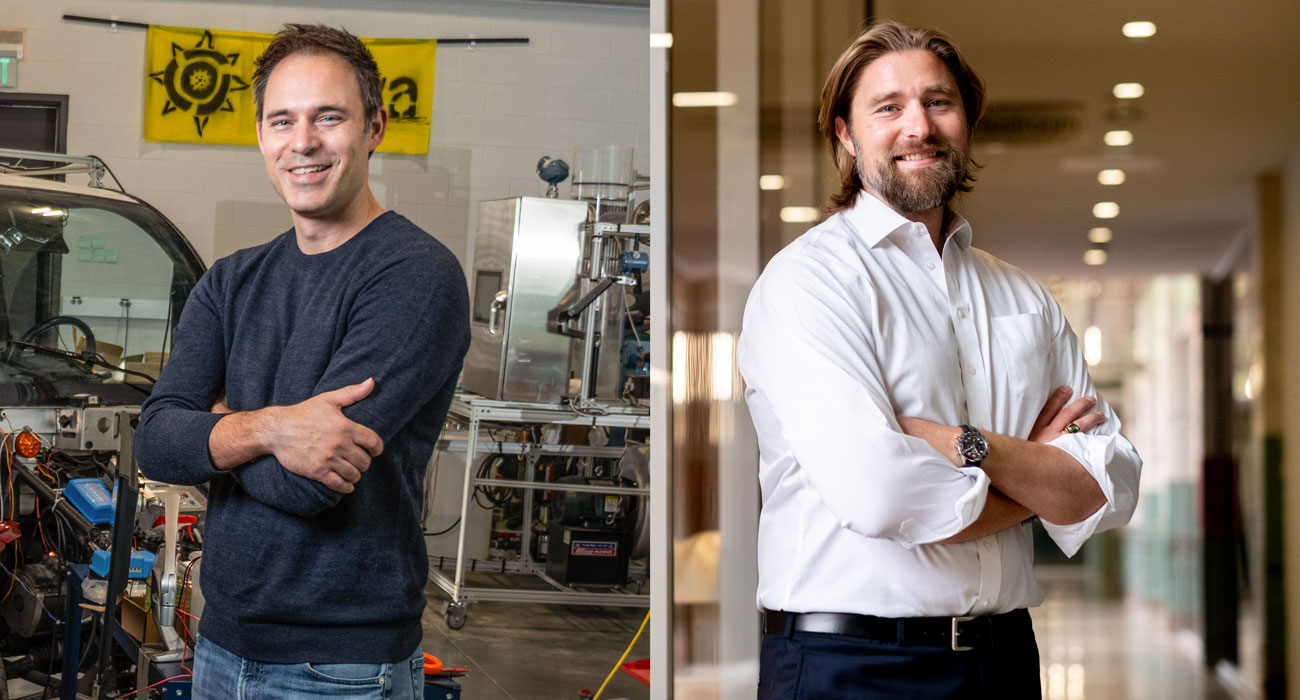
Justin Ruths is an associate professor at the University of Texas at Dallas with appointments in mechanical and systems engineering. He directs the Applied Systems Lab, where students research the potential impact of cyberattacks on physical systems and develop algorithms for safe autonomy.
Troy Ruths
DEGREES
BS, Computer Science, WashU, 2008
PhD, Computer Science, Rice University, 2013
CAREER
Troy Ruths is the founder and CEO of oil and gas startup Petro.AI, which pioneered the application of AI to subsurface challenges like well planning and deal evaluation.
Justin had already earned a bachelor’s in physics at Rice University and a master’s in mechanical engineering at Columbia University, where he’d decided to focus on control systems.
“Troy already being at WashU gave me awareness of all the great opportunities there,” he said. “Although we worked in different areas, I was able to discover the school’s strength in systems science and control.”
The timing was ideal, as Justin‘s first two years at WashU coincided with Troy leading the men’s basketball team to the Final Four in 2007 and the DIII national title — the program’s first — in 2008.
Having the ability to attend his basketball games was just more reason to zoom into that option,” he said. “Our parents and (younger brother) Weston often came up for the games, so it would also give me the opportunity to see all of them more.”
A standout player and student, Troy Ruths was recognized by a slew of organizations. He was named DIII News Division III National Player of the Year after scoring 33 points in the championship game, as well as a two-time All-American, the 2006–07 UAA Player of the Year and three-time All-UAA and All-Region selection. He earned the prestigious Jostens Trophy Award in 2008. For his academic efforts, he was honored as a three-time Academic All-UAA, Academic All-District and Academic All-America selection. Ruths was named the 2007 and 2008 Academic All-American of the Year and ESPN The Magazine College Division Academic All-American of the Year.
Ruths remains among the top players in program history, ranking second in all-time scoring (1,801 points), field goals (672) and free throws (457) made. He was inducted into the WashU Sports Hall of Fame in 2016.

Troy Ruths celebrates with teammates after leading the WashU men’s basketball team to the DIII national title — the program’s first — in 2008.
After graduating from WashU as a valedictorian in 2008, Troy decided to put his full focus on his educational pursuits, heading to Rice University to pursue a doctorate in applications of AI and algorithmic thinking to computational biology.
“I knew I was interested in entrepreneurship, so those wheels were always turning as well,” Ruths said. With his doctorate complete, he spent seven years at Chevron before launching Houston-based startup Ruths Analytics & Innovation (now Petro.AI) in 2013. Today, he is CEO of the firm, which pioneered the application of AI to subsurface challenges like well planning and deal evaluation. It focuses on automating workflows across siloed technical teams into a powerful AI optimization engine that blends data-driven with first-principle physics. A fourth Ruths brother, Derek, serves as the firm’s CTO.
The jump from computational biology to oil and gas wasn’t completely unexpected for Troy, whose father once worked for Chevron. Yet despite his familiarity with the industry, Troy set out to do something different with Petro.AI.
“It was a new trend, using AI to build reasonable world models around what a reservoir could produce,” he said. At the time, not only was the need for analytics in petroleum not fully realized — engineers weren’t exactly eager to jump on board.
“Engineers have to sign their names on an outcome, which is a lot of responsibility,” he said. “AI is still a black box and learning to trust it takes time, you have to see results.”
Then came the oil market crash in 2014, a dramatic price collapse driven by a combination of global supply and demand factors. By 2016, the price of crude oil fell by more than 70%. The profitability of oil and gas companies plummeted, leading to a sizable reduction in new investment and drilling activity.
Oil and gas companies were faced with a new reality, one which would push them to reduce headcounts and embrace the role of AI automation to maintain performance and productivity.
“Our systems give technical receipts, which automate a lot of manual number crunching,” Troy said. “We’ve helped multiple public and private companies make successful AI transformations.”
The size of the school was right, and the academic strength was well-known … it really felt like the right fit, both for academics and basketball.”
- Troy Ruths
Troy says he looks forward to the opportunity to continue making those transformations, and to exploring more real-world applications of AI.
“I like being at the edge where AI is intersecting with the real world,” he said. “We’re just beginning to understand the limits of AI and how far it can go.”
Meanwhile, Justin earned a master’s degree in electrical engineering from the Engineering school in 2008 and a doctorate in systems science & applied math in 2011. He was the first graduate student in the lab of Jr-Shin Li, the Newton R. and Sarah Louisa Glasgow Wilson Professor of Engineering. Li’s transdisciplinary emphasis on the fundamentals of systems science and mathematics gave him the opportunity to apply his physics background in studying complex large-scale systems.
But it wasn’t just the research aspect of his training that had a lasting impact. As a National Science Foundation Graduate STEM Fellow in K–12 Education, he taught STEM subjects to area middle and high school students for two years, bringing the fundamentals of engineering to life using the Lego Mindstorms kit and other creative outlets.
“I really loved my time in St. Louis,” he said. “And that was a great experience, getting outside campus and into the community.”
Inspired to conduct research and teach future engineers, Justin moved to Singapore after earning his doctorate to become assistant professor of engineering systems & design at Singapore University of Technology and Design (SUTD), where he was one of the first 20 faculty members. He remained there until an opportunity to join the faculty at the University of Texas at Dallas (UTD) brought him back to the U.S. in 2016.
WashU was a great place to learn how to overcome challenges — and you have to enjoy the challenge of it all.”
- Justin Ruths
Today, as associate professor at UTD, he holds appointments in the mechanical engineering and systems engineering departments. His research efforts include studying the fundamental properties of controlling networks, bilinear systems theory and security of cyber-physical control systems, with applications in neuroscience, social systems and autonomous driving.
“Computers now control and monitor real physical systems, and these systems are vulnerable to cyberattacks,” he said. “But we can use our knowledge of their physical behavior to detect unusual patterns of behavior that alert us to a problem.”
Justin directs the Applied Systems Lab, where students research the potential impact of cyber-attacks on physical systems and develop algorithms for safe autonomy. Within the lab, a team of more than 25 undergraduates from across the engineering school known as Nova is developing and maintaining an open-source, research-ready, self- driving software stack and a pair of autonomous vehicles under his guidance.
Another research focus delves into a more unexpected territory — the human brain.
“The brain is essentially a network of neurons, and a seizure is a behavior occurring on that network,” he said. “By approaching that as an engineering problem, using models of seizure activity, we can attempt to change the brain’s behavior.”
Justin’s work has earned him an NSF CAREER Award and the 2025 Provost’s Award for Excellence in Faculty Mentoring. His research has been published in top journals including Science and the Proceedings of the National Academy of Sciences.
“WashU was a great place to learn how to overcome challenges — and you have to enjoy the challenge of it all,” he said. “A lot of people start with large intentions and don’t realize how long these things take. But it’s worth it.”

Justin Ruths and wife, Melissa, took a six-day horseback trek through Mongolia during Ruths’ time as an assistant professor at Singapore University of Technology and Design.