
Driven by design
Senior course gives hands-on way to implement classroom concepts
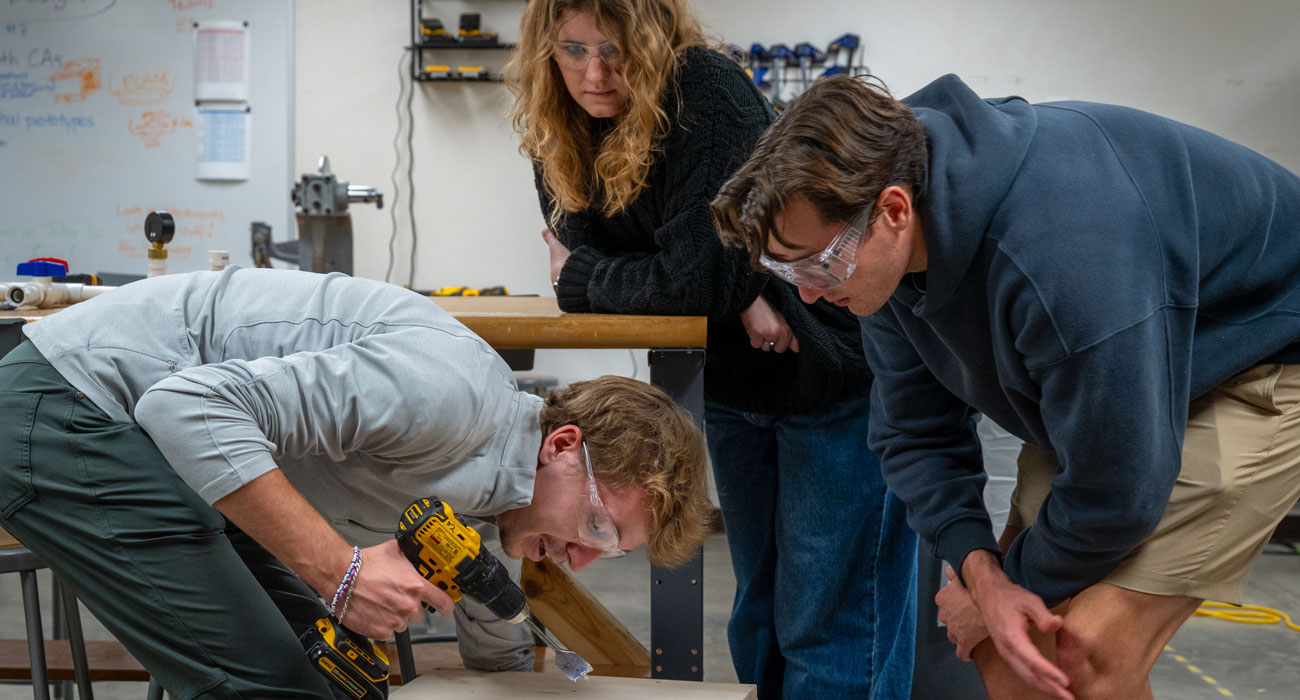
With seven weeks to go until the fall semester’s end, MEMS 4110 Mechanical Engineering Design Project group members Luke McCann, Emma Sloan and Carter Hahnfeldt came together in the workshop to make progress.
“This is going to be cool when it works,” McCann said.
“I like that you say ‘when’ and not ‘if,’” Hahnfeldt responded. Armed with a wood box, pipes and various other necessities gathered during what Sloan called a “productive Lowe’s trip,” the group began cutting and connecting the pieces of what will be their final semester project: a science museum demonstration designed to teach children how Bernoulli’s principle causes water to flow at different exit velocities despite the same pressure input.
As the students took turns with the tools, Sloan said, “Everybody gets a turn being the boss.”
It’s the kind of teamwork that takes place each fall, when seniors in the course are asked to solve an open- ended mechanical design problem by working in small groups.
“They gain an appreciation for how difficult open-ended design can be,” said Jackson Potter, senior lecturer in mechanical engineering & materials science, who has taught the course since 2017. “And an understanding that the process of designing is its own skill, which is valuable and takes time to develop.”
It’s a skill, he says, that is “complementary to, but not the same as, technical skill at solving ‘book problems.’”
-
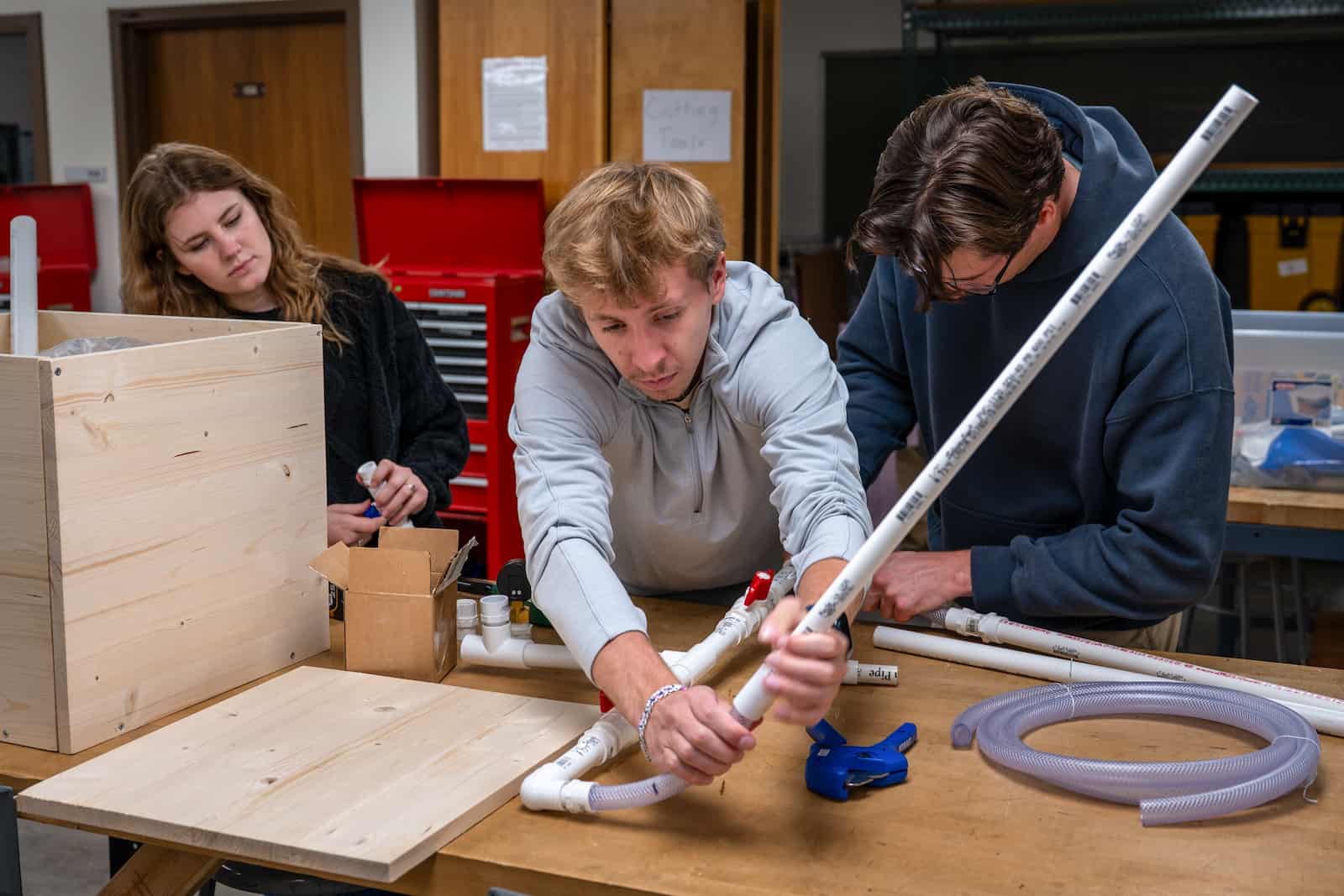
Carter Hahnfeldt and Luke McCann use custom piping to reduce the number of components in their demo designed to demonstrate Bernoulli’s principle.
-
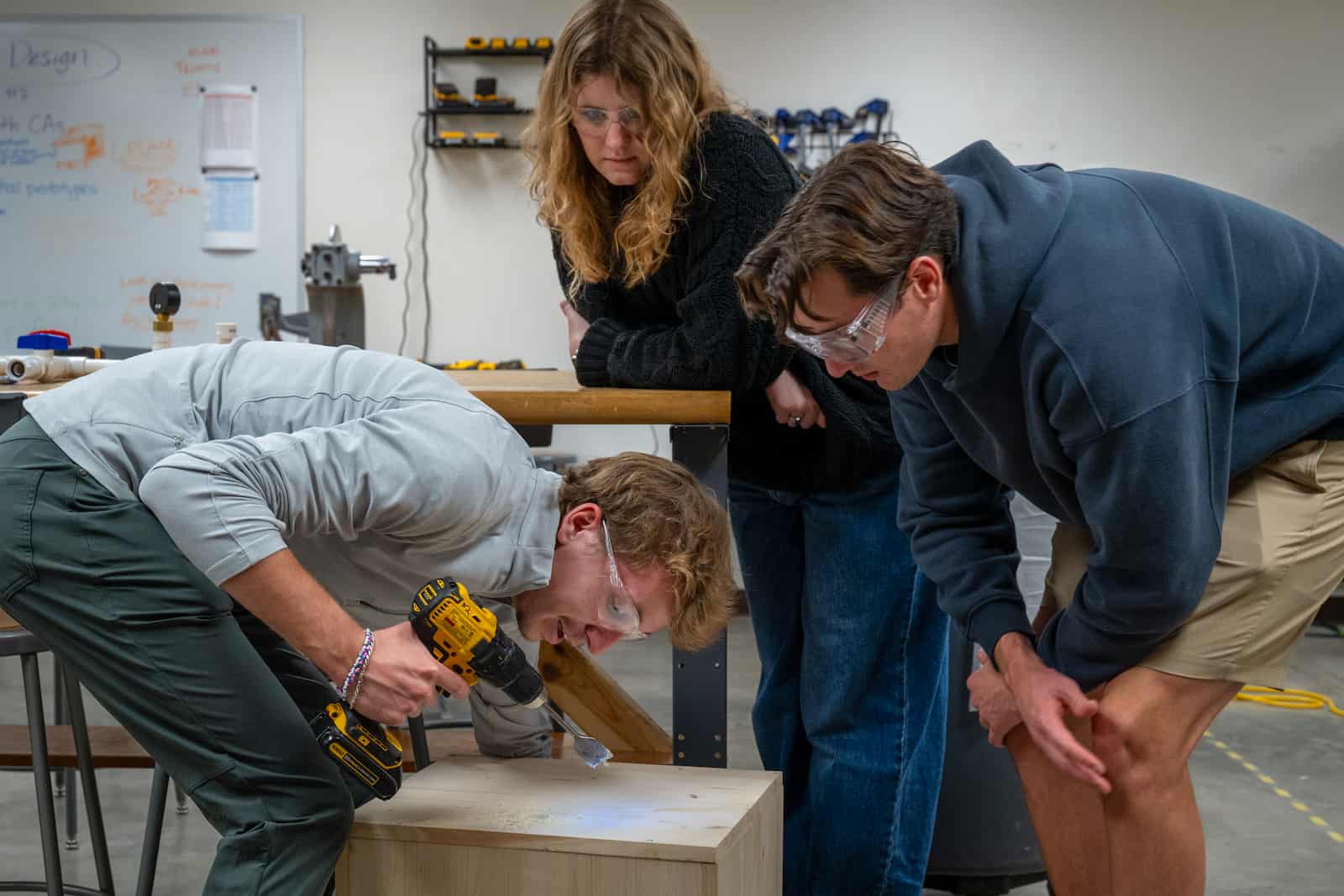
(From left) Carter Hahnfeldt, Emma Sloan and Luke McCann make adjustments to their demo designed to introduce Bernoulli’s principle to children.
-
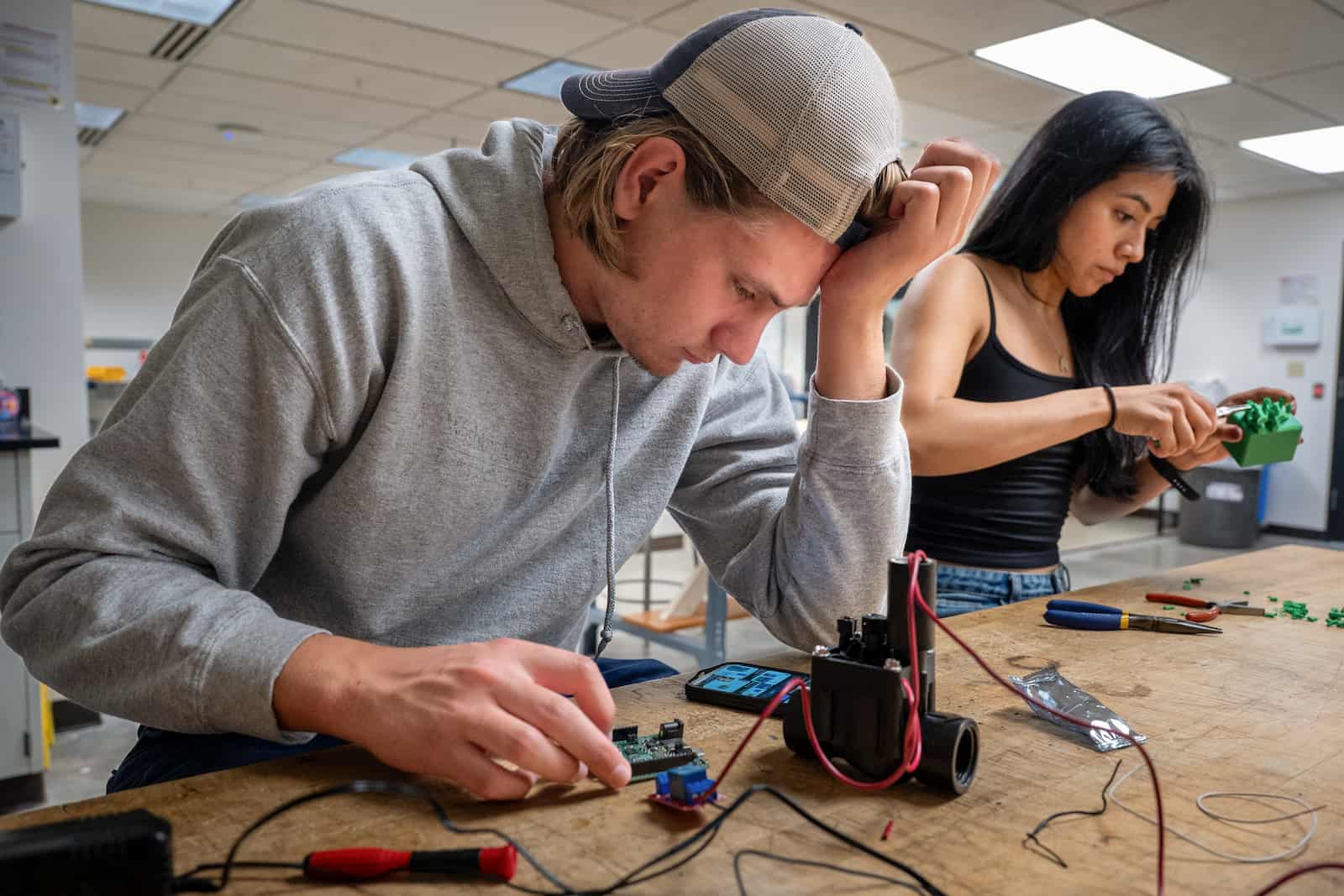
JP Torack and Morelia Reyes-Perez work on components of their prototype for an automatic precise watering system designed to support plant research conducted in the WashU greenhouse.
-
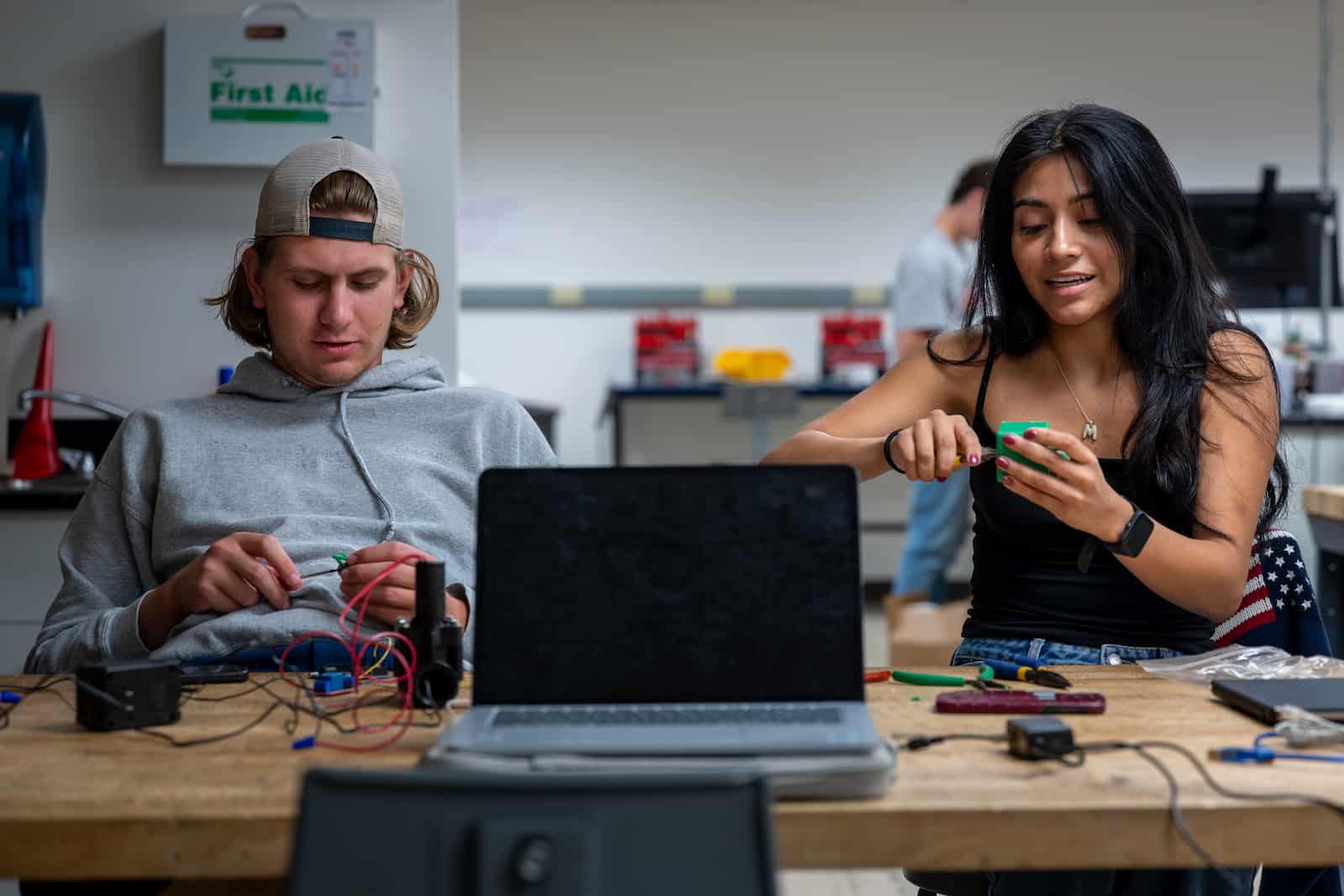
JP Torack and Morelia Reyes-Perez work on components of their prototype for the MEMS 4110 Senior Design Project course in Jolley Hall.
-
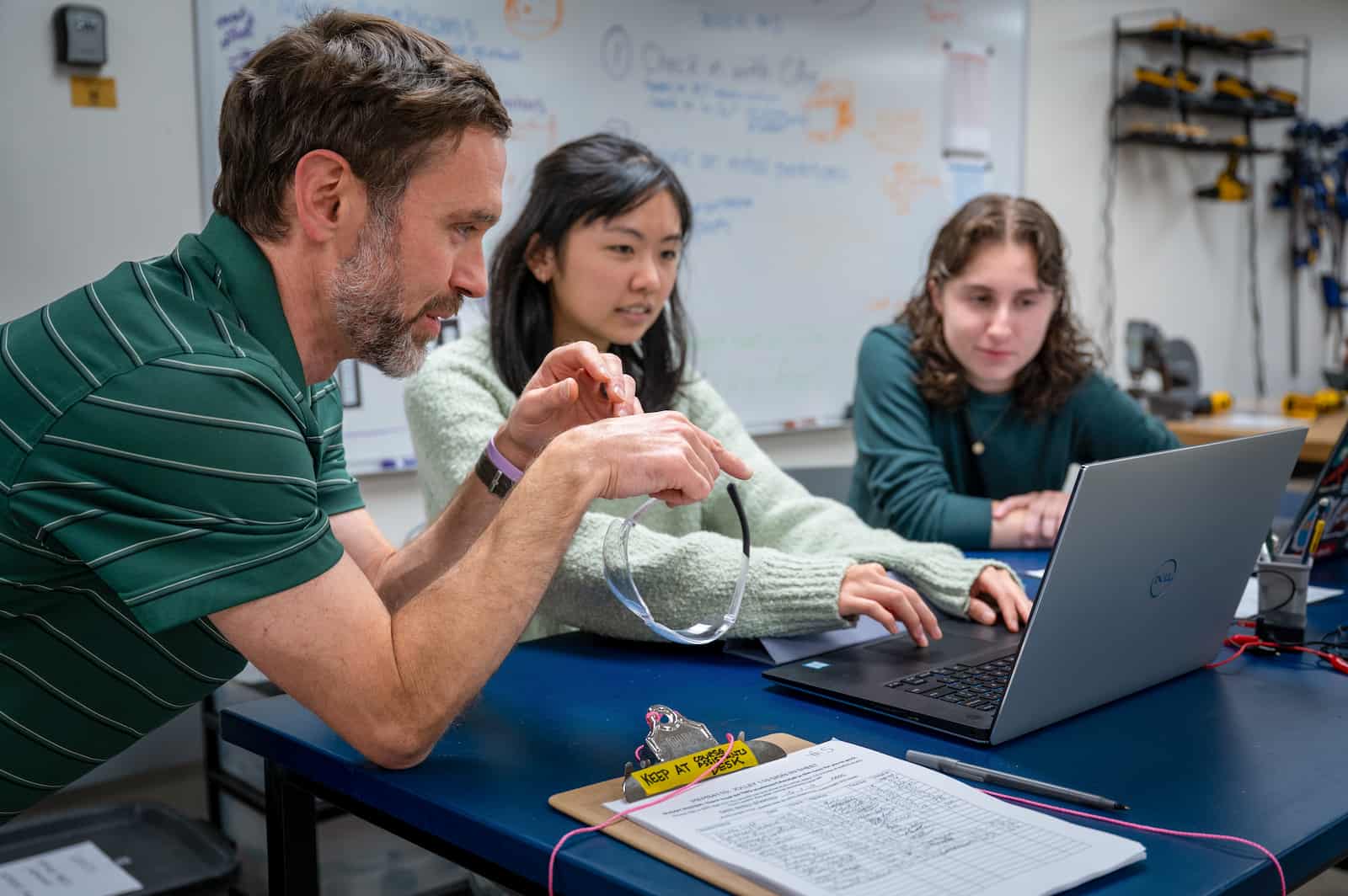
Jackson Potter, senior lecturer in mechanical engineering & materials science, talks with MEMS 4110 course assistant Birdie Lee.
All projects must have a “customer,” who might be a local business, campus group or faculty member. Students can choose from a list of pre-approved projects, which Potter creates after talking to potential customers and identifying projects of interest. In certain cases, students retain the intellectual property rights to their designs.
One of the pre-approved projects this semester was a “trick” armoire to be used by the Performing Arts Department in a stage production of “The Christmas Carol.”
“No groups picked it, which was a bit disappointing,” Potter said. “I wanted to give it a shot!”
The projects chosen this year included a hard-boiled egg peeler for local restaurant Neon Greens; an air hockey table intended to be used as a physics education exhibit; a deployable banner device for a remote-controlled plane owned by the WashU Design/Build/Fly club; and a precise water distribution system for greenhouse research in Arts & Sciences. Several groups also chose to participate in the American Society of Mechanical Engineers (ASME) Trash Collection Challenge, which tasks students with designing robots or systems to autonomously collect, sort and dispose of waste in simulated urban or ocean environments.
Students also had the option to present a novel project with a specific customer to Potter for approval.
“It has to be mostly electromechanical in nature,” Potter said. “The group shouldn’t spend 90% of their design time writing computer code. Instead, it should involve physical structures and connections, and often actuators, such as motors, electric valves, etc.”
The student-proposed project this semester is the Rapid Drink Chiller, whose customer is a small brewery in New York.
Groups are guided through the engineering design process by completing a set of project deliverables that are evaluated for individual and team performance. The course emphasizes the importance of user-centric design, communication and presentation skill, consideration of real-world constraints, sketching and creativity, prototyping, and data-driven decision-making using engineering models and analyses.
“It’s an extremely valuable experience since it gives students a sense of what real engineering work is like, without the structure or constraints of typical classes,” Birdie Lee, course assistant (CA) for MEMS 4110, said. “I really enjoyed taking the course, partly because Dr. Potter and the CAs who led my subsection were so supportive and kind. I hope to make the experience just as positive.”
-
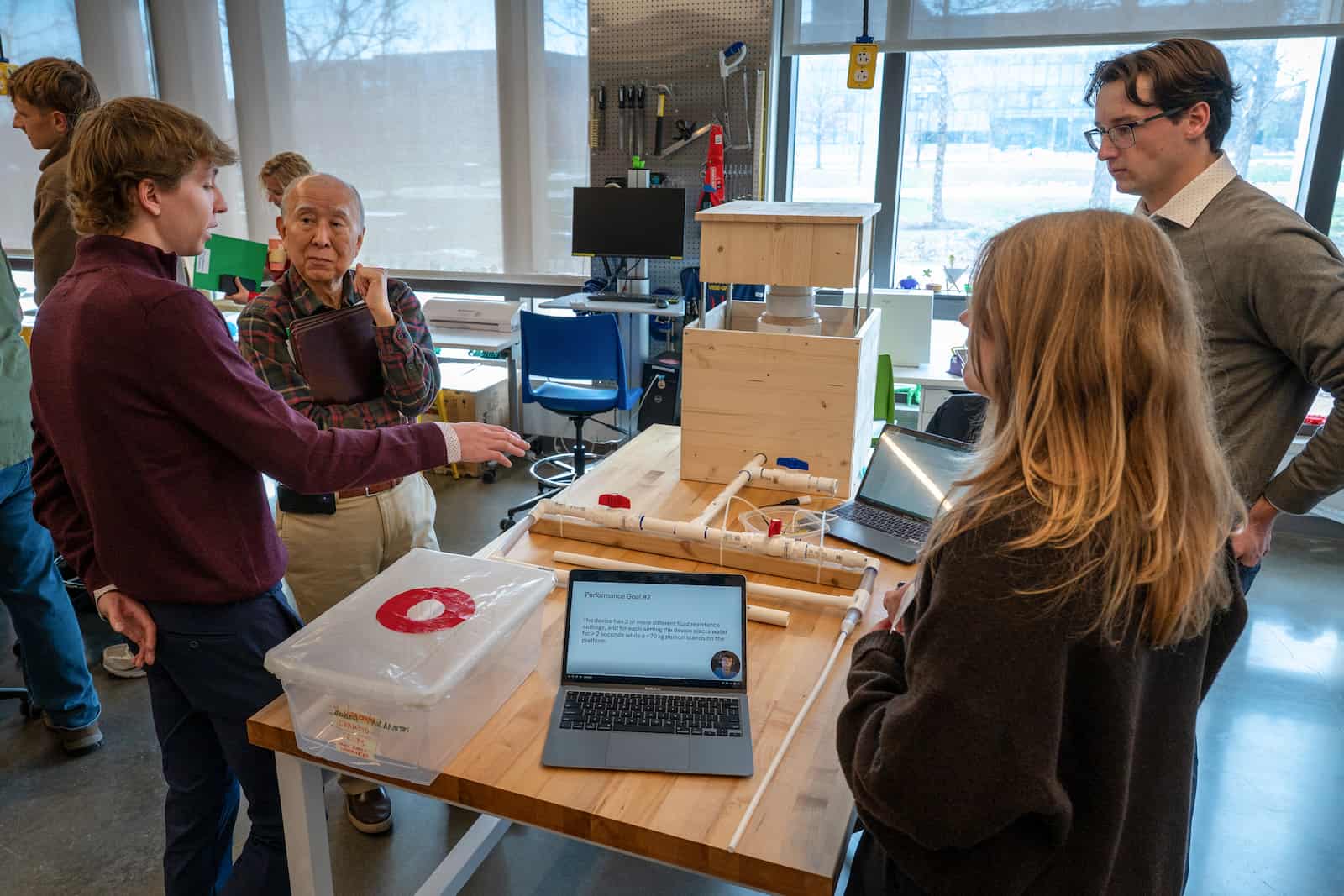
(From left) Carter Hahnfeldt describes the group’s project to Masao Nishi, a member of the Alumni Advisory Board serving as a reviewer, with help from Emma Sloan and Luke McCann.
-
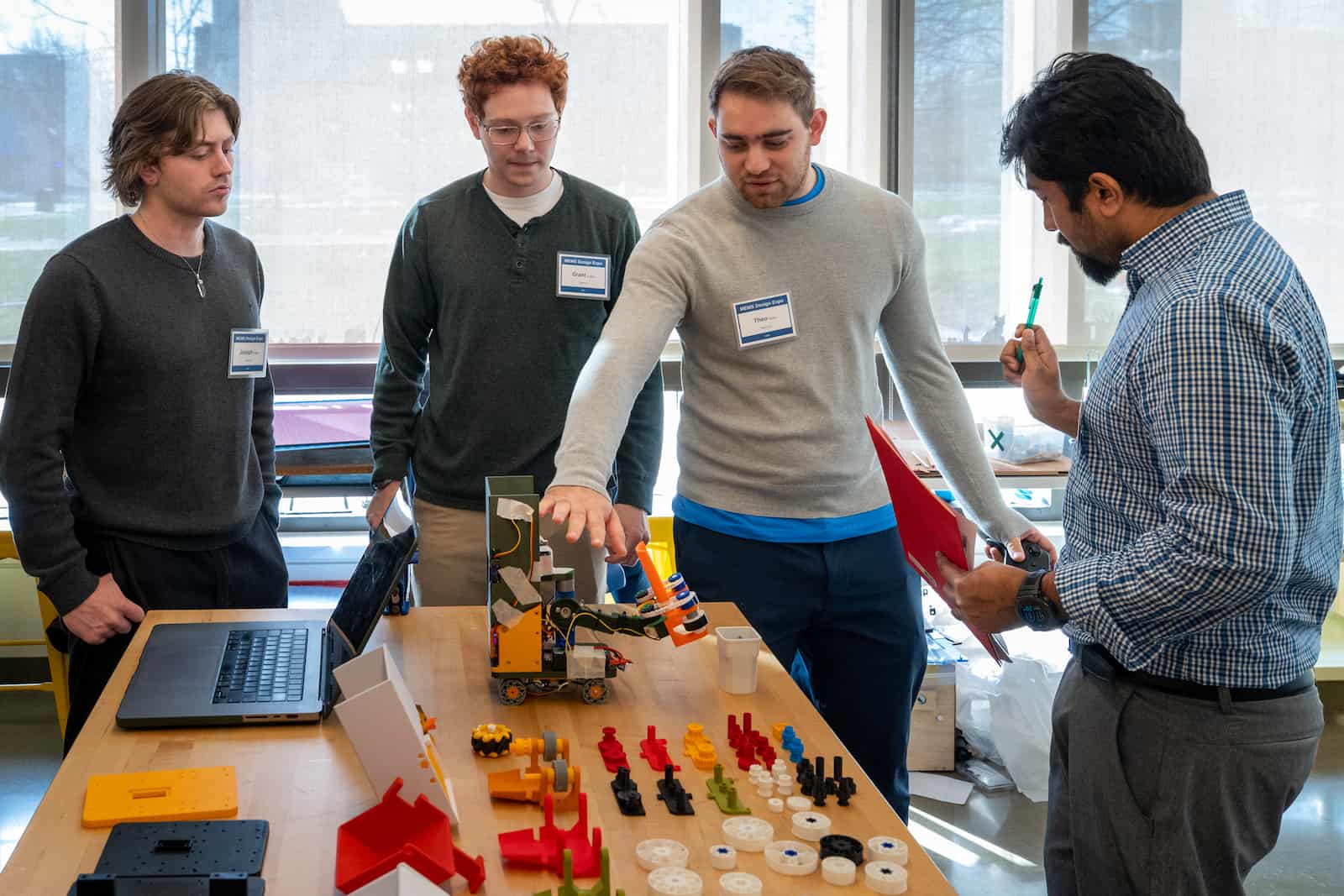
(From left) Grant Kaplan and Theo Mass discuss their Efficient Jolley Trash Grabber with Afaque Manzoor, senior lecturer in mechanical engineering & materials science, at the Senior Design Expo.
-
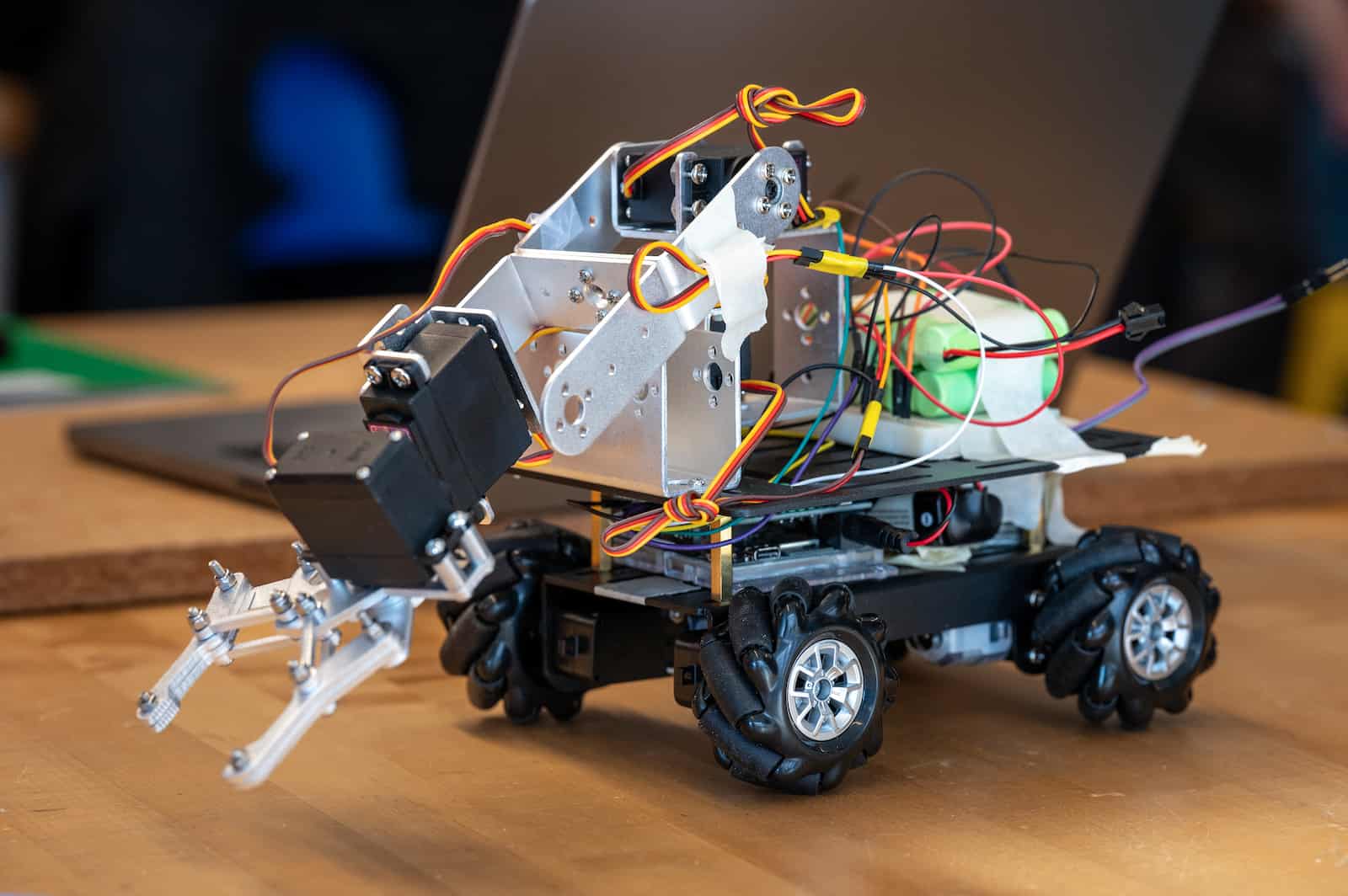
Several student groups created prototypes for the American Society of Mechanical Engineers (ASME) Trash Challenge.
-
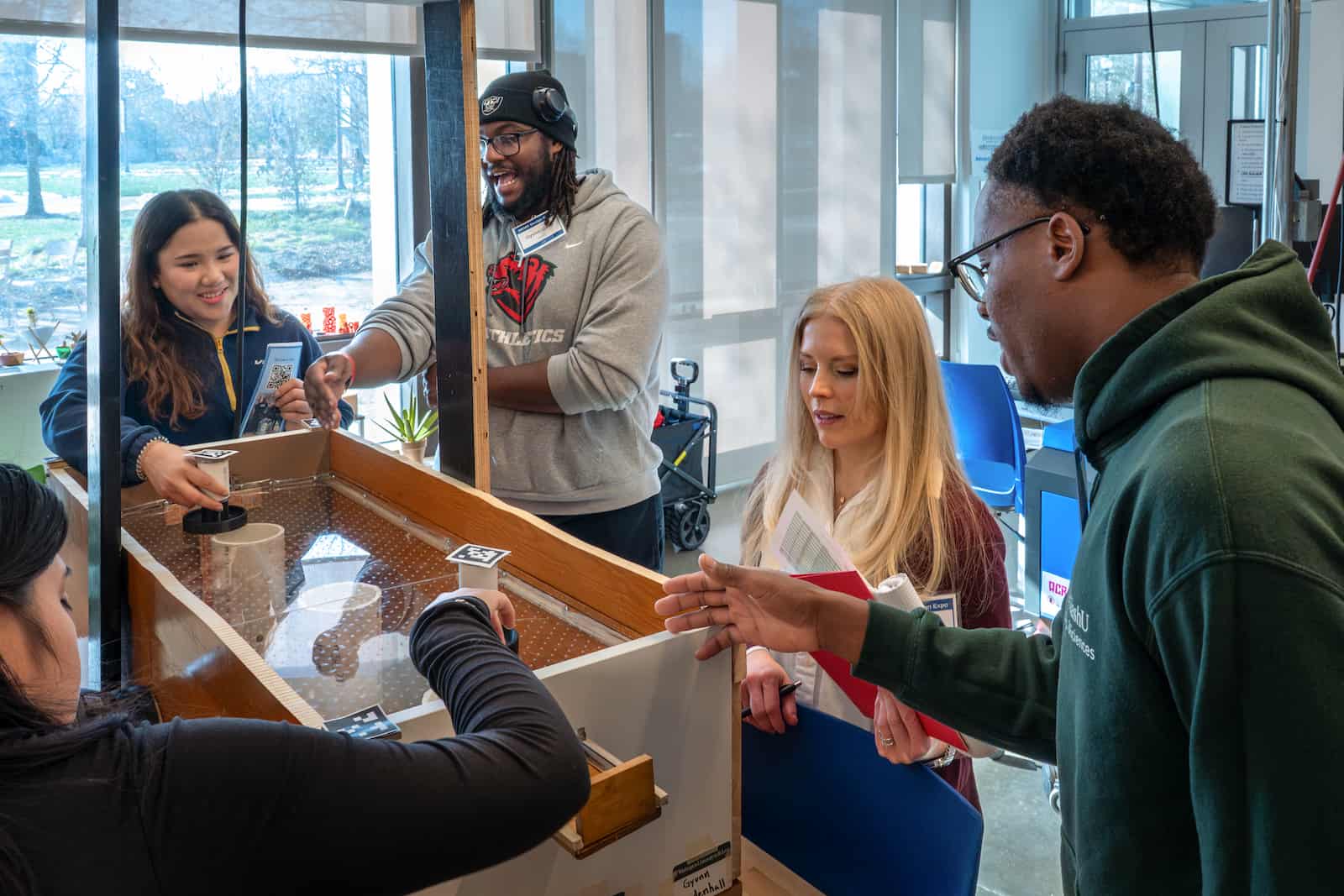
Gyvnn Mendenhall and Joshua Adeniji present their air hockey table physics education exhibit to Emily Boyd, teaching professor in mechanical engineering & materials science, and students Citlalli Sanchez-Ayala and Duyen Nguyen at the Senior Design Expo.
Potter says students emerge with a feeling that will serve them well regardless of whether they pursue engineering design as a career.
“They get a sense of satisfaction from producing something that is useful for their customer, or at least giving it their best effort,” he said.
Just before final exams, each group displayed and demonstrated its projects for a group of alumni and McKelvey Engineering faculty at a design expo.
With the completed project in front of him, Hahnfeldt acknowledged that the amount of time the course spent on certain aspects of the design process sometimes felt ”a little frustrating” for a team ready to keep moving forward.
But when the group’s early run- throughs didn’t quite work the way they hoped, he said, they were able to make necessary design adjustments, including changing from an open box to piston setup, adding rails for increased safety and decreasing pipe diameters for increased exit velocity.
They get a sense of satisfaction from producing something that is useful for their customer, or at least giving it their best effort.”
- Jackson Potter
“Looking back at the entire process and seeing the end result, it all makes sense,” he said. “Our initial idea was good, but we were able to make those improvements that were needed.”
Sloan noted that she found the course’s brainstorming sessions very helpful and appreciated the “expectation to work through the design process from start to finish.”
Nearby, another group displayed their “Efficient Jolley Trash Grabber” for the ASME Challenge project. Team member Emanoeel Ghabrial explained that the group “just wanted to design as much as possible, and that’s what we did.
“Everything aside from core electronics was designed and wired by us,” he said. “So that moment when everything works is just so gratifying.”
Seeing each group present what they have produced is a highlight of the semester for Potter, who has spent months watching students expand their skills in the “design space” — at times advising them on new or modified ideas that could help their prototype succeed.
“It’s sharing their enthusiasm for what worked well and understanding their disappointment at what could have worked better,” he said. “And assuring them that it’s all a normal part of the process.”