
Meet the new department chairs
Friend brings medical device expertise, persevering attitude to McKelvey Engineering. Ching’s expertise in neuroengineering brings strengths of electrical & systems engineering together.
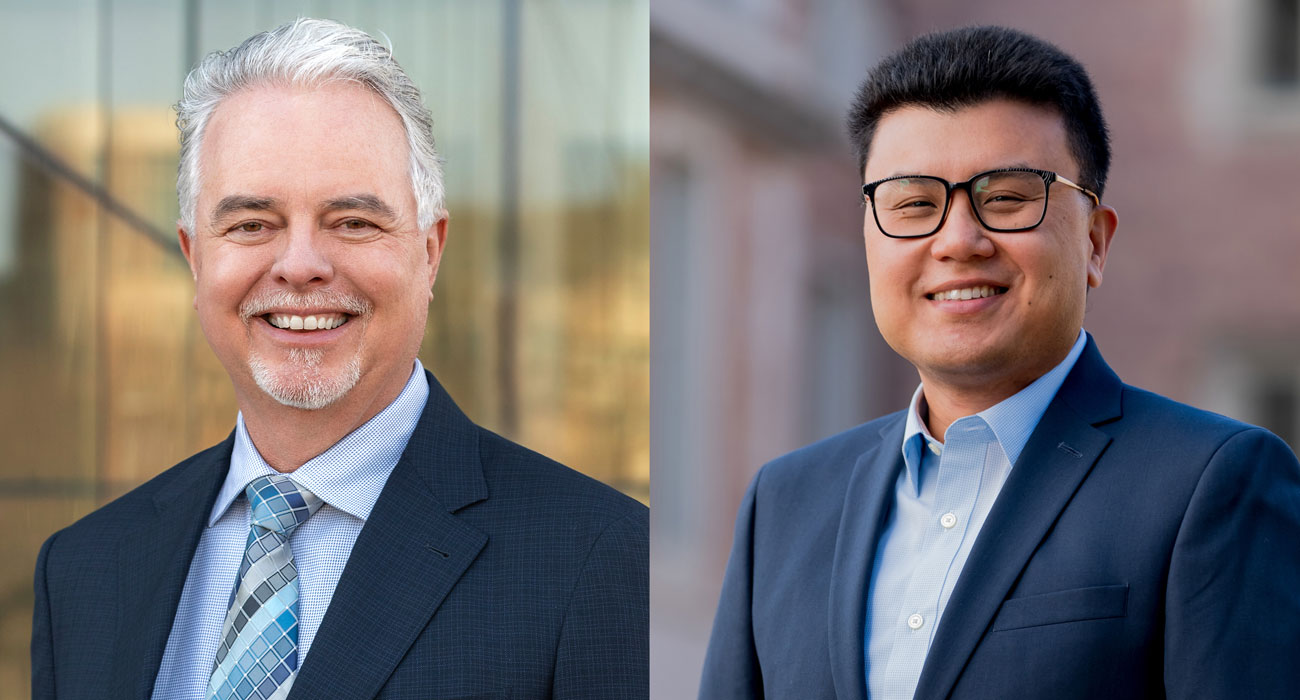
James Friend
James Friend joined McKelvey Engineering in November 2025 as chair of the Department of Mechanical Engineering & Materials Science (MEMS), succeeding Philip V. Bayly, the Lee Hunter Distinguished Professor, who had been chair since 2008.
Friend was the Stanford S. and Beverly P. Penner Endowed Chair in Engineering at the University of California, San Diego, where he led the Medically Advanced Devices Laboratory in the Center for Medical Devices and was director of the Center for Medical Device Engineering and Biomechanics.
Friend’s research explores and exploits acoustic phenomena at small scales for primarily biomedical applications. He has more than 270 peer-reviewed research publications, 34 issued patents, 25 provisional patents, and has been awarded more than $31 million in competitive grant-based research funding.
A southwest Missouri native, Friend earned a bachelor’s in aerospace engineering and master’s and doctoral degrees in mechanical engineering all from the University of Missouri, Rolla, now the Missouri University of Science & Technology.
Q & A
Why WashU and McKelvey Engineering?
WashU is a unique place in the United States. You know the old saying that WashU is ivy without the ivy, and that fits me to a T, in the sense that it’s all about the rigor and excellence. It leads in interdisciplinary work between engineering and medicine, and WashU Medicine is dominant nearly worldwide. And I think engineering is certainly on its way to that level, and I’d like to play a role in that.
What really excites me is the opportunity to contribute now when the engineering school is growing. St. Louis seems to be coming back pretty well, and the faculty in the department are incredible in their research and teaching. I think there’s an extraordinary opportunity to make a significant difference in the department to continue its trajectory and expand its interactions with other work that happens at the institution.
What are your priorities for your first year?
First, I know enough to know that I don’t know enough. I need to talk to the people here and find out what they believe the issues are. There are certainly significant issues in the past year that have come to all academic institutions in the U.S., though this is not the first time we’ve faced existential issues. Second, I aim to put groups of faculty together to go for larger grants. We’re going to go for non-standard sources of funding, and we’re going to go for interdisciplinary work that may have translational benefit beyond medicine. Third, I want to make sure the staff are clear in their roles and to check their morale in these difficult times.
What are the strengths of the department, and where do you see opportunities for growth?
I think the strengths are certainly the individual faculty and the research areas that they’re pursuing. They’re outstanding. The teaching is outstanding. For the size of the department, it does an amazing job. The opportunities from here are to reinforce collaboration and to engage with other faculty in other disciplines at WashU, and outside WashU as well, to go for larger opportunities. Given the effort and risk involved with fundraising today, assembling teams for large grants likely makes more sense. Moreover, I hope to encourage translation of the work being done in research into commercial opportunity where feasible. I’m not sure that research funding is going to go back to the levels that we’ve been accustomed to, and the faculty at WashU and my department deserve better. Most of the work they do would be commercially quite valuable. There are other ways to make things work, and I’m not about to give up.
How do you plan to connect with other schools, particularly the School of Medicine, since so much of your work intersects with the medical school?
We have in motion plans to try to bring faculty together across these areas. I’m a strong believer in getting people together to discuss potential projects and encouraging engagement from the bottom up in teams. There’s a lot of incredible work that happens in MEMS, and for that matter, in the engineering school more broadly. I believe the faculty in medicine will enjoy the engagement with the engineering faculty.
What are your plans for your research lab?
I’ll refocus my efforts on the acoustofluidics work that we’re doing. There are several different aspects of it that seem to be attracting interest, from chip cooling to organoid manipulation. We’ve recently had several medical device innovations from neurosurgical devices, including a clog-free ventricular peritoneal shunt that’s put in for hydrocephalus, to pacifiers for diagnosing issues that infants may have that prevent them from effectively breastfeeding.
What’s the best piece of advice you’ve ever been given?
It was basically to not give up, to have patience and see things through, to persevere — that this, too, shall pass. I’ve had some interesting times. I had an apartment, no furniture, 33 cents in my bank account, and could not afford antifreeze for my beat-up car with bald tires in the middle of winter. I had to pour boiling water over my car’s engine overnight to keep from ruining it, and I had a final exam the next day. I was paying my way through my undergraduate education by being a mechanic on the weekends. I didn’t know if I was going to make it. But I remembered that advice, and I managed to stick it through: Perseverance can pay off.
Shinung Ching
ShiNung Ching became chair of the Preston M. Green Department of Electrical & Systems Engineering (ESE) Jan. 1, 2026, after 12 years on the McKelvey School of Engineering faculty. He succeeds Bruno Sinopoli, the Das Family Distinguished Professor and chair, who became director of the School of Electrical, Computer and Energy Engineering at Arizona State University.
Ching conducts research at the intersection of engineering and computational neuroscience, particularly in using systems and control theory to study the dynamics and function of neural circuits and networks. His research includes efforts to provide new scientific characterizations of brain function from data and models, as well as clinical work aimed at improving neural technology, including brain monitoring and neurostimulation for cognitive enhancement.
After spending his formative years in upstate New York and eastern Canada, Ching earned bachelor’s and master’s degrees in electrical and computer engineering from McGill University and the University of Toronto, respectively.
He earned a doctorate in electrical engineering from the University of Michigan in 2009 and subsequently completed postdoctoral training in computational neuroscience at the Massachusetts Institute of Technology and Harvard Medical School. He has received more than $11 million in research funding from such agencies as the National Institutes of Health, National Science Foundation and U.S. Department of Defense, including an NSF CAREER Award, an award from the U.S. Air Force Office of Scientific Research Young Investigator Program, and a Career Award at the Scientific Interface from the Burroughs-Wellcome Fund.
In research, one of my mentors told me to always follow my curiosity and work on problems that are exciting to me. And I’ve tried to stay close to that in my career, to work on things that are compelling to me at an intellectual level.”- Shinung Ching
Q & A
What are your priorities for the first year?
It will be important for us to grow while staying true to our core identity. As a department, we have clear strengths in our degree programs and the ways in which we prepare students to tackle emerging engineering challenges. Likewise, there are areas of research where we know we are internationally competitive, including applied physics and systems science and engineering. That said, our field is changing quickly, most notably with the proliferation of AI. By bridging between the information and physical worlds, ESE will play a critical role in the evolution of AI and its various technological instantiations. We need to be strategic in positioning our curricula and our research portfolio to meet these opportunities over the next five to 10 years.
How do you plan to connect with the other departments and schools?
Our department has always been very interdisciplinary. If you look at the research that is conducted in ESE, part of what makes us effective is our ability to deploy the things we work on across different applicative contexts, including in collaborations with the medical school. Two areas of emphasis for us in this sense are first, imaging science, where we have been a key player in the formation of new academic programs, as well as in driving forward new technology and methods development. I expect this will be a continued area of growth for us. The other emphasis area will be in neuroengineering, where we are pursuing new paradigms to measure and interact with the brain and the nervous system for better understanding, clinical applications and for new brain-inspired technologies. I see this as a major area of growth and collaboration across the university, and something we will be prioritizing in research, as well as on the academic side with a new PhD program in neuroengineering that we are excited about.
What is your vision for ESE students?
I look at ESE as engineering in the biggest sense of the word. It is both the traditional view of how we design and construct things, but it’s also a paradigm by which we come up with innovative solutions for complicated problems. We try to give our students a rigorous quantitative and technologically oriented foundation, then empower them to use these tools and methods as a language to analyze, design and create. This allows our students to go out into the world prepared for high-level engineering careers as well as a wide array of other fields. In fact, many of our students in ESE go on to areas that you wouldn’t typically associate with engineering, like management, business, finance and medicine. These are challenging domains where they are confronted with complex problems, and we think that the ways in which we train them to think prepare them for this in a unique way.
What’s the best piece of advice you’ve ever been given?
In research, one of my mentors told me to always follow my curiosity and work on problems that are exciting to me. And I’ve tried to stay close to that in my career, to work on things that are compelling to me at an intellectual level. Paired with this was his advice that persistence is the foundation for success, and that if you have belief in your ideas, to stick with them, something that is easier to do when driven by your own curiosity.