
The unseen war
Ning Zhang uses his cybersecurity expertise to anticipate and thwart threats in an increasingly interconnected world
Early in his career, while working with a defense contractor in Washington, D.C., Ning Zhang was confronted with the reality that some technologies are built for environments where failure is not theoretical. From the beginning, the work was framed not as abstract problem-solving, but as a responsibility tied to human lives and national security. It left a lasting impression about what it means to build systems that people truly depend on.
Zhang’s lab aims to build defenses that people can actually use and the broader community can adopt and improve.
Now a nationally recognized associate professor specializing in cyberphysical security, Zhang’s research focuses on the protection of systems in which digital computation and physical processes are tightly coupled. His work reflects a guiding principle formed during his time in defense: technology must be developed with the understanding that failures can have serious, real- world consequences. This philosophy informs both his research agenda and his approach to educating future engineers.
In fact, computing is already woven into the systems that move people and goods, manage buildings and keep essential services running. With the emergence of AI and embodied agents, information flows faster, more decisions are automated and society increasingly relies on connected technology to function smoothly. Looking ahead, as new interfaces and intelligent systems continue to tighten the connection between humans and computing, cyberphysical systems will become indispensable in daily life. Brain computer interface is one example of where that trajectory could lead, offering a path to more direct interactions between people and machines, and perhaps even new ways to acquire capabilities.
“In the future, you may be able to acquire a new skill directly from the internet through a brain-computer interface,” said Zhang, who was recently named the Spencer T. Olin Career Development Associate Professor. “Imagine transferring the ability to paint straight into your mind and using it right away.”
As such technologies become more deeply embedded in the physical world, protecting cyberphysical systems becomes critical: when these systems are compromised, the consequences can extend well beyond inconvenience to threaten safety and trust.
Zhang’s lab participates in public challenges such as the Federal Trade Commission Voice Cloning Challenge, which sought approaches to counter the misuse of voice cloning. His team’s submission won the challenge and led to AntiFake.
While Zhang is optimistic about the technologies on the horizon, he is equally clear-eyed about the risks they introduce. One tool his lab has developed, XCheck, helps defend 3D printed medical devices against tampering by using CT scans to verify that a manufactured device matches its original design. The scans can reveal hidden defects, unexpected voids or subtle structural changes that could weaken performance or create exploitable openings. Zhang views these scenarios as increasingly realistic as cyberphysical systems become more interconnected and more widely deployed.
Zhang’s broader research portfolio has attracted sustained support from a wide range of sponsors, totaling multi-millions of dollars in external awards. That includes two early career honors, a National Science Foundation CAREER Award in 2023 and a 2025 early career award for scientists and engineers from the U.S. Army Research Office for his project, Cyberphysical Reasoning Foundation. His work has also been supported by the Office of Naval Research, as well as the Department of Homeland Security and the Department of Energy, and by industry partners including Mastercard and Intel.
Zhang’s lab aims to build defenses that people can actually use and that the broader community can adopt and improve. That focus is why his team invests in open-source releases and participates in public challenges such as the Federal Trade Commission Voice Cloning Challenge, which sought approaches to counter the misuse of voice cloning for fraud and related harms. His team’s submission won the challenge and led to AntiFake, and the lab also open sourced PiGuard, a prompt injection detection effort designed to help developers and researchers secure AI agents and applications in real settings. PiGuard was later highlighted by Mozilla AI as a leading prompt injection detection approach.
Someday, through a brain-computer interface, you may be able to acquire a new skill directly from the internet. Imagine transferring the ability to paint straight into your mind and using it instantly.”
- Ning Zhang
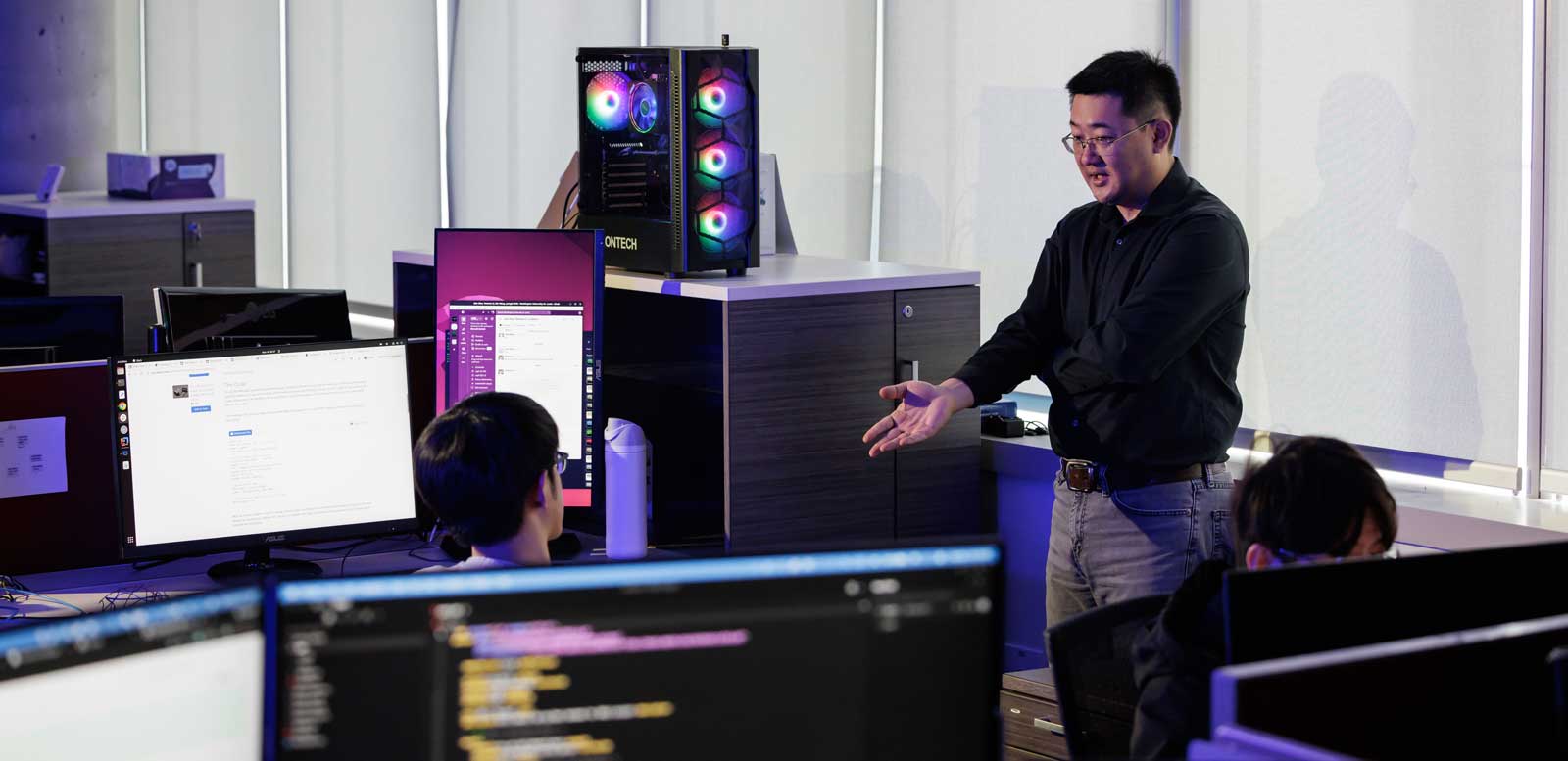
In the classroom, Zhang grounds courses such as “Introduction to Computer Security” and “Recent Advances in Security and Privacy” in real-world challenges, helping students connect core concepts to the kinds of threats they will face in practice. He also emphasizes how attackers think and how defenses fail, so students learn to reason about security under realistic constraints. Outside class, Zhang serves as faculty adviser for B34R5HELL (Bearshell), McKelvey Engineering’s competitive white-hat hacking team. The team competes in capture the flag events that build defensive skills through hands-on, adversarial problem solving.
Zhang redirects attention about his success to the WashU community that has helped shape his work. He speaks first about students, whose creativity and drive keep the lab moving forward, but he also highlights the mentors and colleagues who have invested in him directly. As he broadened his research agenda, he leaned on faculty guidance about how to think rigorously about new problem spaces, how to craft a research narrative, and how to build a sustainable and impactful program, from proposal writing to long-term planning. He also acknowledges the people who make the enterprise run day to day and the departmental and school leadership that provides the support and direction needed for research to thrive. The result, Zhang says, is a WashU culture that is demanding in the best way, and supportive in the ways that matter, and he does not take that for granted.
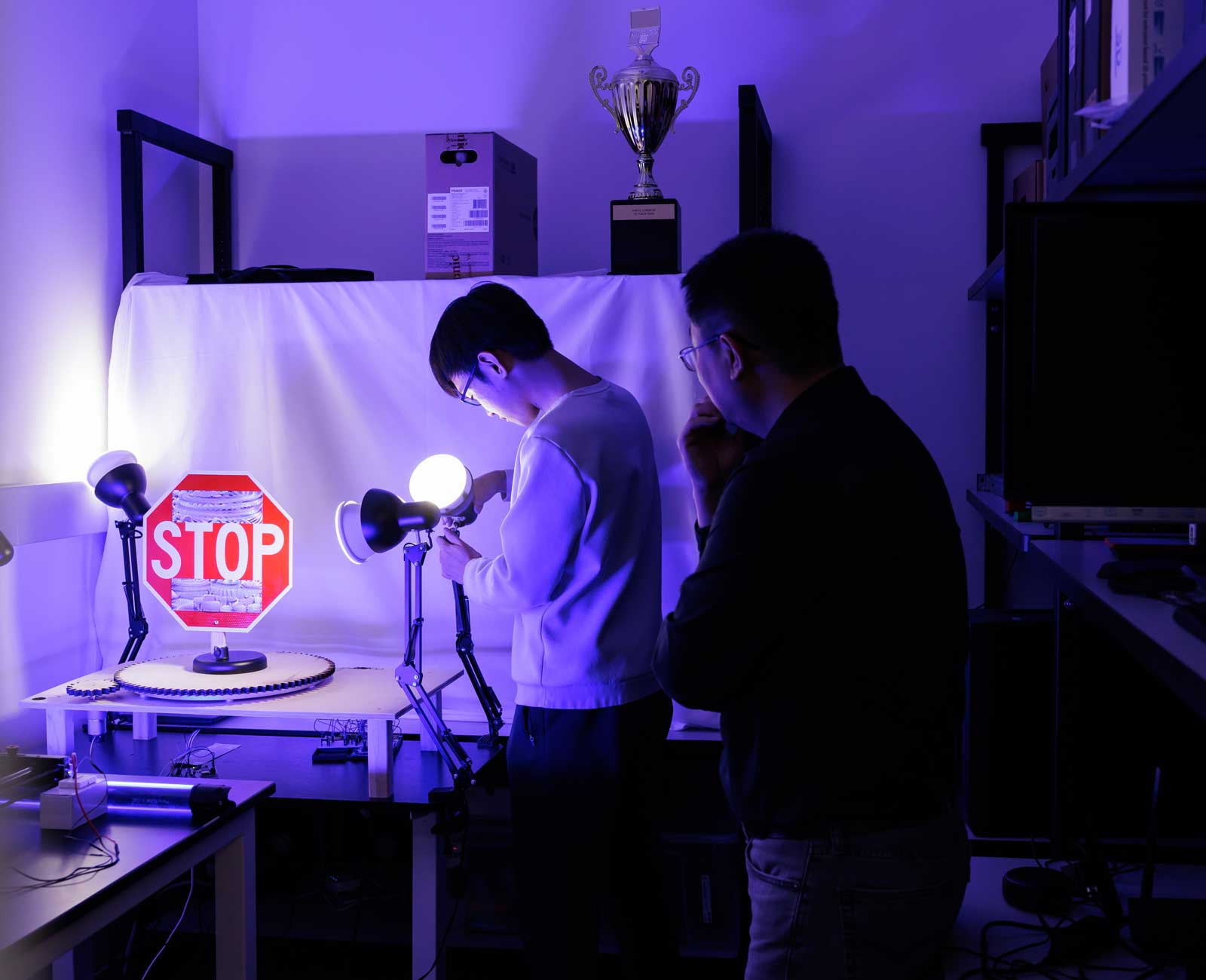
Cyberphysical Reasoning Foundation
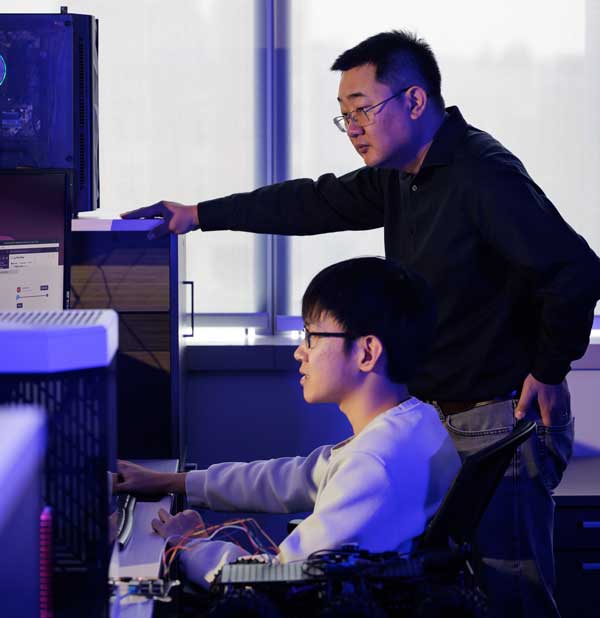
Students in Ning Zhang’s lab perform an experiment as part of its Cyberphysical Reasoning Foundation project, in which they are studying how AI systems interact with the physical world. They are exploring how subtle, real-world modifications can alter what an AI system “sees,” revealing important gaps between laboratory assumptions and reality. Rather than focusing on a single attack, their goal is to understand how reliable these effects are outside controlled settings. Their insights will help to shape new ideas and defenses for AI systems that increasingly operate in safety-critical environments.