Best defense? Invest in research
WashU engineers have earned highly sought-after Department of Defense grants for network engineering, energy storage

WashU’s engineering experts have earned highly competitive grants from a Department of Defense program aimed at building research infrastructure in underutilized areas of the country.
Grants from the Defense Established Program to Stimulate Competitive Research (DEPSCoR) were recently awarded to two researchers at the McKelvey School of Engineering at Washington University in St. Louis.
Chongjie Zhang, associate professor of computer science & engineering, and Sang-Hoon Bae, assistant professor of mechanical engineering & materials science, each received a $600,000 award to be used over three years in their research areas.
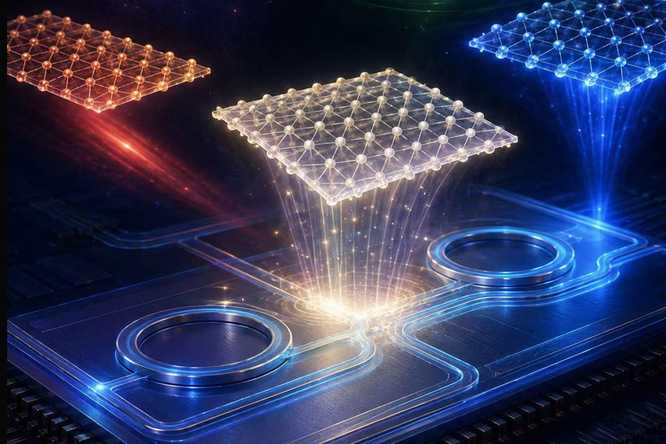
Bae will continue to refine his work into ultra-high energy capacitors. Capacitors are a form of energy storage that make use of an electric field that can discharge electricity quickly as opposed the slower releasing chemical energy used in batteries. Bae and collaborators aim to create ultra-thin materials capable of dense energy storage, the type that could power future quantum computing technologies.
Bae will use the grant to develop his research on single-crystal oxide sheets known as nanomembranes, which can generate extraordinarily strong internal electric fields and act as “electrical engines” capable of influencing other materials placed on top of them.
This work could provide the foundation for these next-generation technologies to operate at unprecedented speed and minimal power consumption, according to Bae.
Zhang’s grant involves a field of computer science called “multimodal sensing” a way to take inputs — images, audio, maps, text — and train a machine to navigate and make predictions for complex networks (such as those used in autonomous driving). Zhang’s team will approach these deep learning models by incorporating recent advances on “object-centric” model-based reinforcement learning.
This type of machine learning can detect objects that are “out of domain,” basically teaching machines how to distinguish different inputs to filter out what’s useful and what’s not. For instance, images of a city streets used in training autonomous vehicles may include billboards. That “noise” needs to be tucked away so the machine can focus on the true “signal,” the movement of pedestrians and vehicles below the billboard. The object-centric model is way to address that challenge.
DARPA work ongoing
It’s not unusual for the military to invest in high risk/high reward research that has the potential to become world changing technology: The internet itself began as a proto-DARPA project. The Defense Advanced Research Projects Agency has been supporting McKelvey Engineering research for decades including most recently awarding a $5.2 million grant to Fuzhong Zhang, the Francis F. Ahmann Professor in the Department of Energy, Environmental & Chemical Engineering. Zhang and EECE colleagues will be developing a genetic “switch” to make microbes work at high efficiency over extended periods during bioproduction. It’s a technology that has the potential to upend manufacturing and help establish a circular economy where bioplastics and waste chemicals can be fed back into the production cycles.
DARPA also has an ongoing project with Xudong Chen, associate professor in the Preston M. Green Department of Electrical & Systems Engineering. With approximately $250,000 in funds, Chen and his team will be using advanced mathematical frameworks to bring order to complex systems. Of particular interest are problem formulations that can exploit Chen’s random graph or “graphon”-based framework for control and estimation of extremely large, complex networks.
“Graphon model is a stochastic model governing the probability that a pair of agents, such as robots, can establish a link,” Chen said. “We want to characterize the chance of a large swarm of robots establishing rich enough communication links so that they can coordinate with each other to accomplish a given task in an uncertain and complex environment.”
DARPA has multiple projects funding McKelvey’s electrical & systems engineering department teams, including a four-year, $2 million grant to enhance the computational efficiency of radio-frequency (RF) correlators. That project, co-lead by Clifford W. Murphy Professor Shantanu Chakrabartty, will improve the efficiency of radar systems by setting up a system where two signals can do similar computation that works like multiplication without the high computation costs.
Another $1 million grant funds the Quantum Nano-Photonics Group, the lab of Associate Professor Jung-Tsung Shen, who will work to prototype a quantum photonic-dimer laser. The project includes using carefully controlled pairs of light particles, or photonic dimers, to generate a powerful and concentrated laser beam. Quantum photonic-dimer lasers take advantage of quantum effects to bind two photons together, increasing their energy and efficiency.
It's not just luck that earned McKelvey Engineering this support but a sustained push from the school’s leaders to tap into new talent and the vast resources offered through military and tech industry partnerships.
Beth Miller contributed to this story
Click on the topics below for more stories in those areas
Back to NewsFaculty in this story