Close to home
BME alumna Isabel Acevedo supports life science innovation in St. Louis
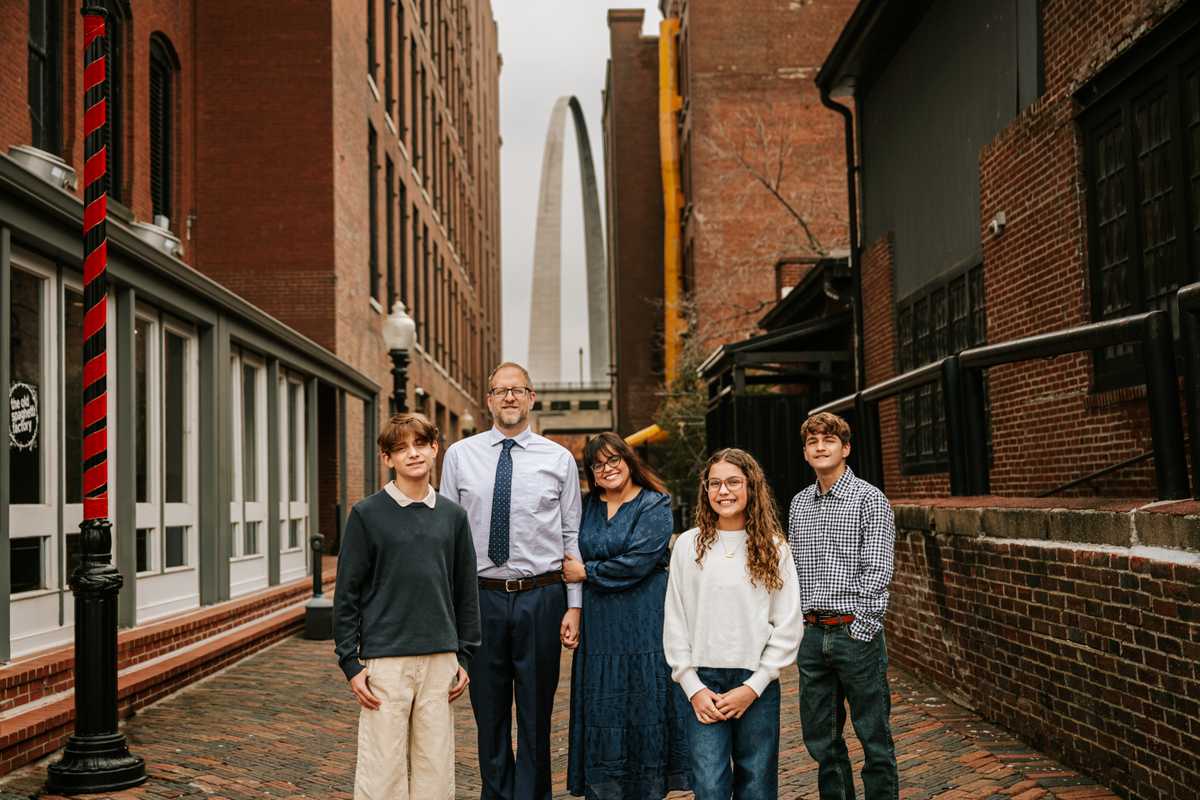
It’s been more than 20 years since alumna Isabel Acevedo accepted an offer to visit Washington University in St. Louis from her native Puerto Rico. She boarded the plane reluctantly, she says, to satisfy her mother, even though she knew she “was never going to end up going there.”
What she didn’t know at the time was that sitting near her on the plane were several other students visiting the university from Puerto Rico, including one who would soon become her roommate. Two other students she met on the trip would later become her children’s godparents.
“It was a trip that changed my life — for many reasons,” Acevedo, who earned a bachelor’s in biomedical engineering in 2006, said. “I came back home and made a PowerPoint for my parents that was: Here’s why I should go to WashU!”
Yet she admits it wasn’t love at first sight for a young woman used to the lush landscape of Puerto Rico.
“I looked outside my window as we were landing,” she said, “It wasn’t a very nice spring, nothing was green yet. I thought, ‘This might be the ugliest place I’ve ever seen.’”
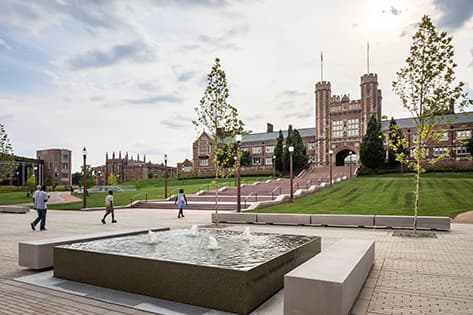
She quickly changed her mind, however, drawn in by the idyllic charm of the campus and the people she met there. It was Celebration Weekend, with the Thurtene Carnival in full swing, and the campus was brimming with energy.
“It was that sense of community that felt familiar to me,” she said. “Twenty years later, I’m still here.”
Today, as manager of technology-based economic development for BioSTL, she provides strategic and operational oversight of place-based initiatives that advance workforce, entrepreneurship and commercialization, aligning resources to scale innovation ecosystems and deliver impact.
“We’re building an ecosystem to support science,” she said. “We’re asking ‘how can we best support life science innovation and fill gaps where needed?’”
One of her biggest hurdles is a familiar one.
“Part of my job now is to attract reluctant innovators to the region,” she said. “A lot of times they don’t know St. Louis, but then they get here, and they don’t want to leave.”
Science was always a natural fit for Acevedo. The daughter of a high school science teacher, she represented Puerto Rico at the international science fair. But figuring out her role in science would take time.
“I came to WashU to do biochemistry,” she said. “Then a floormate showed me a BME project he was working on, and I started exploring that option.”
She was encouraged by Shelly Sakiyama-Elbert, then assistant professor of biomedical engineering.
“She was an incredible mentor,” she said. “We still keep in touch.”
Acevedo’s plan was to eventually go to medical school. After graduation, she took a job as a research technician in an Anatomy and Neurobiology lab at WashU Medicine.
“It was eye opening,” she said. “I realized, ‘OK I’m good at it, but it’s not for me. What else can I do with this degree?’”
Attending an innovation-centered talk at the medical school piqued her interest in translating science to make an impact in people’s lives. After earning an MBA from Saint Louis University, she accepted a position as a licensing associate at the WashU Office of Technology Management (OTM), evaluating university inventions for technical merit, patentability and commercial feasibility. OTM moved into a new building in the Cortex District, adjacent to the Medical Campus, and Acevedo enjoyed the convergence of the technical and life science worlds.
After stepping away after the birth of her third child and devoting time to volunteer for nonprofit organizations, Acevedo said her “entire perspective on life shifted.
“A job takes time away from your family and I needed that time to have meaning,” she said.
When she reentered the workforce, she took on a role supporting science research through fundraising, primarily grant writing, at the Donald Danforth Plant Science Center.
But she kept feeling the pull toward innovation.
Her current job is “an evolution of the work at the Danforth Center” — and of her engineering degree.
“My role is to ensure that scientists and innovators have the entire ecosystem of resources to be successful,” she said. “Solving system problems – that’s where the engineering degree comes in. Engineering gave me the tools to think with a systems approach.”
It also gave her “the ability to quickly relate to the science involved” as well as “the resilience to keep trying to figure it out.
“Failure is embedded in the scientific process. When you reframe it as learning it becomes a good metaphor for life,” she said. “We’re always testing new environments to see what works and what doesn’t. That’s how my career has gone.”
With her own 20-year WashU reunion just days away, Acevedo says she’s looking forward to being back on campus with friends.
“Our group chat is very active these days,” she said. “Being so far from home, these people became family to me. They became my anchor through life’s highs and lows, and they’ve been there consistently through all of it.”
She says it’s “impossible to overstate the impact that trip had” on her life and how it helped her fall in love with so much more than just a school.
“St. Louis is a great place to grow a career, especially in life sciences and innovation, and to experience that sense of community.
“I tell my (St. Louis native) husband I’m more St. Louis than he is,” she said. “Every day I’m telling the story of this city – what’s amazing about it and how we can make it even better.”