Not wasting time
CSE alumnus Tej Seelamsetty is using AI to make health care communications faster, more efficient
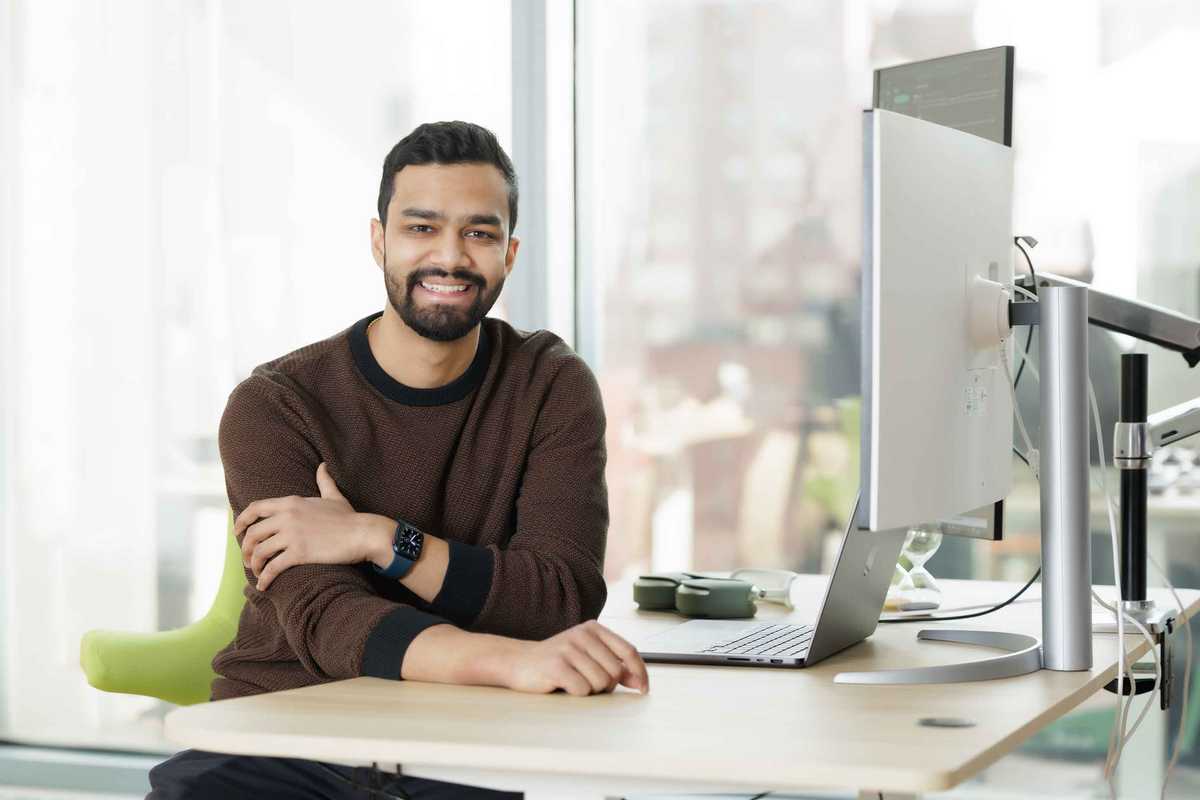
From flipping houses to harnessing technology, alumnus Tej Seelamsetty says he’s never been one to wait when he sees an opportunity to build something better.
Seelamsetty began flipping houses along the Jersey Shore at the age of 18, using knowledge he’d gained from years of tagging along to foreclosure auctions with his father, who worked in real estate.
“As soon as I was 18 and could sign personal guarantees, I didn’t waste any time,” he said. “I needed that money to help with college.”
But Seelamsetty, who earned a bachelor’s degree in computer science from Washington University in St. Louis’ McKelvey School of Engineering in 2019, knew flipping houses wasn’t his long-term plan. He’d developed an appreciation for building software to automate the more burdensome aspects of business.
“Running the business was super gratifying,” he said. “I wanted that same feeling but with more of a technical component as well.”
In 2024 he co-founded Tivara, a tech startup making health care communications faster and more efficient, along with fellow WashU CSE alum Aumesh Misra, who earned a bachelor’s degree in 2020. Tivara’s platform offers medical groups an AI workforce, which automates patient phone calls across scheduling, refills, intake and after-hours workflows — all while improving access, reducing wait times and lowering operational costs. Based in New York, its clients include large specialty medical groups across the country.
“Our AI can handle common phone requests, delivering faster answers and, ultimately, a better patient experience,” he said.
Looking back, he says, his college years were pivotal to the success of his business. He’d initially visited WashU after his brother – then a student at the school – suggested he participate in the High School Summer Scholars program.
“That’s how I discovered on my own that WashU was what it claimed to be — a top academic institution with a collaborative learning environment,” he said. “Students are serious but social, and they want each other to succeed.”
He later entered WashU as a student in the Olin Business School.
“CS was definitely a love I discovered while studying at WashU,” he said. “Ron Cytron convinced me I wanted to major in computer science, and then I did a second major in financial engineering through the business school.”
He said Cytron, professor of computer science & engineering, had a teaching style that “not only opened his students’ mind intellectually but also encouraged the kind of thinking that is for anyone who wants to be a problem solver in life.”
Seelamsetty was eager to participate in two independent study programs with Cytron.
“Independent Study allowed me to take that intellectual piece from the classroom and apply it in practical ways,” he said. “I’d stay up until 3 a.m. working on these projects, just for fun.”
During his sophomore year, Seelamsetty made another valuable campus connection when he became friends with Misra while both were members of the WashU Indian dance circuit. It didn’t take long, he says, before the two were “kicking around different ideas” for business.
After graduating, Seelamsetty joined Bain & Co. as an associate consultant in Dallas before he landed at Fair Square, a San Francisco-based startup that helps older adults navigate Medicare insurance through a tech-enabled platform. As head of growth, he increased revenue more than 10 times in three years. His time there, he says, taught him about growing and scaling a business and exposed him to the realities of health care from the patient-customer experience.
At the same time, the tech landscape was rapidly changing.
“LLMs became a big thing,” he said. “It was obvious AI had the potential to solve many health care problems.”
Seelamsetty and Misra saw the opportunity to make the type of impact they’d been talking about for years.
“We had always said, ‘if we’re going to do this, let’s do something we’re passionate about,’” he said. “We saw a big opportunity in using voice AI to help these medical groups.”
They tapped into their connections — many from WashU — as they shadowed medical practices to better inform their product.
What they found convinced them that they were on the right track.
“Doctors offices are chronically burdened by taking calls for things that could be handled by AI,” he said.
And contrary to one of the concerns many raise over the use of AI, Seelamsetty said he believes that in the case of Tivara, the opposite is true.
“Our AI platform is designed to make health care more human,” he said. “We’re not eliminating jobs; we’re freeing up front-desk workers to do more personal work that requires a human touch.”
The response, he says, has been positive.
“Burnout is real,” he said. “When you remove the parts of health care administration that stand in the way of people enjoying their jobs, you improve the experience on both sides of the interaction.”
Keeping the patient experience top of mind is key.
“We’re very intentional, always asking: would we want our parents using this AI?” he said. “Our AI agent should not take longer or cause more friction than talking with a person.”
After converting all pilot customers in 2025, Tivara is scaling business with existing customers and building more use case features to “get as many as possible on the platform, all over the country.”
Seelamsetty says choosing WashU was a singular decision that led to a wealth of valuable experiences and personal and professional relationships.
And while CS was a love he discovered at WashU, it wasn’t the only one — he’s set to soon marry another WashU alum, Shamilka Seneviratne, who just happens to be a physician.
“She’s a big fan of anything that will reduce the administrative burden and keep the focus on patient care,” he said. “And that’s what we keep hearing, and what we’re committed to doing.”