
Condensate engines could power bioelectrochemical devices
Biomedical engineers at Washington University in St. Louis have outlined how properties of biological condensates may serve as engines to power electrochemical reactions at a microscale
Researchers at Washington University in St. Louis are learning more about the principles of the electrical toolkit available within living cells: protein condensates.
In a paper published recently in Nature Materials, Yifan Dai, assistant professor of biomedical engineering at the McKelvey School of Engineering, demonstrates how these constantly shifting clumps of protein material can generate electricity, delivering a new framework for engineering biomaterials that could power bioelectrochemical devices. Such devices could be used to fight infection or clean up pollutants.
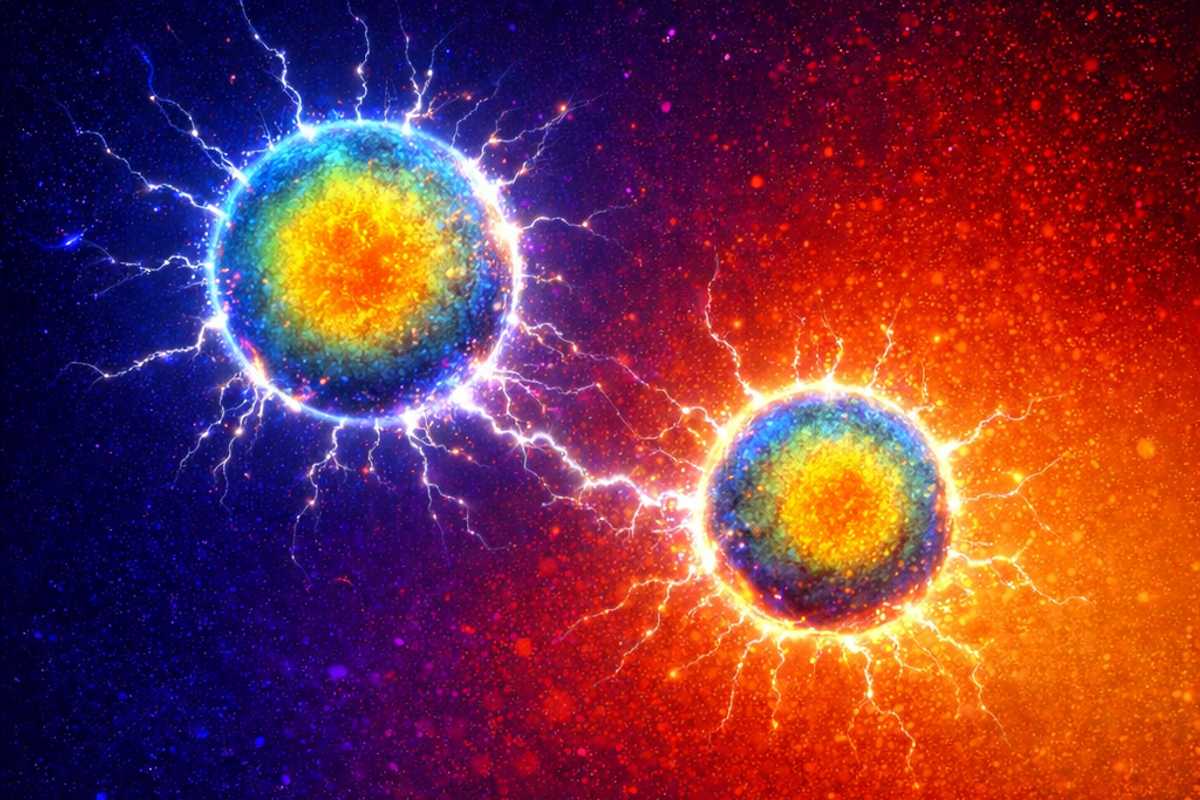
In the new research, Dai outlines how condensates can act as “battery droplets.” Inside a battery the real action happens at the interface — the thin boundary where the electrode and electrolytes touch. An “interfacial” electric field drives chemical reactions within a cell in a similar manner, converting chemical energy to electrical energy.
Protein condensates are formed through the phase transition of intrinsically disordered proteins (IDPs). This process is governed by the interplay between the solvent (water and ions) and physical properties of these cell materials. Such material naturally creates a setting conducive to creating a nanoscale electrochemical battery.
Though they lack the metal plate electrode used in batteries, the proteins still have that interface that serves the same purpose, a surface where a condensate meets the surrounding solvent, where certain ions and molecules prefer one side over the other. That uneven distribution creates tiny electrical imbalances, like miniature voltages inside the cell.
This voltage can drive electrochemical reactions like the metal electrode, thereby powering electron transfer. And because these droplets move, bump into membranes and fuse with each other, their interfaces are constantly rearranging — charging and discharging in bursts.
In other words, cells may be filled with countless of these soft “battery droplets” that store and release electrochemical energy on demand, giving synthetic biologists a new, dynamic way to power signals and reactions, said Dai.
In this research, the team demonstrates how genetically encoded protein materials that can undergo self-assembling into protein condensates can be engineered as an “electrogenic protein powerhouse.” That powerhouse can be programmable depending on how they tinker with those surface residues and the extent of charge imbalance of the phase transition.
With a powerful battery droplet that can operate in living cells, as they further refine the technique, the potential applications for this biotechnology are boundless.
Dai’s team demonstrates that microscale “engines” in cell can drive a bit of alchemy, producing gold and copper nanoparticles directly in living cells. Such “biohybrid” electrochemical devices could be used to degrade pollution in wastewater. Further, through the same protein materials, they show how the redox reactions can be exploited to kill bacteria in an antibiotic free manner, which could lead to many new medical devices to improve human health.
Yu W, Ma Y, Yang L, Zhou Y, Liu X, Dai Y. Electrogenic protein condensates as intracellular electrochemical reactors. Nat Mater. 2026 Jan. 15 DOI: https://10.1038/s41563-025-02434-0
This research was supported by the Center for Biomolecular Condensates, the Institute of Material Science & Engineering, and the McKelvey School of Engineering at Washington University in. St. Louis.
Click on the topics below for more stories in those areas
Back to NewsFaculty in this story