

Harnessing evolution: Evolved synthetic disordered proteins could address disease, antibiotic resistance
Yifan Dai’s lab designs directed evolution-based method to program synthetic intrinsically disordered proteins
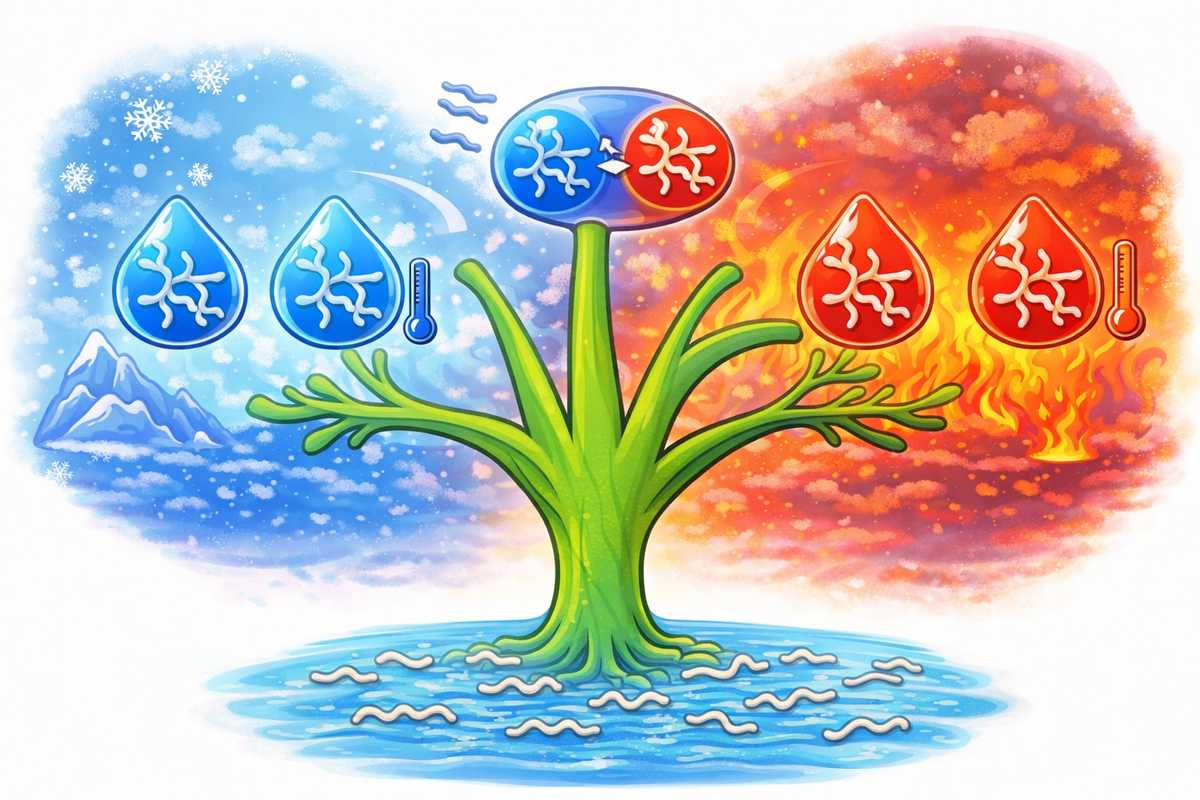
The increased prevalence of antibiotic resistance could make common infections deadly again, which presents a threat to worldwide public health. Researchers in the McKelvey School of Engineering at Washington University in St. Louis have developed the first directed evolution-based method capable of evolving synthetic condensates and soluble disordered proteins that could eventually reverse antibiotic resistance.
Yifan Dai, assistant professor of biomedical engineering, and his team designed a method that is directed evolution-based to create synthetic intrinsically disordered proteins that can facilitate diverse phase behaviors in living cells. This allows them to build a toolbox of synthetic intrinsically disordered proteins with distinct phase behaviors and features that are responsive to temperatures in living cells, which helps them to create synthetic biomolecular condensates. In addition to reversing antibiotic resistance, the cells can regulate protein activity among cells.
“Phase separation is the first concept from which we know how a cell can organize things in a spatiotemporal manner,” Dai said. “Thereby, from a synthetic biology aspect, what if you can engineer synthetic intrinsically disordered proteins, just to mimic the spatiotemporal biochemistry in real cells? But, engineering without rules is largely trial and error, so we let the evolution force lead the design.”
Results of the research are published in Nature Chemical Biology Jan. 9, 2026.
Intrinsically disordered proteins regulate various processes in cells and help to create biomolecular condensates, which are membrane-less compartments in cells that concentrate specific biomolecules, such as proteins and nucleic acids, with specific functions. Creating synthetic biomolecular condensates may allow researchers to manipulate condensates that cause disease and develop new treatments.
Intrinsically disordered proteins have different phase behaviors that take place at increasing or decreasing temperatures. This is defined by their sequence-encoded driving force, but designing such thermal-responsive phase behavior is difficult, Dai said.
Directed evolution has been used as a method to evolve structured proteins. This effort was part of the Nobel Prize in Chemistry awarded in 2018. However, their potential in evolving non-structured or disordered proteins has not been exploited due to the lack of functional connection between cellular fitness and evolution, Dai explained.
“We designed the evolution-based assay and selection strategies to connect cellular survival and the behaviors of the disordered proteins, then put them into different temperatures or other selective pressures, and let it go,” Dai said. “We let the nature do the work to give us a sequence that can behave and let them survive.”
Dai has been involved this area of research since he was a postdoctoral researcher at Duke University, where researchers pioneered the work, developing the rules as they progressed. When he joined the WashU faculty in 2023, he wanted to design a strategy to directly evolve intrinsically disordered proteins.
Dai’s lab, including first authors and graduate students Yuefeng Ma, Leshan Yang and others, used E. coli bacteria for their experiments because it grows quickly, is easy to work with and allows for efficient screening of many protein variations. Although E. coli has some limitations, Dai said, it's simpler than mammalian cells, which have more complex systems that could interfere with the evolution process.
“Overall, this evolution-based method could be useful not just in synthetic biology, but also in studying protein behavior in biochemistry and cell biology, helping to understand how protein sequences influence their functions,” Ma said. “Our future work focusing on developing context-dependent evolution strategy in mammalian cells might open a new paradigm to develop a platform to create condensate-dependent therapeutics.”
Dai and Ma are co-inventors on a U.S. provisional patent application. They are working with the university’s Office of Technology Management, which is assisting in protecting the intellectual property and advancing commercialization efforts.
Ma Y, Yang L, Chen Y, Chen MW, Yu W, Dai Y. Directed evolution of functional intrinsically disordered proteins. Nature Chemical Biology, Jan. 9, 2026, DOI: 10.1038/s41589-025-02128-3
This research was funded by the Center for Biomolecular Condensates and the McKelvey School of Engineering at Washington University in St. Louis.
Click on the topics below for more stories in those areas
Back to NewsFaculty in this story