
Light gives boost to image processing, optical systems
Work in Mark Lawrence’s lab has benefits to image processing with AI
Of the many feats achieved by artificial intelligence, the ability to process images quickly and accurately has had an especially impressive impact on science and technology. Researchers in the McKelvey School of Engineering at Washington University in St. Louis have found a way to improve the efficiency and capability of machine vision and AI diagnostics using optical systems instead of traditional digital algorithms.
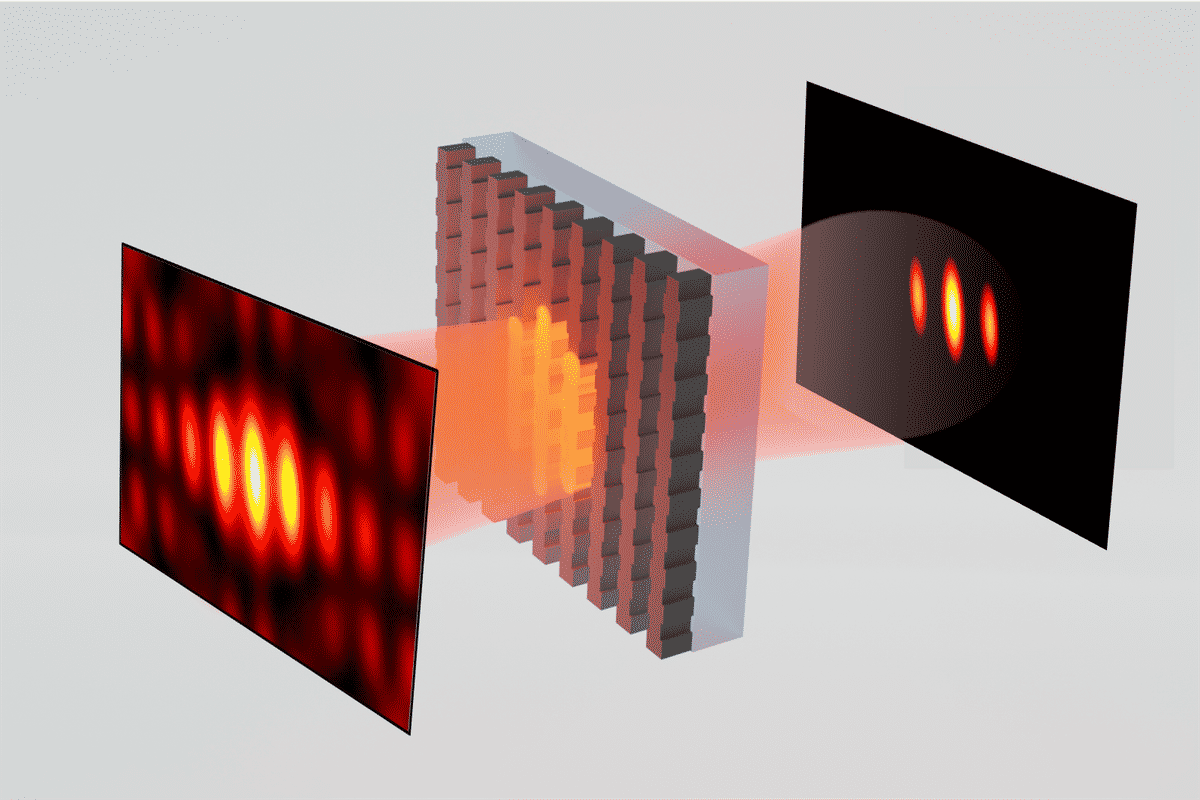
Mark Lawrence, assistant professor of electrical & systems engineering in the Preston M. Green Department of Electrical & Systems Engineering, and Bo Zhao, a doctoral student in his lab, developed this approach to achieve efficient processing performance without high energy consumption. Typically, all-optical image processing is highly constrained by the lack of nonlinearity, which usually requires high light intensities or external power, but the new method uses nanostructured films called metasurfaces to enhance optical nonlinearity passively, making it practical for everyday use.
Their work shows the ability to filter images based on light intensity, potentially making all-optical neural networks more powerful without using additional energy. Results of the research were published online in ACS Nano Letters Jan. 21, 2026.
“While all-optical filters capable of performing all sorts of linear transformations, like the Fourier transform, polarization manipulation, or edge extraction, are well established and compatible with everyday light sources, the key to unlocking supercharged all-optical image processing lies in nonlinearity,” Lawrence said. “But most examples of intensity dependent optical image filtering are impractical to use in passive optical systems because they require extremely high light intensities, external electrical power or the sacrifice of spatial details. Because of this, low-power, passive nonlinear processing has been an unsolved challenge.”
Lawrence said the main obstacle to solving that challenge is the lack of strong light-matter coupling in unbiased materials at room temperature.
“We rely on the physics behind two everyday phenomena – properties of materials change when they get hot, which is why you might see a mirage appear in the desert, and materials heat up when they absorb light,” he said. “Designing a resonant silicon antenna to respond as sensitively as possible to temperature while absorbing as much light as possible leads to a dark pixel that becomes transparent under the illumination of extremely low light intensities. Absorption and transparency do not usually go together, but we found that our nanostructures could capture up to 40% of the incident light and still let almost all of it through when heated.”
Spreading thousands of tiny nanostructures across a chip, his team created a device that reacts to light intensity and can selectively filter features in images based on brightness, similar to how key thresholding functions work in digital algorithms. This approach works with very low light levels and does not need extra energy. The technique uses silicon nanostructures and can be adapted for various wavelengths. This innovation could greatly enhance the performance of low-cost image sensors without increasing energy consumption, making it compatible with existing camera technologies.
Zhao B, Lin L, Samuel A, Lawrence M. High-resolution and ultra-low power nonlinear image processing with passive high-quality factor metasurfaces. ACS Nano Letters. Published online Jan. 21, 2026. DOI: 10.1021/acs.nanolett.5c05424
Funding for this research was provided by the National Science Foundation (CCF-2416375) and Optica Foundation.