STEM Exchange to boost learning, support faculty
Effort launched at iTeach, biennial conference to improve teaching on campus
As part of Washington University in St. Louis’ ongoing work to transform undergraduate STEM education and support low-income and first-generation STEM students, the Office of the Provost is launching the WashU STEM Exchange, a new community where educators, advisers and researchers in science, technology, engineering and math can share strategies and interventions and track outcomes.
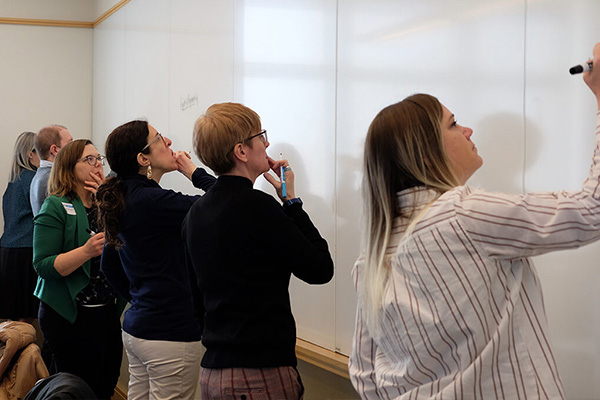
Kurt Thoroughman, an associate professor of biomedical engineering at the McKelvey School of Engineering, announced the initiative Jan. 8 at iTeach, a biennial conference hosted by the Center for Teaching and Learning (CTL) with support from WashU Libraries, the Office of the Provost and Arts & Sciences Information Technology. The full-day conference drew about 220 faculty members and featured 40 panels, workshops and presentations on a range of topics, from the university’s new artificial intelligence (AI) literacy Canvas module to creative course design to innovative assessment practices.
“The goal of the WashU STEM Exchange is to bring people together from across the university to look at our strengths and our opportunities and to build a community of practice,” Thoroughman told participants in the iTeach panel “Transforming Undergraduate STEM Education at WashU and Nationwide.”
“As we’re building iteratively over the long haul, we can compare notes with our peers and discover new ways to do better by our students and measure what we are doing so we can continue to build.”
This work will build on the ongoing efforts of the Office of the Provost to support faculty in incorporating evidence-based inclusive teaching methods that improve student outcomes and close disparity gaps. Internal data show that, following national trends, first-generation and Pell Grant-eligible students entering WashU with an interest in STEM are less likely to graduate with a STEM degree than their peers. The data also show that many of the first-generation and Pell students who do not persist in STEM majors or do not graduate struggle in large, entry-level courses.
“The kind-of good news is that we can find these students early,” Jennifer Smith, vice provost for educational initiatives, reported to iTeach participants. “All of our students come in with incredible talent, but their educational experiences and background are variable, so we do see disparities. But we believe that if you are good enough to get admitted to WashU, you should have an equitable opportunity to thrive, not just in college, but in the field we admitted you to study.”
Read the full story here.
Click on the topics below for more stories in those areas
- Energy, Environmental & Chemical Engineering
- Biomedical Engineering
- Mechanical Engineering & Materials Science