
An inside look at drone swarm behavior
Method developed in labs of Netanel Raviv, Andrew Clark
Researchers in the McKelvey School of Engineering at Washington University in St. Louis have developed a new method to understand information in complex systems.
Led by a new theory developed by Aobo Lyu, a doctoral student in McKelvey Engineering, this collaboration applies an information-theoretic approach to control and direct swarms of unmanned arial vehicles (UAVs) as part of a $184,000 grant from the Defense Advanced Projects Research Agency (DARPA).
Lyu’s approach, which published March 3, 2026, in Physical Review E, provides a framework to understand the collective dynamics and spontaneous, synchronous behavior observed in collections of interacting agents, each governed by their own individual local dynamics.
“Emergence is the phenomenon where large complex systems of many agents present large-scale synchrony, even though there is no one party that tells each agent what to do,” said Netanel Raviv, assistant professor of computer science and joint adviser of Lyu with Andrew Clark, assistant professor in the Preston M. Green Department of Electrical & Systems Engineering. “Each agent decides what to do based only on the agents adjacent to it, but nevertheless, in many cases in nature, in robotics, in power grids, or in similar systems that have these characteristics, you can find large-scale phenomena that appear as if someone is telling each agent exactly what to do.”
The study of emergent phenomena is compelling across disciplines: ecology sees flocks of birds flying together as a single dark cloud, neuroscience notices the sudden onset of a seizure where brain activity suddenly coherently malfunctioning, sociology observes a crowd of strangers caught in an unwilling cooperation, and economists watch entire markets crash into a deep red. Bridging dynamical systems theory and information theory, Lyu plans to apply his new theoretical contribution to realize an induced emergent behavior in swarms of UAVs by determining the information shared between a small number of coordinating drones in the swarm with a common goal.
“What excites me is the possibility of connecting two worlds,” Lyu said. “On one hand, we want an information-based explanation for how emergence arises in nature. On the other, we want control tools that let us intentionally induce similar collective behavior in engineered systems—so emergence becomes something we can design, not just observe.”
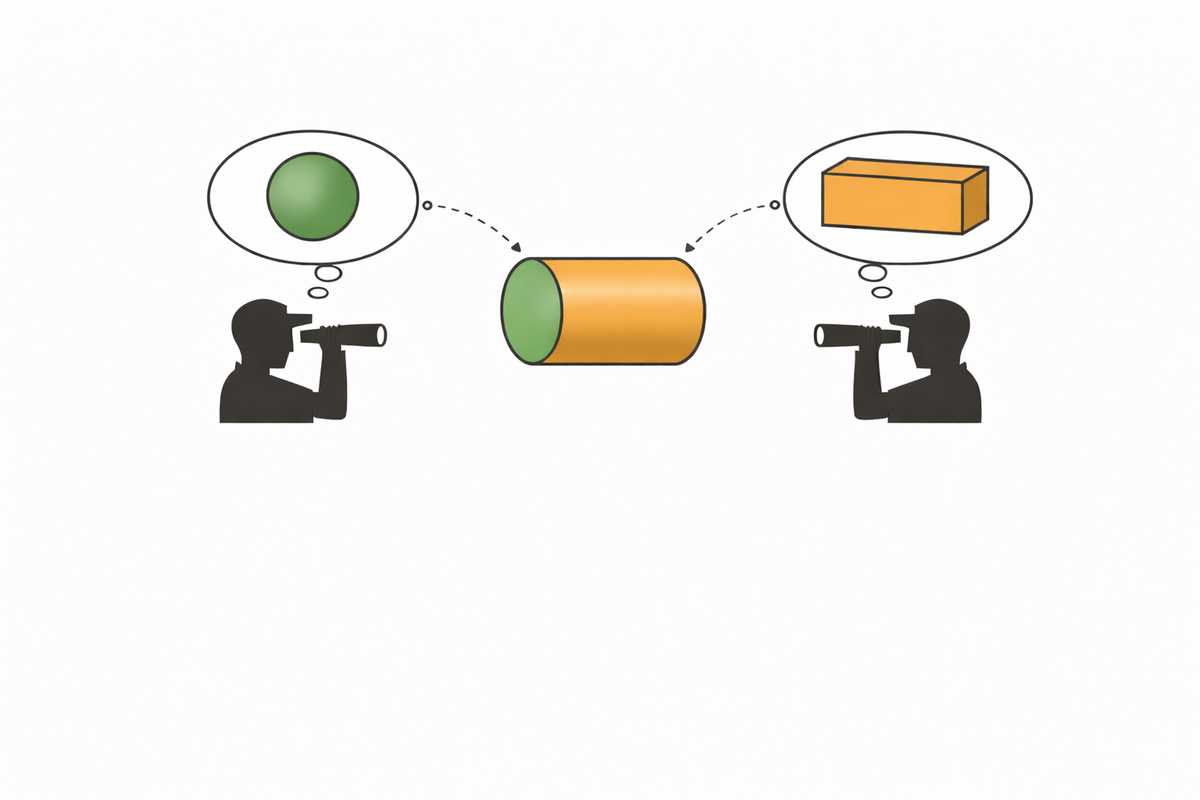
Traditional information theory offers mutual information, which measures how much information two variables share, but it doesn’t reveal how information is distributed across larger collections of variables. In multi-agent settings, the information relevant to a shared task can be decomposed into what agents both know, or redundant information; what only one agent knows, or unique information; and what becomes available only when they combine what each one knows, or synergistic information. This decomposition helps researchers distinguish whether a group is merely echoing the same signals or generating genuinely collective information through coordination.
“If two drones are trying to avoid a tree, the joint information they have about that obstacle can be separated into what’s shared by both, what only one drone has, and the most interesting part, what they can only infer together,” Raviv said. “Our method lets us measure these components, including synergy, to better understand — and ultimately promote — collective behavior in drone swarms.”
So far, the team has validated the approach in the Ising model, a classic testbed in complex-systems research. Raviv said they are cautiously optimistic it will generalize to more realistic settings, but they have a major computational hurdle.
“The math is clean on paper, but real systems are high-dimensional,” Lyu said. “Existing decomposition formulas rely on the full joint distribution of the systems and estimating that from large-scale system’s data quickly becomes the bottleneck. We’re now exploring machine-learning approaches — especially structured variational autoencoders (VAEs)—to make the information decomposition methods computable in large-scale real-world scenarios.”
“Our hope is that this gives researchers a sharper lens for distinguishing what a system already ‘shares’ from what it can only ‘create together,’” Raviv said. “That distinction matters if you want not just to observe emergence, but to engineer it.”
Lyu A, Clark A, Raviv N. Multivariate partial information decomposition: Constructions, inconsistencies, and alternative measures. Physical Review E, March 3, 2026. https://doi.org/10.1103/8rzp-w5z1
This work was supported in part by the Air Force Office of Scientific Research (AFOSR) (FA9550-23-1-0160).