Data driven
Alumnus Daniel Larremore uses mathematical modeling to solve real-world problems
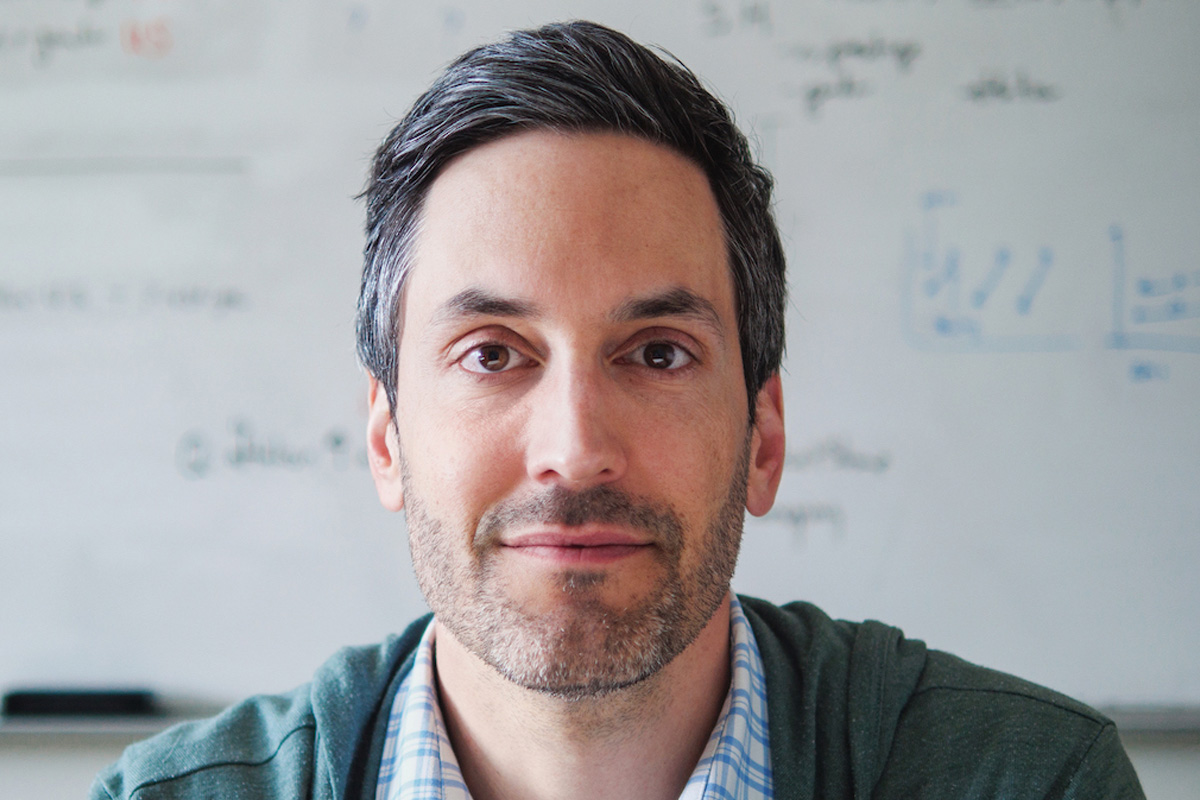
Long before the COVID-19 pandemic brought his work to the attention of public health officials and policymakers, alumnus Daniel Larremore was a WashU undergraduate with a hazy view of his post-college life.
“You could say I was a little clueless, rescued by the advising system,” he said. “I was majoring in computer science but taking classes more geared for chemical engineering and didn’t even realize it.”
He credits WashU for its commitment to “giving you the flexibility to chart your own path and foster your interests,” which for Larremore included not only his academic pursuits but also the resources to start a campus rock band.
After earning a bachelor’s in chemical engineering from WashU in 2005, Larremore worked as a research engineer for a medical device company and then went on to earn master’s and doctoral degrees in applied mathematics from University of Colorado Boulder (CU). After postdoctoral fellowships at the Center for Communicable Disease Dynamics at the Harvard T. H. Chan School of Public Health and the Santa Fe Institute, he joined the CU faculty in 2012.
Today, as associate professor of computer science and associate chair for research in the Department of Computer Science at CU, Larremore continues to explore his interests, leading a team of graduate students focused on developing methods of networks, dynamical systems and statistical inference to solve problems in infectious diseases and computational social science.
Larremore’s lab was using computer modeling to study how infectious diseases like malaria, polio and tuberculosis spread through a population long before the COVID-19 pandemic, but the goal was the same: use models and computation to improve the study of pathogens to ultimately decrease the burden of disease.
“A doctor looks at the patient in front of them and asks why this individual patient is sick,” he said. “But looking at how disease is spreading through the population is a different endeavor, and I am driven by the impact on that scale.”
When COVID-19 emerged, Larremore’s lab responded with urgency, quickly producing mathematical models that demonstrated the value of COVID-19 rapid tests in studies published in Science Advances and The New England Journal of Medicine. As the pandemic wore on, the team continued using mathematical models to answer some of the pandemic’s toughest questions, including how vaccines should be distributed to minimize hospitalizations and deaths. Their findings, published in Science in 2021, were cited in the Centers for Disease Control and World Health Organization vaccine prioritization guidelines.
The pandemic, he says, amplified the role of computational methods in public health intervention, particular around the use of rapid tests.
“A test that’s mostly right but used widely is more impactful than one that’s 100% right but at the single patient level,” he said.
By 2022, with life slowly returning to normal, Larremore’s efforts during the pandemic earned him the National Science Foundation (NSF) Alan T. Waterman Award, the nation's highest honor for early-career scientists and engineers. He was only the fifth computer scientist to receive the award since it began in 1976.
Larremore says the award has given him more flexibility to explore his research interests and to encourage his graduate students to do the same.
“These students are so fun to work with, and they contribute so much,” he said. “It’s great to be able to say, ‘Take a semester to explore your idea.’”
With COVID-19 no longer dominating the public health landscape, Larremore’s lab remains committed to the study of “viral kinetics — understanding pathogens that make us sick and what they’re doing inside the body.”
Another focus of Larremore’s lab is the “science of science,” including the study of academic careers, peer review, and social inequalities in the academic labor market.
“We’re using mathematical models to better understand the complexities of who gets to be a scientist and why,” he said. “And not just how people get into science careers, but also why they leave.”
One motivating goal of this work, he says, is to “open the doors wider so more people have access.
“What makes science so interesting to study is the people who do it and the passion they have,” he said. “It makes it harder to predict and more interesting.”
In addition to his work in the lab and the classroom, Larremore co-founded Cevian Labs in 2025 to address some of the most common frustrations faced by researchers. The startup’s flagship AI-powered platform CVParsa automates manual tasks that hinder the work of faculty hiring committees, grant applications, strategic planning and scientific collaborations.
Finding time to follow his own interests, Larremore says, is part of his job.
“One of the great things about being a professor is the expectation to prioritize curiosity and follow through with it,” he said. “Whether it is spinning off a company or following an idea, it’s a really unique and appealing aspect of academia.”