
Synthetic biology leads to recyclable textiles: Engineered protein fibers for a cleaner future
Researchers develop engineered protein polymers that can be easily recycled and reused
The textile industry produces a substantial portion of world’s waste with only about 12% of fiber materials ending up in recycling. Textiles also account for much of the microplastics in oceans. During every wash cycle, synthetic fibers shed microplastics that are flushed down the drain and eventually enter aquatic environments. Increasing textile recycling alone won’t solve this problem because most petrochemical-based fibers are difficult to recycle and continue to release persistent microplastics throughout their life cycle.
Engineers from Washington University in St. Louis may have a solution, thanks to dedicated synthetic biology work in the lab of Fuzhong Zhang, the Francis F. Ahmann Professor in the Department of Energy, Environmental & Chemical Engineering in the McKelvey School of Engineering and co-director of Synthetic Biology Manufacturing of Advanced Materials Research Center (SMARC).
The results of that work, now published in the journal Advanced Materials, created protein-based materials, which are produced in bioreactors (think giant brewing tanks) using genetically engineered microbes. These materials can be readily recycled after use and remade into the same fibers over multiple cycles. In addition, any microparticles, if released from these fibers during washing, would be biodegradable.
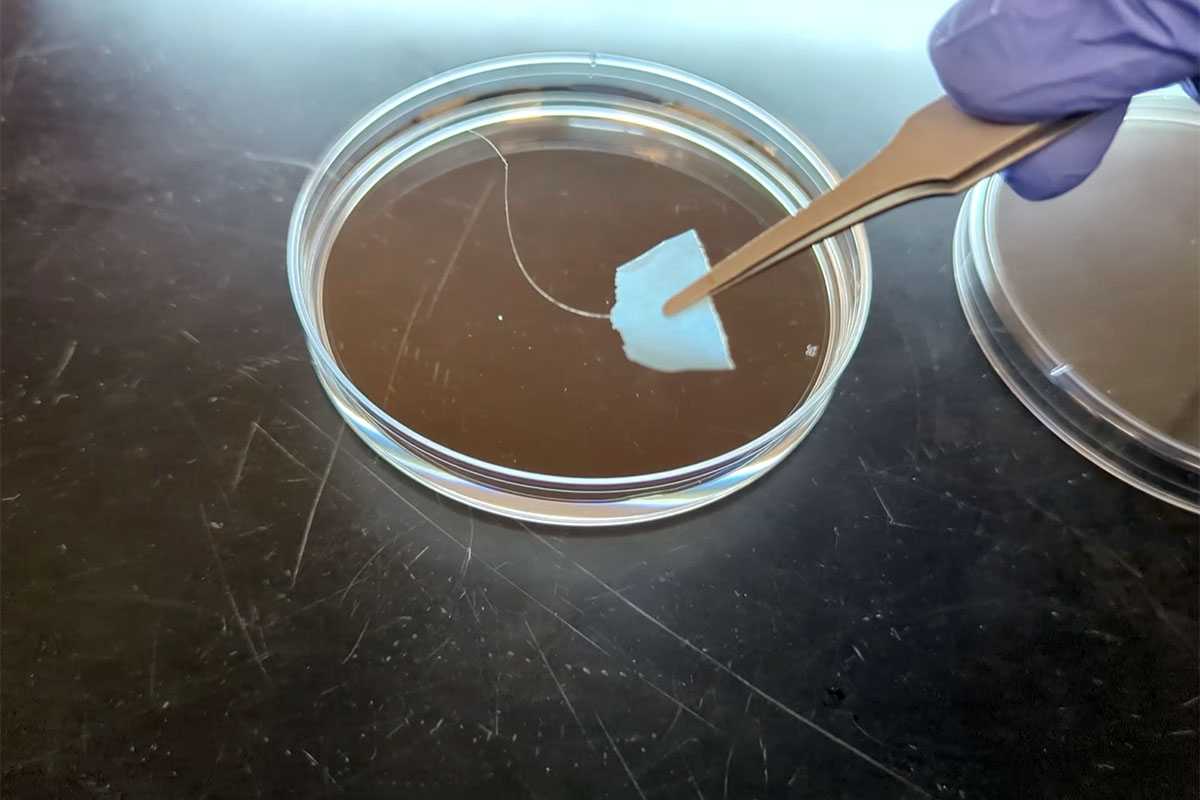
“We engineered recyclable protein fibers that dissolve in a formic acid solution within seconds, yet remain stable in water and strong after drying,” said Zhang.
Formic acid solution is an affordable, volatile solvent, commonly used in industry, for animal feed preservation, leather processing, traditional textile dyeing, cleaning and many other processes. In this case, the solvent breaks down protein interactions that bind the fiber together without changing the protein itself. Later, solvent evaporation leaves behind those raw protein materials that can remake fibers of the original strength and properties.
The recycling industry has long struggled to make plastic reuse more practical and cost-effective. Plastics can be melted and remolded, but the recycled plastics are often weaker, especially when they contain additives or contaminants. Other recycling methods break the chemical bonds within polymers and then rebuild them through resynthesis, but that can greatly add to costs and emissions. In general, the stronger a material is, the harder it is to recycle, because the same bonds that give the material its strength often need to be broken during recycling.
To solve this problem, the team drew inspiration from nature. They took genetic sequences from mussel foot proteins, spider silk, and amyloids (protein aggregations) and “knitted” them all together using sophisticated protein engineering techniques, so that strength and recyclability of the resulting material can be independently controlled.
Their protein-based material is called SAM, silk-amyloid-mussel protein hybrid. The sticky protein sequences from mussels help control the materials’ ability to dissolve in formic acid solution. The spider silk and amyloid protein sequences ensure the materials form strong interactions that “reconnect” the polymer chains back together after recycling.
“We tune the mussel foot sequences to make SAM fibers recyclable while preventing them from shrinking when they get wet,” said Zhang.
The team demonstrated this process by dissolving and remaking SAM fibers multiple times, giving them fibers with consistent high strength. Recycled raw proteins can also be repurposed to make adhesive hydrogels for various applications, which can be further recycled to fibers or hydrogels again.
Getting a closed loop recycling system also help reduce the cost of these materials. Biomanufacturing is not inexpensive, so researchers were often limited to targeting luxury applications. But with a circular system of resources, costs for biomanufacturing start to drastically lower.
“Recycling the final product multiple rounds can greatly reduce manufacturing costs over time.”
Li J, Jeon J, Lee KZ, Zhang F. Biosynthesized Silk-Amyloid-Mussel Proteins as Dissolution Recyclable Materials With Tunable Supercontraction. Advanced Materials (2026): e73200. https://doi.org/10.1002/adma.73200
This research is funded by the United States Department of Agriculture (Grant number 20196702129943 to F.Z.) and the National Science Foundation (DMR-2105150, DMR-2207879, and OIA-2219142 to F.Z.). This research used mass spectrometry resources at Washington University Biomedical Mass Spectrometry Resource, which is supported by NIH grant 8P41GM103422.