Alumna Gandhi uses engineering experience to pursue a new purpose
As founder of Young Engineers Chicago, Kita Gandhi is building kids’ interest in STEM

Over the course of her 25-year career, many people have trusted their projects in Kita Gandhi’s hands — from her numerous roles in the pharmaceutical industry and engineering consulting, and even her parents’ business. But that wasn’t always the case.
“My friends would say, ‘Don’t give that to her, she’ll break it,’” she laughed. “I was always the kid who took things apart to see how they worked.”
Growing up the daughter of a mechanical engineer, she recalls an early love of math and science. She was lucky, she says, to have exposure to STEM at school and at home.
Today, as founder and program director of Young Engineers Chicago, she’s found a new purpose in providing that exposure to kids ages 6-12. Young Engineers’ specialized STEM educational programs use custom building block sets — often with Lego bricks, specialized gears and motorized components — designed to teach children physics, engineering and coding principles.
“Children deserve every opportunity possible to further their understanding of how things work,” she said. “I’m passionate about introducing the next generation to the wonders of engineering.”
It’s a job that keeps Gandhi on the move.
“Young Engineers is completely mobile,” she said. “We go to where the kids are — camps, after-school classes, community centers.”
While much of her time is spent working with schools, planning the next round of classes, communicating with parents and hiring teachers, Gandhi says she visits each class at least once per session to meet the kids and ensure that her standards are maintained.
"I'd love to teach more classes and work with every child,” she said. “But I can't teach all of the classes. A lot of my teachers are college students in STEM and education fields, so they are enthusiastic and love our format."
Young Engineers, she says, “gives kids a space where they can do more than just play,” with activities that allow them to construct functional models with real mechanical components like dual-gear transmissions and propulsion systems.
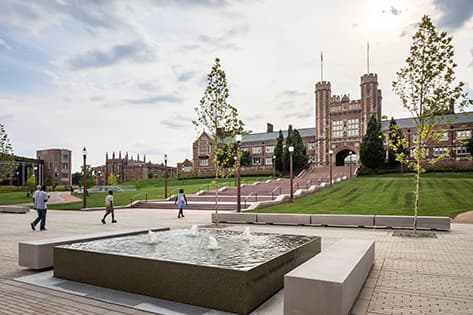
Gandhi’s decision to pursue engineering led her to enroll at WashU as an undergraduate, where she served in leadership roles on the South Asian Students Association (SASA) and as a member of Tau Beta Pi and the American Institute of Chemical Engineers (AiChE) before graduating with a bachelor’s in chemical engineering in 1998.
One of her favorite WashU memories, she says, is leading the effort to move Diwali, an annual student-run production organized by SASA, from the Gargoyle to the Edison Theater inside the Mallinckrodt Center.
“It took a lot of convincing until they eventually said yes,” she said. “Now it is one of their biggest events of the year.”
Gandhi went on to earn a master’s in chemical engineering from University of California Berkeley, but soon returned to the Midwest, establishing her career in Chicago with an emphasis on pharmaceutical and life sciences engineering at major companies including Abbott Laboratories and AbbVie.
In 2018, she left AbbVie to manage her parent’s fire protection business, which they had run together for more than 40 years, and to help them transition to retirement.
“I was flying to Kansas City every week, Monday through Thursday, wearing all the different hats – business, financial,” she said. “I definitely got bit by the entrepreneurship bug.”
Two years later, the family decided to sell the business, with Gandhi handling all the details from negotiation to closing, which happened in February 2020, “right before the COVID-19 pandemic shut everything down.
“My sabbatical didn’t look quite the way I wanted to, travel was limited to say the least,” she said. “But it was a good time to take a break and figure out what to do next.”
She toyed with the idea of starting her own business, but was reluctant to start from the beginning. Her husband, fellow WashU alum Salil Gandhi, who earned a bachelor’s in biology in Arts & Sciences in 1996, already had launched a startup, and it did not appeal to Kita Gandhi at that stage of her career.
While exploring franchise opportunities related to engineering, she came across Young Engineers and remembered research she’d read while involved in Society of Women Engineers outreach events in the early 2000s.
“It said that high school was too late to change minds — kids already think math and science is too difficult or too boring,” she recalled. “It pointed to needing to reach students early, particularly young girls.”
She made the decision to commit to a Young Engineers franchise. Yet just as she was getting started, she received an offer to join Sterling Engineering as the director of the life sciences division.
“I just couldn’t turn it down, and so Young Engineers was kind of a side gig,” she said. “But that income definitely helped me move the business forward.”
After four years at Sterling, Gandhi decided, “It was time to give Young Engineers a shot, full time.”
Today, she continues to take on consulting jobs while growing the franchise.
The Gandhis maintain strong ties to WashU, with Kita serving as chair of the Chicago Eliot Society Committee and Salil participating in the WashU Chicago Professionals Network. In past years, Kita has mentored through WashU CNX, and given a keynote speech at a McKelvey Engineering event.
“We have a lot of WashU pride,” she said. “We’re always trying to encourage people to consider WashU.”
She calls her current career “so different than I pictured back then.”
One of the best things about Young Engineers, she says, is that it provides children something useful beyond math and science concepts.
“It’s giving them the confidence to solve problems,” she said. “To make adjustments when something’s not working. That’s life.”