McKelvey Engineering-led startups win 2026 Arch Grants
Annual competition awards $75,000 in equity-free funding
Two of the 16 winning companies at the 2026 Arch Grants Startup Competition were founded by students in the Department of Biomedical Engineering (BME) in the McKelvey School of Engineering at Washington University in St. Louis.
The annual competition awards innovative, scalable and job-creating startups with $75,000 non-dilutive grants, as well as an additional $25,000 for companies relocating to St. Louis, and access to an ecosystem of resources in exchange for making their business headquarters in St. Louis for at least one year. Competition applications are evaluated by over 400 industry experts from the St. Louis community and around the country.
This year’s winning startups, announced at the Arch Grants neXus Gala held Oct. 30 at St. Louis Union Station, included:
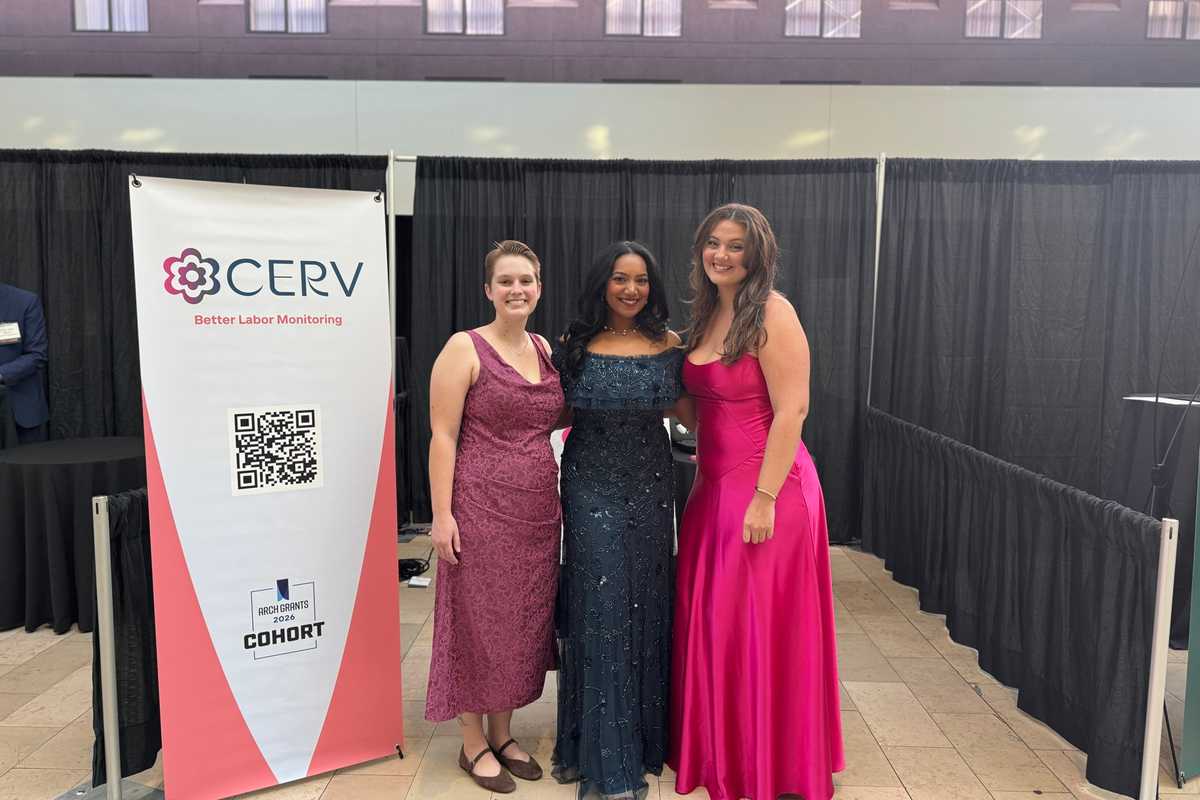
- CERV is developing a novel medical device to measure cervical dilation and improve labor monitoring. Its mission is to transform maternal healthcare through innovative, patient-centered technology that enhances safety, accuracy and dignity in childbirth.
CERV was cofounded by Elizabeth Buzbee, who earned a bachelor’s degree in 2024 and is now a doctoral candidate in biomedical engineering; Annika Avula, who earned a bachelor’s degree in biomedical engineering in 2024 and now attends Texas A&M University Naresh K. Vashisht College of Medicine; and Sandy Montgomery, who earned bachelor’s and master’s degrees in biomedical engineering in 2024 and 2025, respectively, and is now a product development engineer at 3D Systems, where she designs 3D-printed surgical guides for the Department of Veterans Affairs.
- NeuroFore has developed the world’s first early diagnostic for Parkinson’s disease, using AI to detect the disease years earlier than is currently possible based on non-motor symptoms alone. By enabling earlier diagnosis and intervention, NeuroFore is improving outcomes for millions of patients worldwide.
NeuroFore was founded by Hamasa Ebadi, doctoral candidate in biomedical engineering, and co-founder Miles Gilliam. Other members include clinical adviser Daniel DiLuca, assistant professor of neurology at WashU Medicine, and business advisor Joe Klaesner, professor of practice in biomedical engineering.
A third startup with ties to BME, Gateway Photonics, was invited to participate in the Arch Grants Pilot Program, a new initiative in which Arch Grants provides companies access to resources, including co-working space, public relations support and an investor network. Gateway Photonics is developing OCTPro, a wearable, clinical-grade optical coherence tomography (OCT) headset designed to make advanced retinal imaging more accessible, affordable and convenient by integrating optical imaging technology onto a photonic chip. It was co-founded by Chao Zhou, the Joseph and Florence Farrow Professor of biomedical engineering and of ophthalmology & visual sciences at WashU, and Jane Cai.
Click on the topics below for more stories in those areas
Back to NewsFaculty in this story