Can brain signals help turn spinal stimulation on only when it’s needed?
Ismael Seáñez’s lab to study more targeted spinal cord stimulation in rehabilitation
People with life-altering spinal cord injuries are often treated with continuous spinal cord stimulation, even when a person is not trying to move.
Ismael Seáñez, an assistant professor of biomedical engineering in the McKelvey School of Engineering at Washington University in St. Louis, plans to study the effects of delivering transcutaneous spinal cord stimulation (tSCS) only when the person intends to move with a three-year, $400,000 grant from the Craig S. Neilsen Foundation. He and his team will evaluate whether people improve with practice and whether such a system can work outside the lab.
“A spinal cord injury interrupts the communication between the brain and the spinal circuits below the injury controlling movement,” Seáñez said. “We want to see whether a person with spinal cord injury can use their own brain signals to trigger stimulation below the injury and improve movement, essentially bypassing the lesion. We expect that this study will allow us to lay the groundwork for a more scalable rehabilitation tool that provides stimulation only when needed.”
The team will test its noninvasive brain-spine interface that predicts movement intention from electroencephalography (EEG) and use the decoded signals to control deliver tSCS in people with spinal cord injury.
The work builds on research funded by the Eunice Kennedy Shriver National Institute of Child Health & Human Development at the National Institutes of Health to investigate the neural mechanisms behind various controls of transcutaneous spinal cord stimulation (tSCS) in generating different leg movements with a five-year, nearly $3 million grant.
“The high costs of treatment for spinal cord injury is a significant burden for a population that has 82% unemployment at 1-year post-injury,” Seáñez said. “The low potential for recovery results in a lifelong socioeconomic burden for survivors and reflects our limited understanding of the pathophysiology underlying the injury and the gaps in current treatment strategies. One of our goals is that our innovations in neurotechnologies will maximize motor function and recovery outcomes through neurorehabilitation that will lead to increased rates of employment and independence for people with SCI.”
Seáñez’s team will recruit 16 people between ages 18 and 65 with chronic spinal cord injury with some motor and sensory function in their legs. Their research will include use of an EEG headset that measures brain activity as well as a different EEG systems from IpsiHand for easier use and translatability. To validate the translation of this technology into a feasible therapy, experiments will be carried out both in the lab and in an at-home setting.
“Since improvements in motor function by tSCS-assisted rehabilitation take several months to a year to appear, we do not expect to see improvements in motor function that persist even when the stimulation is turned off,” Seáñez said. “However, we aim to establish the feasibility of delivering stimulation that reinforces movements only when someone intends to move. We believe pairing stimulation to voluntary effort could ultimately result in improved recovery of motor functions when used for long-term rehabilitation.”
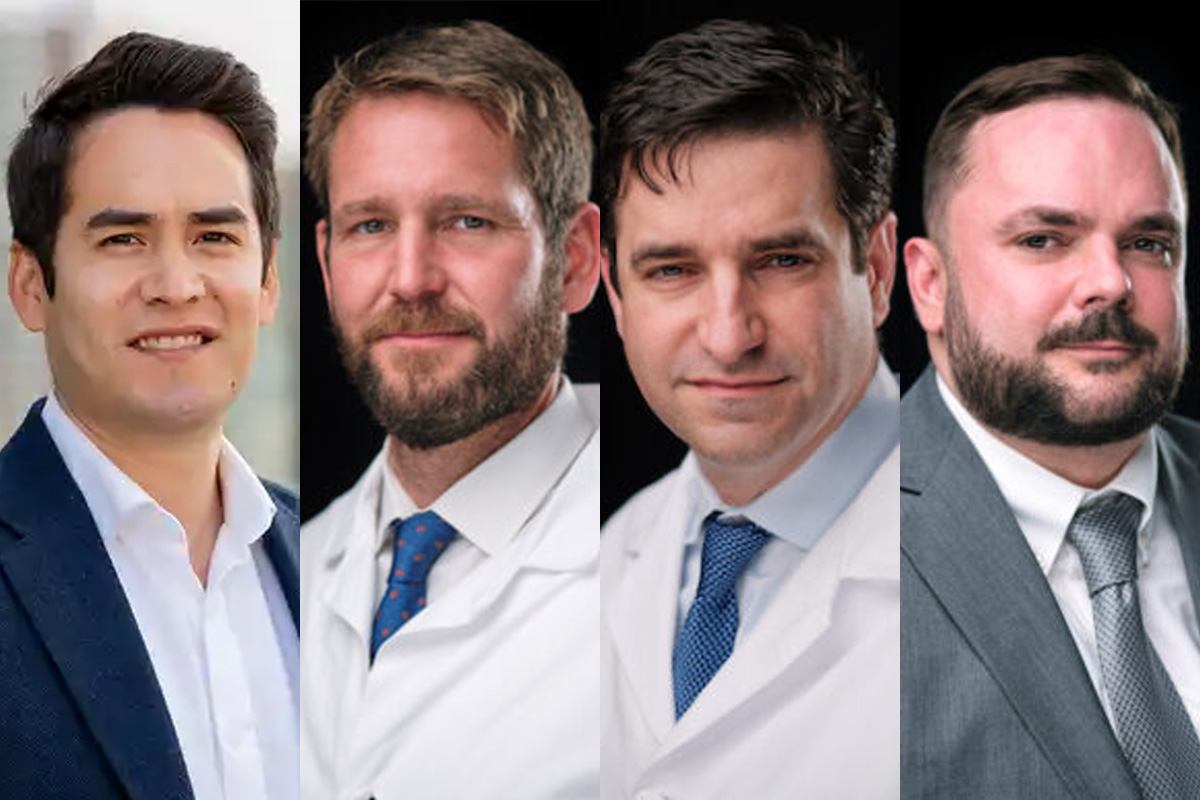
Collaborators include Wilson Z. Ray, MD, the Henry G. and Edith R. Schwartz Professor of Neurological Surgery; Eric C. Leuthardt, MD, the Shi Hui Huang Professor of Neurological Surgery; and Peter Brunner, associate professor of neurosurgery, all in the Taylor Family Department of Neurosurgery at WashU Medicine and affiliate faculty members in the Department of Biomedical Engineering in McKelvey Engineering. Leuthardt has extensive experience translating an EEG-controlled exoskeleton from proof-of-concept to an at-home rehabilitation system, the IpsiHand, that became the first FDA-cleared non-invasive brain-computer interface for stroke rehabilitation.