Clearing the way for renewable carbon fiber production
Joshua Yuan’s lab develops a method to use waste pulp to reduce costs, improve quality of carbon fiber
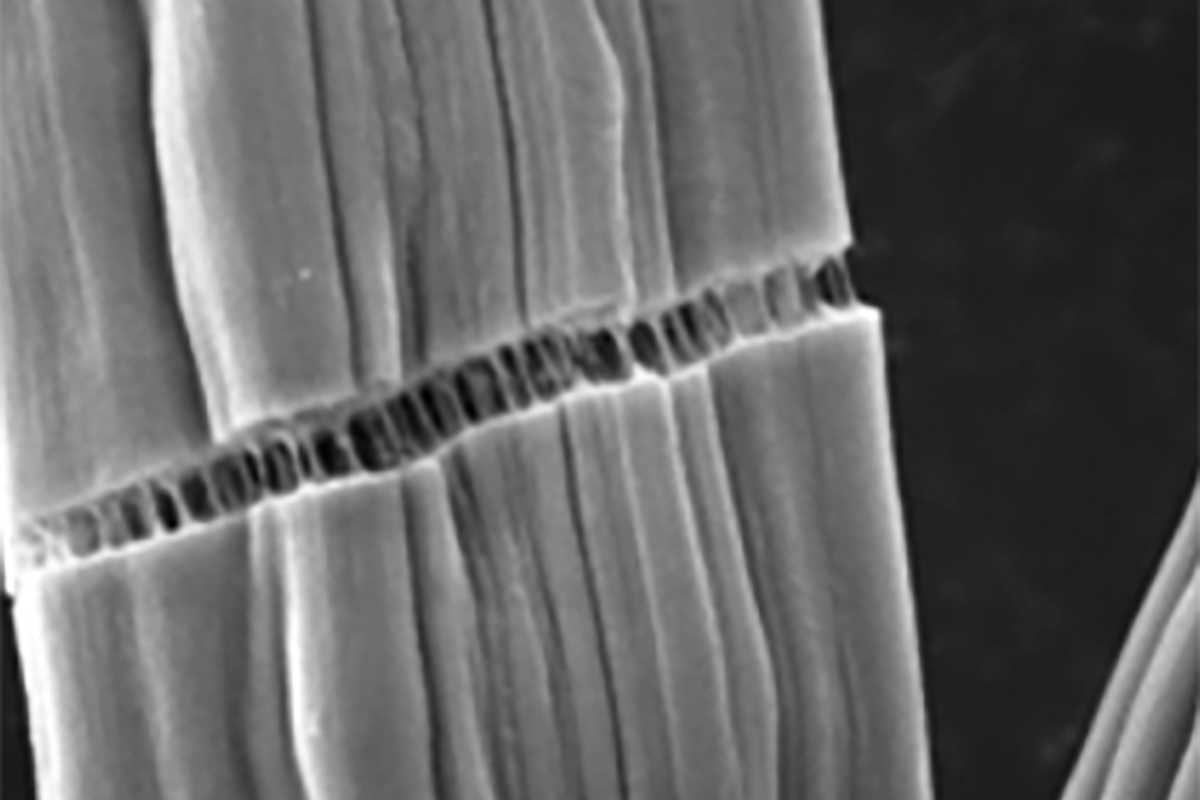
Carbon fiber is a key component in automobile manufacturing, aerospace engineering and energy infrastructure, but it mostly relies on petroleum-derived products, which can be expensive and contribute to carbon emissions. What if carbon fiber was made of a free waste material and could perform as strong or even stronger than the petrochemical-based products? Engineers at Washington University in St. Louis are unveiling that prospect in research recently published in the journal Matter.
“This allows, for the first time, to create renewable carbon fiber that reaches the high standard of quality used in automobile manufacturing,” said Joshua Yuan, chair and the Lucy & Stanley Lopata Professor in energy, environmental & chemical engineering, and director of Carbon Utilization Redesign for Biomanufacturing (CURB) Engineering Research Center at the McKelvey School of Engineering.
Key to the work is making use of a waste material called lignin, the second most abundant natural product or biomaterial on earth, a byproduct of the paper pulping and biorefining industries. Its disposal contributes a substantial environment footprint.
Carbon fiber is traditionally manufactured using synthetic polyacrylonitrile (PAN), a petroleum-derived product used with a wet-spinning industrial process. However, PAN is not cheap, accounting for up to 50% of the total manufacturing cost of carbon fibers, which limits its use to only high-end products, noted Yuan.
With the addition of affordable and abundant lignin to the process, the team cut the use of PAN by half and was able to reduce production costs by 25% and carbon emission substantially. But that fiber still needs to be up to automobile industry standards for tensile strength and elastic modulus, so they developed a new process for manufacturing carbon fiber that greatly improves that performance. That process involves deploying single-walled carbon nanotubes into the polymer matrix, acting almost like rebar in lining up the crystallization chemistry. The innovative process revealed a new design principle for carbon material development.
“Crystallization alignment is critical for carbon fiber quality,” Yuan said.
The carbon nanotubes allowed them to make a precursor solution of the lignin and PAN. That solution was then extruded as fiber for the wet spinning process of production, then further heat-treated to strengthen the product.
Weiwei Li, a postdoctoral scholar in Yuan’s lab and first author of the research, described their research as an innovation in three steps.
The first step was to create that nanotube template that can mix well with lignin and PAN and allows for high crystallization or orientation. Step two involves running that precursor solution through a wet spinning and tension-assisted heat treatment, and lastly, one round of optimized carbonization to fully strengthen the fiber. The three steps synergistically maximize the mechanical properties of the resulting carbon fibers.
“All these together allow us to create lignin-based renewable carbon fiber that has highly aligned crystalline structure,” Yuan said.
The automobile industry is just the entry point for markets of optimized carbon fiber, It’s used in many industries from sports equipment to wind turbines.
“Carbon fiber reinforces plastics and has very broad application,” Yuan said.
Li W, Hu C, Zhu T, Chen Y, Zhang R, Jiang P, Dhatt PS, Li J, Xiang S, Liu M, Fei CJ, Liu J, Dai SY, Yuan JS. Transforming renewable carbon fiber performance, economics, and sustainability via oriented crystallization design, Matter, 2026, 103001. DOI: https://doi.org/10.1016/j.matt.2026.103001
This research received support from the Lucy & Stanley Lopata Professorship and U.S. Department of Energy Projects (DE EE 0008250). Further support came from the Institute for Materials Science and Engineering (IMSE) and Chemical and Environmental Analysis Facility (CEAF) at WashU as well as the NSF CURB Engineering Research Center (NSF EEC 2330245).
Click on the topics below for more stories in those areas
Back to NewsFaculty in this story