
Exploring metabolic ‘noise’ opens new paths for biomanufacturing
Fuzhong Zhang’s lab finds source of metabolic fluctuations that can jam bioproduction
Much like humans, microbial organisms can be fickle in their productivity. One moment they’re cranking out useful chemicals in vast fermentation tanks, metabolizing feed to make products like pharmaceuticals, supplements, biodegradable plastics, or fuels, and the next, they inexplicably go on strike.
Not so inexplicable anymore, as engineers at Washington University in St. Louis have found the source of the fluctuating metabolic activity in micro-organisms and developed tools to keep every microbial cell to in their peak productivity during biomanufacturing.
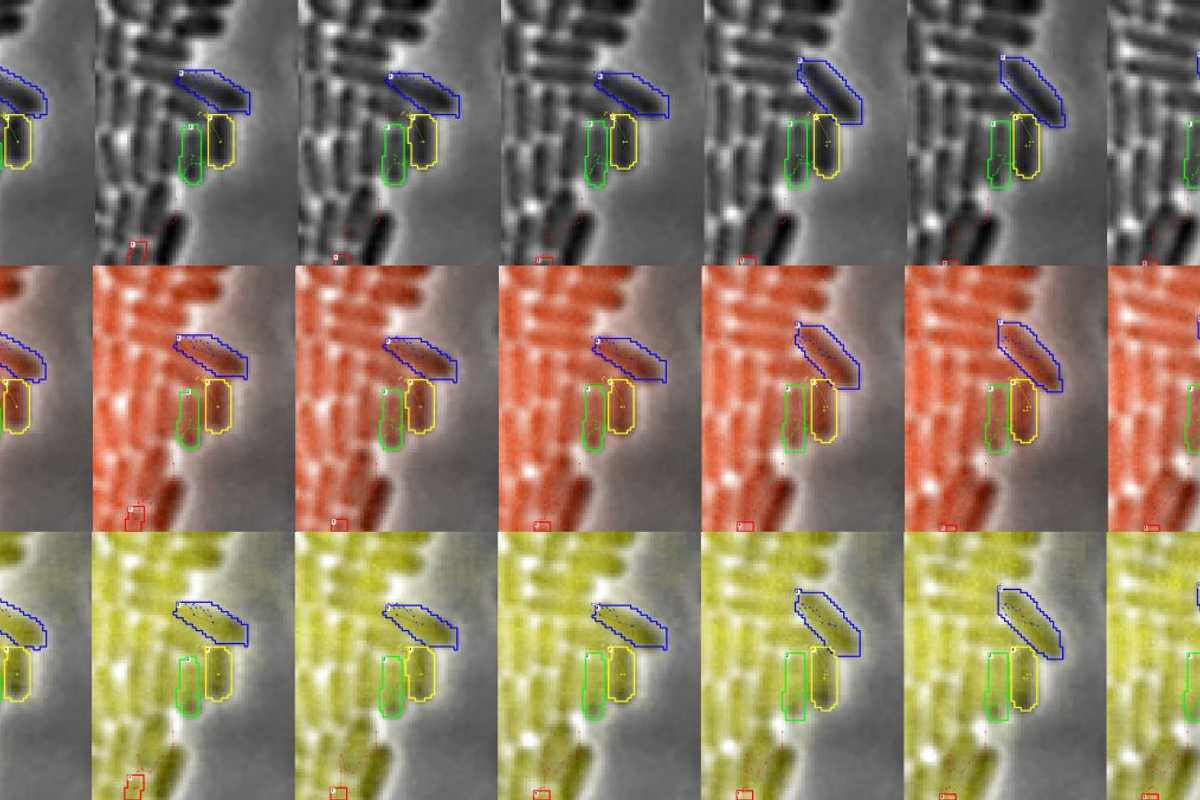
The work, now published in Nature Communications, tracks hundreds of E. coli cells as they produce a yellow food pigment — betaxanthin — while growing, dividing and carrying out normal metabolic activities.
“Like the behavior of a person, sometimes microbes are motivated to work hard, but they ‘get tired’ much more quickly and easily,” said Fuzhong Zhang, Francis F. Ahmann Professor in the Department of Energy, Environmental & Chemical Engineering (EECE) and co-director of the Synthetic biology Manufacturing of Advanced materials Research Center (SMARC). Zhang is the corresponding author of the research, along with PhD students Xinyue Mu and Alexander Schmitz.
Bioengineers and biologists have long observed large cell-to-cell variations in microbial metabolism, often called “metabolic noise” or more generally “cellular noise.” However, it remained unclear what causes these differences and how frequently highly productive cells switch to low-productivity states. This lack of understanding has limited engineers’ ability to develop effective strategies to enrich hardworking high-producing cells for biomanufacturing.
Answers to these questions lie in the fluctuating behavior of single cells, which is extremely challenging to study. Researchers must be able to measure a low-abundant metabolite along with the enzyme that produces it inside a tiny single cell while that cell grows and divides. To address this challenge, the team built microfluidic devices and engineered E. coli to produce a unique, bright-yellow metabolite — betaxanthin — what can be easily distinguished from thousands of other cellular metabolites.
These new advances allowed them to discover that betaxanthin production fluctuates very rapidly, with cells switching from high production to low production states within just a few hours. Approximately 50% of this betaxanthin noise comes from the fluctuations in the enzyme responsible for producing betaxanthin, which arise from natural randomness (stochasticity) in gene expression. Fluctuations in cell growth rate account for less than 10% of the betaxanthin variability.
Using experimental data, the team developed computational models to test four different control strategies to ramp up bioproduction. The models showed that enriching cells that stochastically overproduce the enzyme leads to substantial increases in betaxanthin production. The team later confirmed this prediction in fermentation experiments.
“We create a gene circuit that allows cells with higher stochastic enzyme expression to grow faster,” Zhang said. “These cells also become high betaxanthin producers, giving us more product overall.”
The work is part of ongoing efforts in McKelvey EECE to develop new biomanufacturing capabilities in support of a zero-waste circular economy. This includes the challenging task of keeping microbial “workers” focused on making renewable products.
Mu X, Schmitz AC, Ding Z, Li Wei, Singh A, Zhang F. Exploring Single-Cell Biosynthetic Noise and Dynamics for Enhanced Betaxanthin Production in Escherichia coli. Nat Commun 2025 Dec 21. DOI: 10.1038/s41467-025-67733-1
This work was supported by the National Institute of General Medical Sciences of the National Institutes of Health under award number R35GM133797 (F.Z.), the Bioenergy Technologies Office (BETO) of U.S. Department of Energy under award number DE-EE0010301 (F.Z.), and the Defense Advanced Research Projects Agency under award number HR0011-25-9-0055 (F.Z.).
Click on the topics below for more stories in those areas
Back to NewsFaculty in this story