Four McKelvey Engineering graduate students selected for Olin-Chancellor’s Fellowships
Program recognizes students’ exceptional academic and research accomplishments in their first year at WashU
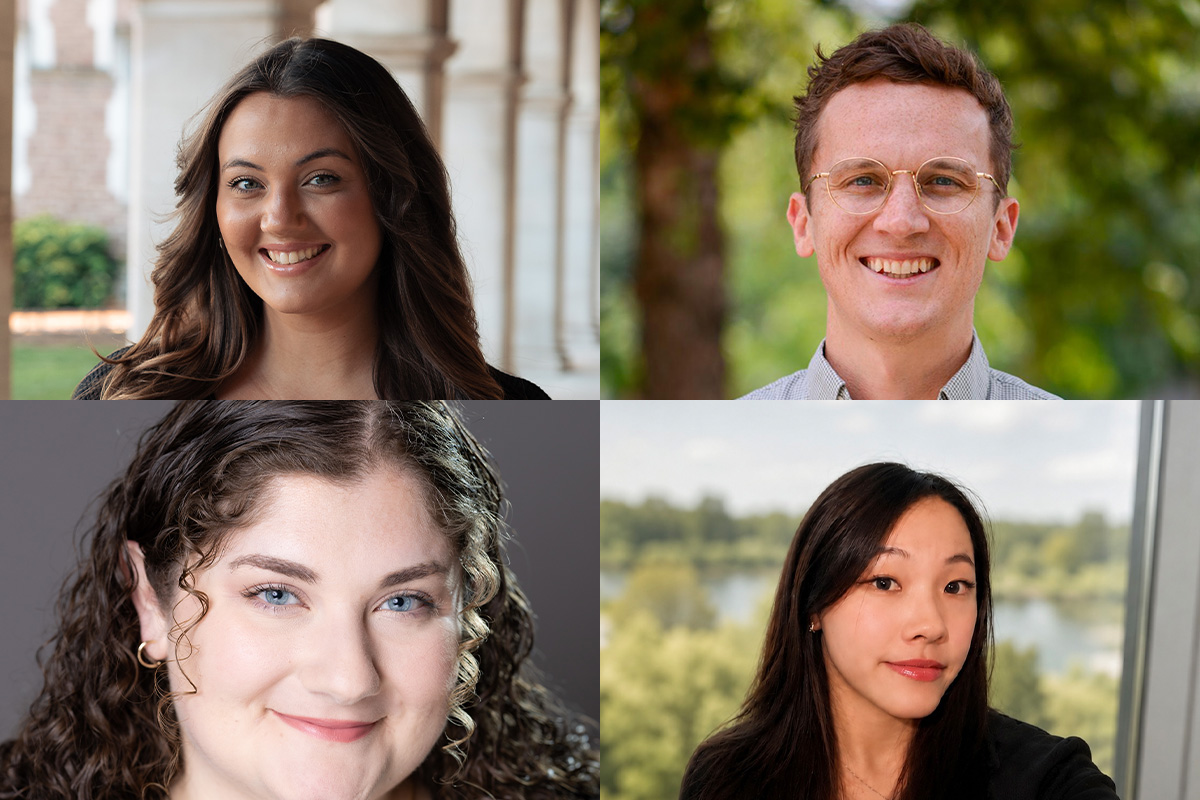
Elizabeth Buzbee, Nick Schimp, Claire Throckmorton and Yanrun Zhou, graduate students in the McKelvey School of Engineering at Washington University in St. Louis, have been selected for the Olin-Chancellor’s Fellowship (OCF).
The prestigious fellowship, awarded annually, recognizes the students’ exceptional academic and research accomplishments in their first year at WashU. The program empowers future scholars and leaders who will contribute to advancing knowledge and addressing challenges in a global society through innovation, integrity and intellectual endeavors.
A highly selective group of rising second-year PhD students across WashU were identified through a rigorous nomination process for OCF consideration. Each of the fellows has demonstrated exceptional academic achievement, research excellence and leadership potential.
In addition to a competitive award package, fellows receive professional development opportunities as well as access to unique resources, networking, programming and mentorship.
The following McKelvey students have been invited to join the OCF program.
Elizabeth Buzbee, Department of Biomedical Engineering
As a graduate student in the lab of Christine O’Brien, Buzbee focuses on optical solutions to global women’s health challenges. Her project specifically focuses on assessing the physical properties of cervical mucus, with the long-term goal of connecting these measurements to preterm birth risk assessment.
Buzbee built a laser speckle rheometer, which uses light to measure the mechanical properties of a material. Cervical mucus changes throughout the menstrual cycle in response to hormonal changes, becoming more liquid-like around ovulation and more rigid during other phases. The more liquid-like mucus is also more permeable. The lab hypothesizes that, in pregnancies at increased risk for preterm birth, cervical mucus may more closely resemble the mucus observed during ovulation, potentially increasing its permeability and allowing pathogens to enter the uterus and contribute to premature delivery.
Buzbee and her colleagues in O’Brien’s lab have built the system and tested it using synthetic mucus and are now preparing to recruit nonpregnant participants to track changes in their cervical mucus properties throughout the menstrual cycle.
Nick Schimp, The Institute of Materials Science & Engineering
As a doctoral student in the lab of Francisco Lagunas Vargas, Schimp’s research focuses on using atomic-resolution scanning transmission electron microscopy to characterize materials. Schimp is interested in developing in situ methods to watch how atomic structures behave under different conditions and understanding how to use these behaviors to design next-generation materials.
Claire Throckmorton, Department of Energy, Environmental & Chemical Engineering
As a doctoral student in the lab of Young-Shin Jun, professor of energy, environmental & chemical engineering, Throckmorton's research focuses on addressing energy and environmental challenges by examining the fundamental interfacial interactions that occur during resource recovery of critical minerals from unconventional sources. Her work examines the nucleation of critical minerals from subsurface brines and clays, as well as how interfacial reactions may affect subsurface environments to advance our understanding of the role that these can play in securing domestic sources of these materials. She employs a unique combination of advanced surface-sensitive techniques and state-of -the-art synchrotron-based X-ray techniques at Argonne National Laboratory in her research to enhance nanoscale understanding.
Yanrun Zhou, Department of Biomedical Engineering
As a doctoral student in the lab of Yifan Dai, assistant professor of biomedical engineering, Zhou’s research focuses on understanding how biomolecular condensates organize and regulate cellular processes. These dynamic, membrane-free structures bring specific molecules together within cells and can influence how biological signals are coordinated and controlled. By integrating approaches from molecular and cellular biology, biophysics and engineering, Zhou aims to uncover how the formation and behavior of biomolecular condensates affect cellular function. A better understanding of these processes could provide new insights into how disruptions in cellular organization contribute to disease and potentially inform future strategies for therapeutic intervention.
Click on the topics below for more stories in those areas
- Graduate Students
- The Institute of Materials Science & Engineering
- Biomedical Engineering
- Energy, Environmental & Chemical Engineering