
Listening for cells: New sensor detects and classifies freely flowing particles without labels
Lan Yang’s lab develops new sensing technique to detect nanoparticles
Finding a single cancer cell in a tube of blood is a bit like finding a needle in a haystack. As researchers seek to detect ever smaller and rarer targets, from viruses to circulating tumor cells blood, the demand for ultra‑sensitive, robust sensors that are both highly sensitive and practical for real-world samples continues to grow.
A major challenge is doing this without adding fluorescent tags or other labels. Most label‑free optical sensors work only when the targets pass extremely close to or binding to a tiny sensing area on the device. At low concentrations, many particles never hit that spot, and even when they do, their signals can be drowned out by background noise, limiting detection efficiency and making rare targets especially difficult to find.
This limitation is shared by many optical microsensors, including whispering‑gallery‑mode (WGM) resonators, among the most sensitive optical sensors ever developed. These devices can detect individual nanoparticles and molecules with exceptional precision, but their sensing region is typically confined to a very small area close to the sensor surface.
“Over the past two decades, whispering-gallery-mode-based sensors have demonstrated exceptional capability to detect extremely weak signals across a wide range of sensing applications” said Lan Yang, the Edwin H. & Florence G. Skinner Professor in Preston M. Green Department of Electrical & Systems Engineering in the McKelvey School of Engineering at Washington University in St. Louis. “Conventional approaches have largely relied on interactions occurring very close to the sensor surface. We wanted to unlock new capabilities for this sensing platform by extending its sensing range beyond the immediate surface, while preserving the exceptional sensitivity that has made these sensors so powerful. This can potentially open entirely new sensing modalities and applications.”
Many applications require sensors that are both extremely sensitive and capable of monitoring a larger volume of samples, without delicate alignment or complex preparation. In a study published in Light Science & Application, a team led by Yang reports a new strategy that closes this gap by enabling the detection of particles beyond the immediate surface of the sensors. Rather than waiting for particles to pass close to or bind to the sensor, the team taught WGM resonators to “listen” for particles as they flow through. The project combined expertise in optical sensing and artificial intelligence, with collaborators from the lab of Chenyang Lu, the Fullgraf Professor and director of the AI for Health Institute at WashU, helping to develop machine-learning approaches for signal classification.
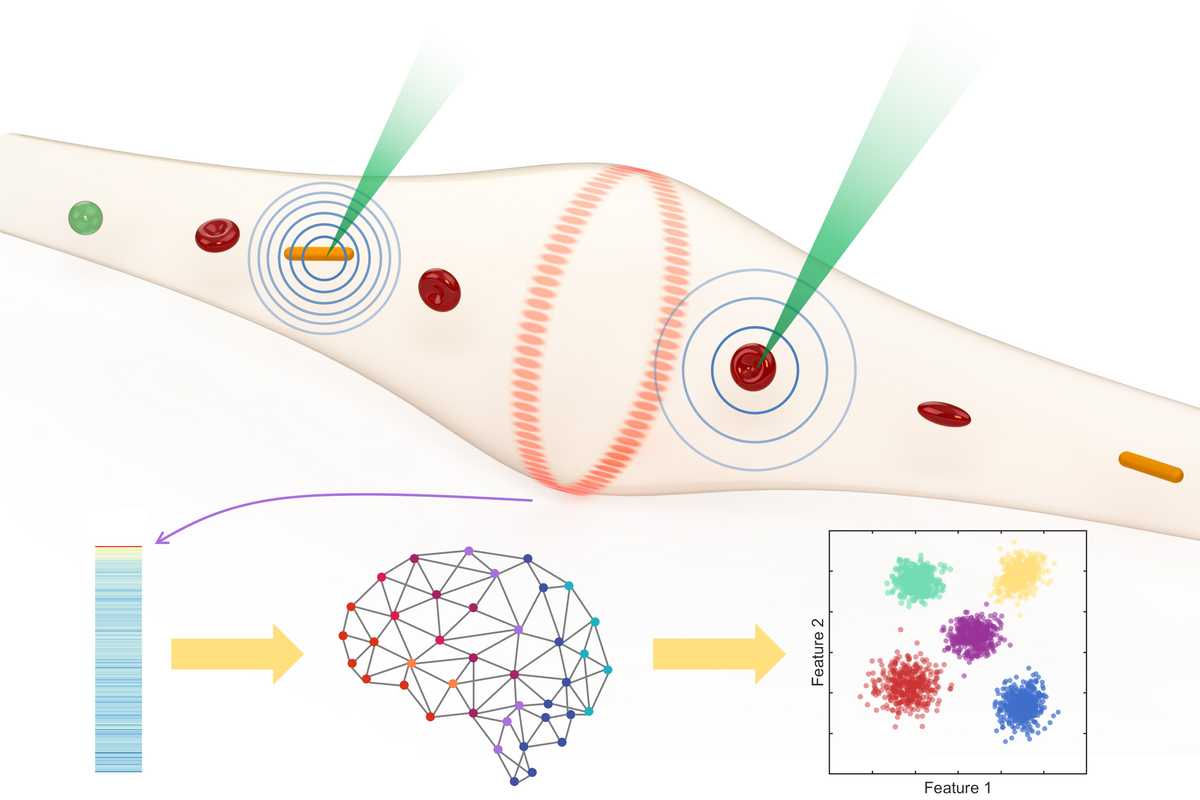
Instead of relying on particles to bind to the sensor surface, the researchers combine light and sound through a process known as photoacoustics. When a freely flowing particle is struck by a short laser pulse, it absorbs the light, heats up and rapidly expands. This expansion generates an acoustic wave, a tiny “whisper” that carries information that carries information about its properties such as size, shape and composition. These sound waves travel through the sample and then detected by the optical WGM resonator sensor, which converts these tiny acoustic vibrations into measurable optical signals. In this way, the system can detect and characterize particles throughout a much larger sensing region, not just near the sensor surface, without the need for labels.
“What excites me most about this platform is its combination of simplicity and robustness,” said Jie Liao, a postdoctoral research associate and co‑first author of the study. “We don’t need continuous reference measurements or complex background subtraction to keep it stable.”
That robustness comes from the sensor design. The researchers built the device inside a glass capillary through which liquid samples can flow. A section of the capillary is expanded into a microbubble that supports whispering-gallery optical modes. Because the bubble wall was intentionally controlled to ensure the light remains confined within the glass rather than overlapping with the flowing sample. This allows the sensor to detect photoacoustic signals generated by particles in the liquid while maintaining high optical sensitivity.
“Many optical sensors perform well in purified laboratory samples but face challenges when working in complex biological fluids,” Yang said. “By keeping the optical field protected within the microbubble while allowing acoustic signals to travel through the liquid sample to reach the resonator sensor, we were able to preserve sensitivity even in highly complex environments such as whole blood.”
This design enables direct sensing in complex fluids such as whole blood, where strong optical scattering and absorption often challenge conventional optical sensing approaches. The ability to operate in these environments opens new opportunities for real-time monitoring in biomedical, environmental and chemical applications.
“Many sensing methods require samples to be labeled, captured or otherwise modified before analysis,” said Dipayon Kumar Sikder, a doctoral student in Yang’s lab and a contributing author on the study. “Our approach allows particles to be analyzed directly in their native environment as they flow through the system.”
The implications are particularly significant for medical diagnostics, Yang said. Detecting rare targets such as circulating tumor cells remains a major challenge, particularly in complex biological fluids. When only a handful of target cells may be present in a sample, approaches that rely on those cells binding to a tiny sensing region to be detected can face significant practical limitations.
“In a blood sample, how do you guarantee that tumor cells will bind to the sensor when their concentration is extremely low, especially during the early stages of disease?” Yang asked. “That question motivated us to develop a sensing approach that does not require direct contact between the target and the sensor.”
Co‑first author Maxwell Adolphson, who earned a doctorate in electrical engineering from McKelvey Engineering in 2024, explains, “The new platform tackles these challenges through a carefully designed sensing architecture. By extending the sensing range and increasing throughput, the system can detect rare events in complex fluids without requiring surface functionalization or elaborate sample preparation.”
To demonstrate the technology’s capabilities, the researchers analyzed whole blood samples from five different animal species. Although blood cells can be readily detected, the differences among species are often subtle and difficult to discern from the complex spectral signatures generated by the sensor. To uncover these hidden patterns, Yang’s group collaborated with Hangyue Li, a doctoral student in computer science & engineering in Lu’s lab
“Many biologically important signals are buried within complex, noisy spectrum data and can be difficult to detect using conventional analysis methods,” Lu. Said. “By combining this novel sensing technology with advanced machine learning, we can uncover subtle patterns that would otherwise remain hidden, enabling more accurate identification and classification of cells. This work highlights the powerful synergy between AI and next-generation optical sensing technologies for advancing biomedical discovery.”
This work demonstrates a new approach to optical sensing that is rapid, robust and capable of high-throughput, label-free analysis in complex, real-world samples, Yang said. By combining photoacoustics, optofluidics and artificial intelligence, the platform extends ultra-sensitive optical sensing beyond the immediate surface of the sensor and into a much larger sample volume. The ability to directly analyze freely flowing particles and cells in their native environment opens new opportunities for applications ranging from early disease detection and point-of-care testing to environmental monitoring and bioanalysis.
Minerva Pappu contributed to this story.
Liao J, Adolphson M, Li H, Sikder DK, Lu C, Yang L. Whispering-gallery-mode resonators for detection and classification of free-flowing nanoparticles and cells through photoacoustic signatures, Light: Science & Applications, 14, 397 (2025). https://doi.org/10.1038/s41377-025-01978-9
This project was supported in part by the Chan Zuckerberg Initiative (CZI) and the AI for Health Institute (AIHealth) at Washington University in St. Louis.
Click on the topics below for more stories in those areas
Back to NewsFaculty in this story