Locusts get a sensory assist from nanomaterials
Hybrid tool combines advantages of synthetic chemical sensors with insect olfactory power
Scientists have long explored the idea of using insects as our agents in the field for places where humans won’t fit or survive. Imagine a cockroach in an earthquake zone, able to skitter into the rubble to map out exactly where human chemical signatures can be found; or a grasshopper leaping through a minefield can potentially bring back a map of the bombs based on the vapors it encountered. Recent research from Washington University in St. Louis brings this sci-fi concept one step closer to reality.
“We marry the best biology has to offer with engineering principles to create a superior sensing system,” said Barani Raman, the Dennis & Barbara Kessler Professor in the Department of Biomedical Engineering at the McKelvey School of Engineering at WashU.
Raman and his colleague Srikanth Singamaneni, the Lilyan & E. Lisle Hughes Professor in the Department of Mechanical Engineering & Materials Science, are senior authors of research now published in the journal Advanced Materials that outlines a hybrid chemical sensing system that can combine the best of biological organisms’ sensing capabilities with nanomaterials that allow sample collection for secondary verification and to boost overall sensing performance.
Both biological and artificial chemical sensing systems have different drawbacks, noted Singamaneni. An organism like a locust has a natural olfactory circuit that is already ultrasensitive to subtle odorants that guide its behavior. But even with 50,000 olfactory receptor neurons (ORN) in each antenna, it has its limits in identifying a wide enough range of chemical compounds. Meanwhile, synthetic sensors still underperform compared to more nimble living creatures but can be very accurate in detecting certain compounds and their precise recognition if in the right circumstances. Why not combine the two?
“Both biological and artificial chemical sensing approaches have their strengths and drawbacks,” said Singamaneni, but if they integrate both systems, “you can cast a broader net.” That means interfacing the locusts’ highly sensitive antennae with a boost —“ultralight, highly porous, three-dimensional surface-enhanced Raman scattering (SERS) substrate.”
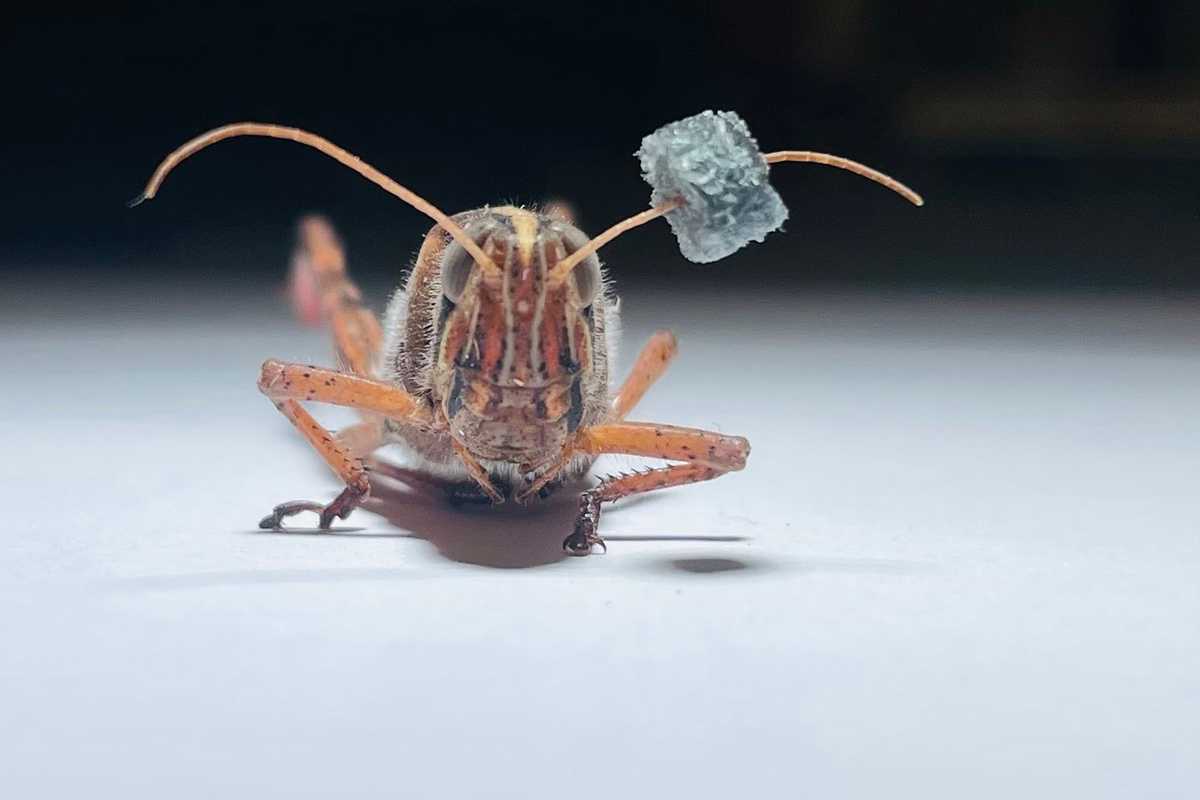
Think of it as adding a spectroscopy Snuggie on top of the insect antennae in the form of “SERS-active plasmonic foam.”
Surface-enhanced Raman scattering is an analytical technique that amplifies signals from molecules on or near nanostructure metal surfaces; it’s especially useful for picking up trace chemical signatures. In this case, the substrate was a type of collagen foam applied to the antennae or wings. This plasmonic foam augmented the insect’s odor-detecting skills while not interfering with its other functions.
Singamaneni’s lab specializes in designing and synthesizing these types of nanomaterials; he’s been working with “plasmonic nanostructures” as long as Raman has been mapping the locust sensory circuits. Now they have melded their research together, and it paid off. Locusts equipped with the foam outperformed non-SERS locusts and the synthetic chemical sensors alone, improving odor-detection performance across all chemicals tested, including odorants like the chemical signature for TNT.
They ran their hybrid systems through a variety of tests, and they were effective at detecting a wider range of smells without interfering with the insect’s normal functions.
Raman noted that a key challenge in chemical sensing issues was that they often don’t know what molecules they’re targeting. The plasmonic foam attached to the antenna allows for precise identification of chemical species, he noted. The biology and the chemical sensing part complement each other.
“It clearly showed the best of the two worlds can be merged,” he said.
A.Debnath, P. Gupta, R. Gupta, et al. “ Plasmonic Foam-Enabled Dual-Modal Biohybrid Chemical Sensor.” Advanced Materials (2026): e75082. https://doi.org/10.1002/adma.75082
Research supported by the Air Force Office of Scientific Research (FA95502310461) and the National Science Foundation (CSE-2319060, CBET-2331330).