McKelvey Engineering students travel to England for EECE International Experience
Program includes two-week trip, fall semester elective
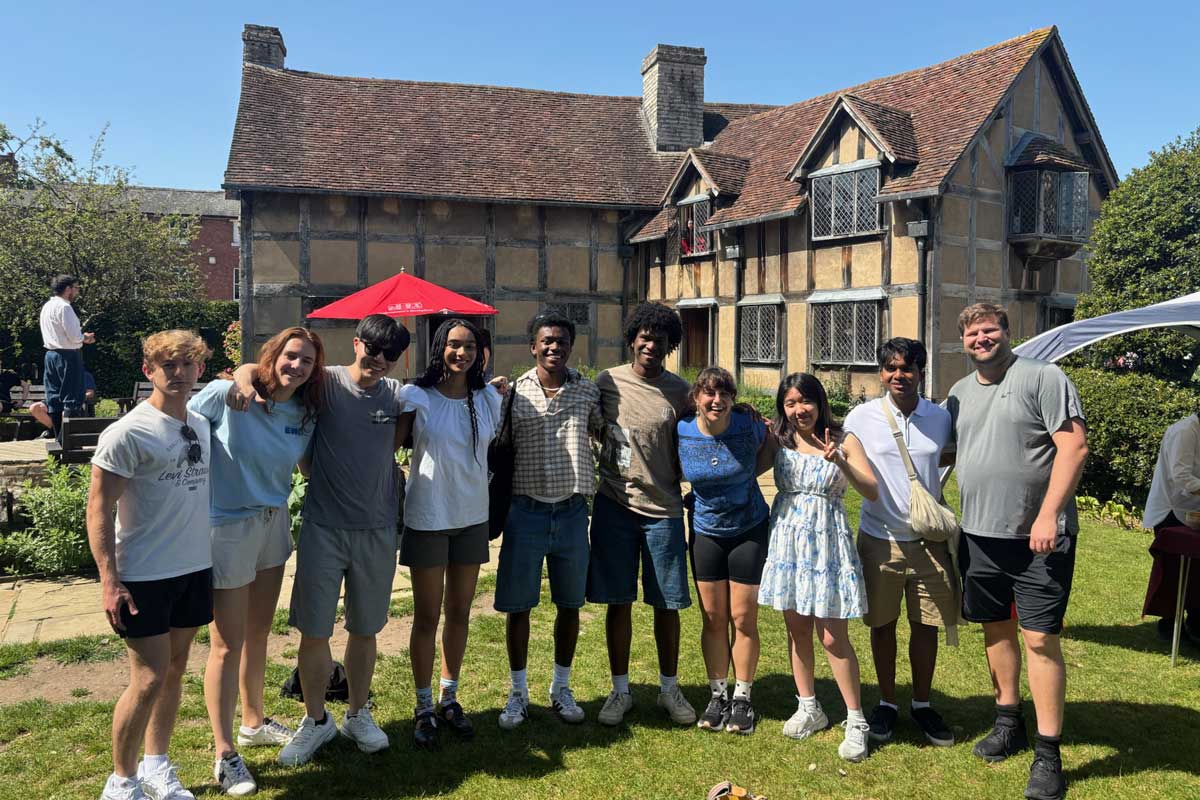
Ten McKelvey School of Engineering students recently traveled to the University of Warwick in Coventry, England, to participate in the International Experience program coordinated by the Department of Energy, Environmental and Chemical Engineering (EECE).
EECE launched the program in 2007 to enhance and enrich the experience of undergraduate students and to provide a focused international experience to study issues related to energy and the environment in a global context while developing teamwork and leadership skills.
Each summer, a group of McKelvey undergraduate students participates in a two-week visit to an international university that partners with the McDonnell International Scholars Academy. They then register for the elective course (EECE 4993) the following semester, when they will engage in project discussions, presentations and report writing.
This year’s trip was coordinated by Ray Ehrhard, senior lecturer in EECE, along with Kurt Russell, lecturer in EECE, and Vijay Ramani, the vice provost for graduate education and international affairs and the Roma B. & Raymond H. Wittcoff Distinguished University Professor. The experience included research lab tours, academic lecture, and local industry tours in biotechnology, petrochemical and environmental engineering science. Additionally, the students enjoyed meeting with alumni and various cultural experiences in London.
Below, Victoria Lisson, a dual-degree student in biomedical engineering and engineering management, and Kash Tanguturi, a junior majoring in finance and computer science, describe their experience.
Victoria Lisson:
When I first arrived at the University of Warwick, I expected to learn about engineering. I did not expect the experience to completely change the way I think about innovation, collaboration and my own future as an engineer. Over two weeks, I had the opportunity to explore world-class research facilities, visit global companies, meet researchers and industry leaders, and experience British culture in a way that would not have been possible inside a classroom. Every single day introduced us to a completely different area of engineering, and by the end of the program I realized that engineering is much bigger than solving technical problems. It is about working across disciplines, learning from different perspectives and creating solutions that improve people's lives.
One of my favorite parts of the program was seeing how connected different fields of engineering really are. Throughout the trip, we explored advanced manufacturing, autonomous vehicles, robotics, AI, battery technologies, composites, polymers, steel research, medical imaging, microscopy and sustainable energy systems. As a biomedical engineering student, I found it especially exciting to see how engineering, chemistry, biology, software and data science all come together in real-world research. Visiting Warwick Medical School and learning about the open-source microscope project was one of the highlights of the trip. Creating 3D fluorescence images of dividing cells and seeing how researchers use advanced imaging to better understand biology reminded me why I chose biomedical engineering in the first place.
Another experience that really stood out was visiting Warwick Manufacturing Group (WMG) Before this trip, I knew WMG had an excellent reputation, but seeing the facilities in person was incredible. We learned about battery manufacturing and recycling, automation systems, digital twins, smart factories, composite materials, additive manufacturing and autonomous vehicle testing. One moment I will never forget was using the driving simulator inside the Safe Autonomy Research Group and seeing how engineers safely test autonomous vehicles before they ever reach public roads. It showed me that innovation is not only about creating new technology but also about making sure it is safe, reliable and ready to improve everyday life.
I also really enjoyed the hands-on experiences. At the Engineering Build Space, my team designed a maze game using CAD before bringing it to life with 3D printing. Seeing an idea become a physical product in just a few hours was incredibly rewarding and reminded me why I enjoy engineering so much. Visiting Jaguar Land Rover and the Coventry Transport Museum also gave me a new appreciation for how engineering evolves over time. It was fascinating to see the connection between historical innovation and today's advanced manufacturing technologies while realizing how much creativity, testing and collaboration go into every design.
Beyond the technical visits, this program helped me grow personally. Spending two weeks with students from different engineering backgrounds showed me how much we can learn from one another. Everyone approached problems differently, and every conversation gave me a new perspective.
One of my favorite experiences was attending the alumni reception in London. Speaking with WashU graduates working in different industries helped me better understand the many career paths available after graduation. Their advice about leadership, networking and taking advantage of international opportunities was incredibly valuable and inspiring.
My time in in the UK also allowed me to experience a different culture while building friendships that I know will last long after this program. Exploring Warwick, Coventry and London made the experience even more memorable, but what I will remember most are the people I met along the way. Whether it was talking with professors, researchers, industry professionals, alumni or my classmates, every interaction reinforced how collaborative engineering truly is.
This experience strengthened my passion for engineering and confirmed that I want to continue working at the intersection of technology, innovation and healthcare. As someone who hopes to combine biomedical engineering with engineering management and eventually work to solve complex global challenges, this program gave me a much broader perspective of what is possible. I returned to WashU with new knowledge, greater confidence, meaningful professional connections and even more motivation to keep learning. Looking back, the EECE International Experience was much more than a study abroad program. It was an experience that challenged me, inspired me and reminded me why I chose engineering in the first place. It is something I will carry with me throughout the rest of my career.
Kash Tanguturi:
One picture that I just couldn’t get out of my head throughout the entire trip — taken the first day — was a fossilized skeleton of a dodo with a clear mark of a bullet hole made visible through a CT scanner, which was pointed out by one of the researchers. The point was that nothing about this hole was visible to the naked eye, which I feel is truly a metaphor for how I learned through this program: by learning what was hiding just beneath the surface of what we were technically there to see.
Our first few days were spent at the Warwick Manufacturing Group. It took us only one day to completely change the way we understand "engineering.” From driving a simulated vehicle inside a Faraday cage and exploring how to spoof the GPS signal and simulate its responses to a vehicle, to learning about 3D scanning and getting 300 precise measurements done from a part in less than five seconds, I stopped being surprised after spending the whole afternoon in a student racing garage where undergraduates assemble a self-propelled submarine diving 30 feet below, along with an autonomous car analyzing its surroundings and adjusting accordingly.
The next day, we went to the Interactive Engineering Build Space, which was one of the highlights of the entire trip. In less than a day, I learned how to design a maze in CAD and had it printed out by the end of the day, while Amira performed an injection molding for the first time, and others learned how to solder together an electronic die as a part of a team.
Chemistry opened my eyes on the subject in ways I would not expect before, especially as someone who has never taken an organic chemistry class. We performed infrared spectroscopy to identify various recyclable materials based on their functional groups, used NMR machines to identify various liquids based on their hydrogen environments and used X-ray diffraction to classify a sugar compound under a microscope. I expected to be completely lost during the whole session. Instead, I wondered why the other parts of chemistry cannot be taught this way, by using hands-on machines and watching data turning into comprehensible information.
Industrial visits allowed me to learn how things work beyond theory. At GE Vernova, with a hard hat and borrowed boots, I heard from the very people responsible for the strategy of this global energy company how to approach the process of decarbonization of the power grid. At Jaguar Land Rover, I was standing a few feet away from a technician fixing and rewiring an old classic Land Rover to work as well as it did when it was first released. Twenty minutes later, I watched the newest Defenders roll down a live production line, prototypes that will never be released being placed right next to it. Learning about restoration and mass production in the same building is something that is impossible to replicate in a lecture slide.
The trip had its own rhythm even outside the labs and factory floors. We got hopelessly lost looking for every sculpture around Warwick's campus. We saw a humanoid robot dancing and, a few minutes later, got to understand how it works it from the backend side. We got stuck in the middle of a river in Stratford-upon-Avon while trying to punt a boat carrying my classmates and managed to get to the shore without making anybody fall into the water. We visited the house where Shakespeare grew up and, several days later, wandered around Oxford accompanied by a tour guide who would have gladly continued talking about that campus for another six hours. Not all of it was engineering-related, but all of it mattered anyway.
If I had to choose one evening of the entire trip, it would be the alumni reception at The Shard. I talked to people who graduated two years ago and those who built entire companies since leaving WashU decades ago. And right in the middle of that room, I stopped thinking about "after graduation" as a vague, distant thing and saw some tangible paths towards it instead. Some of them I am still in touch with.
A special thanks goes to Ray, Kurt and Vijay for organizing this trip and for making sure that it was not just complete, but great in all aspects.