

New platform explored to meet emerging need in mechanobiology
Alexandra Rutz’s lab works with conducting polymers to change stiffness
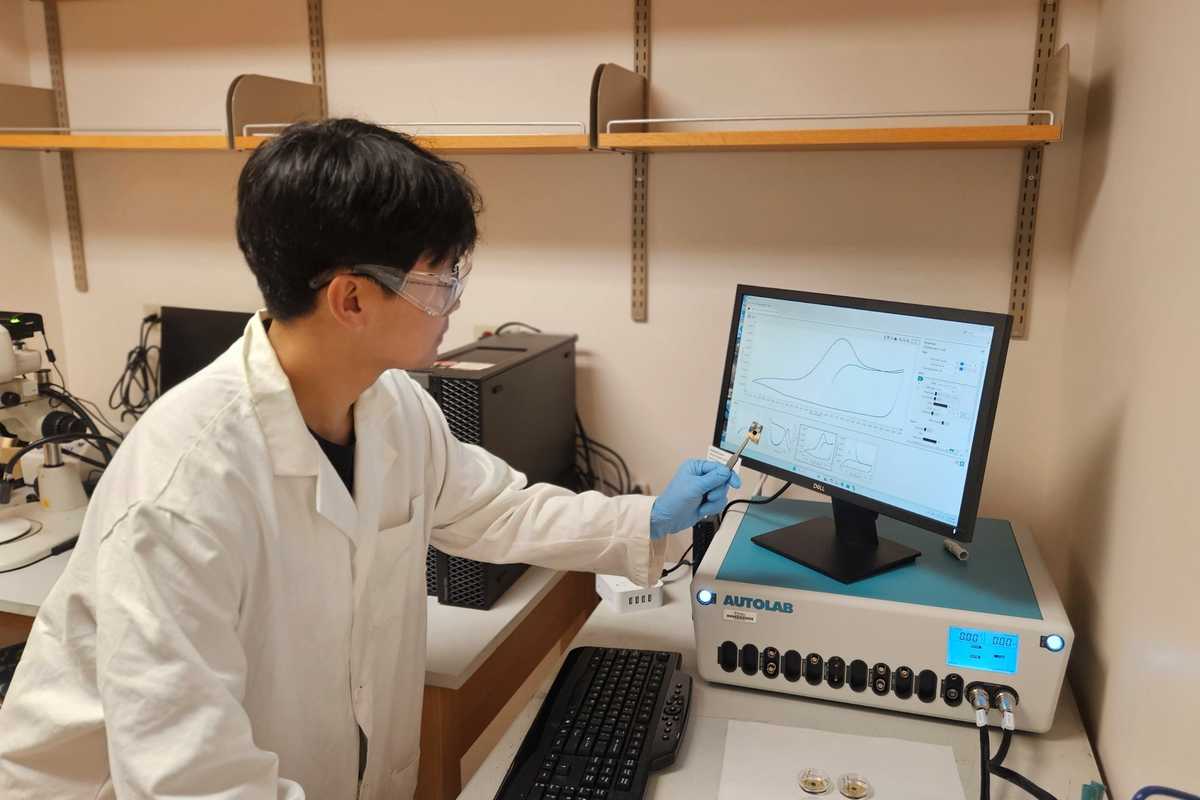
Because living systems are dynamic, biomaterials should be dynamic in their mechanics, such as stiffness, as well. The bioelectronic conducting material PEDOT:PSS is often used in electronics and biomedical applications. The material is capable of changing stiffness in response to applied voltage, but that hasn’t yet been rigorously studied — until now.
Jae Park, a doctoral student in the lab of Alexandra Rutz, assistant professor of biomedical engineering in the McKelvey School of Engineering at Washington University in St. Louis, has developed a unique, dynamic platform with electricity-conducting biomaterials in which stiffness can be modulated by applying voltage. Such a platform can help researchers learn more about the potential to use conducting polymers to study mechanobiology and to study the effect of stiff environments on cells, which play a role in fibrosis and some types of cancer.
Results of the research were published in Advanced Functional Materials June 1, 2026.
In past research, Rutz’s lab has shown it can make PEDOT:PSS very soft with tissue-like stiffness, as well as 3D. The new research stems from Rutz’s National Science Foundation CAREER Award research, in which Rutz and her team are using electronically conducting polymers to create 3D bioelectronic scaffolds that change stiffness in response to applied electricity.
“We've shown that this material can be great for cell-material and tissue-material interactions,” Rutz said. “Now, we are looking to use the conducting polymers in a different way to see if they can mechanically stimulate cells.”
Other researchers have studied how stiffness influences cells using static stiffness, Rutz said.
“An emerging need in mechanobiology is to move past static stiffness and have a material to which you can apply different stiffness states to the same cell or tissue because then we can ask different biological questions,” she said. “Do the cells remember if they're put back on a soft substrate after being on a stiff substrate? Do they permanently change? There are a lot of pathologies that result in higher stiffness that change cells, so we need mechanobiology tools to study that.”
Park applied voltage to observe the change in stiffness when the voltage was applied and what happened after the voltage was removed.
“When you apply voltage to these conducting biomaterials, it recruits ions,” Park said. “I thought stiffness would be incrementally and linearly proportional to the ions so we could achieve incremental and multiple stiffness states.”
The maximum stiffness change the team saw upon application of voltage over the tested voltage range was 32.5%, with changes of 6.7% to 10.4% with 0.2-volt increments. After voltage was removed, over a 24-hour period, the PEDOT:PSS materials lost their charge, and the stiffness changed by 2.6% to 15.2%.
“In the future, we can integrate this material with electronics or microelectronics to make high-throughput mechanical biology platforms so we can study various kinds of cells or various kinds of conditions,” Rutz said.
Park and Rutz are inventors on a U.S. patent application that covers stiffness modulation of PEDOT:PSS by voltage. They are working with the university’s Office of Technology Management.
Park J, Liu T, Okafor SS, Goestenkors AP, Semar BA, Montgomery SK, Keene ST, Rutz AL. Characterizing PEDOT: PSS for Electronic Control of Stiffness. Advanced Functional Materials, June 1, 2026. https://doi.org/10.1002/adfm.76262
This research was supported by funding from the National Science Foundation CAREER Award (2443128); the Center for Engineering MechanoBiology (CMMI 15-48571); and the Women’s Health Technologies Collaboration Initiation Grant, Ovarian Cancer Research Innovation Fund Award and McDonnell International Scholars Academy (SSO) from Washington University in St. Louis.