WashU Expert: Scaling up the circular economy
Engineers at Washington University are addressing the challenges to scaling up CO2 electrolysis
Electrolysis can resemble a modern version of alchemy. Start with one compound, run it through an electrochemical process and end up with an entirely different mix of chemicals. One can’t turn straw into gold, but humans have used water electrolysis to generate hydrogen fuel from water broken into its separate parts. Similar processes can be applied to carbon dioxide. After all, the world has an excess carbon, why not turn it into something more useful?
Such is the mission for Lauren and Lee Fixel Distinguished Professor Feng Jiao, researcher in the energy, environmental, chemical engineering department of the McKelvey School of Engineering at WashU. In a recent commentary in Nature Chemical Engineering, Jiao, outlines the steps ahead to bring CO and CO2 electrolysis to the big time.
The challenge ahead: “How we can go from lab-sized device to a scale which is relevant to commercialization,” Jiao said.
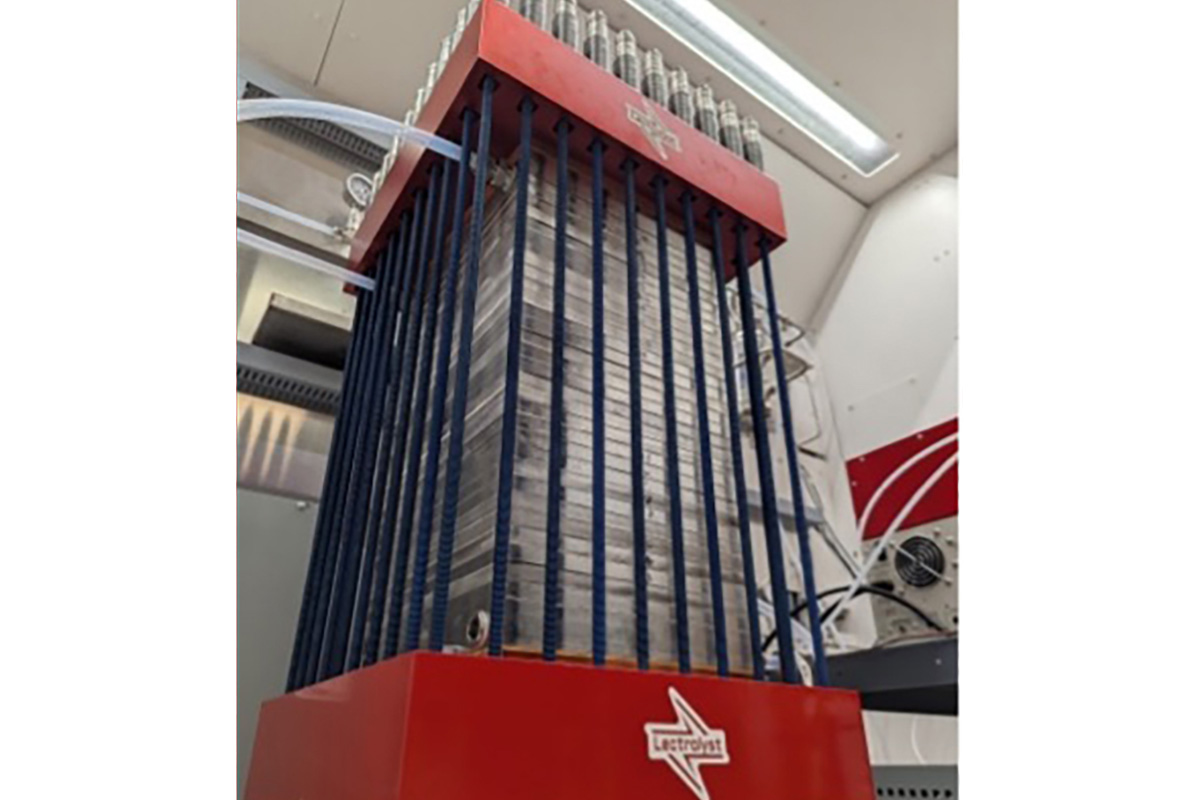
The device that converts carbon waste gas to other materials looks like a stack of hard metallic plates encased in a cage. The top plate serves as the cathode, bottom plate is the anode and in between are layers of separators that tease apart the chemical elements and run the electrochemistry that changes its component parts into platform chemicals such as carbon monoxide, formate/formic acid, methanol, ethylene and acetate/acetic acid. These products can be used in manufacturing to create food, fuel, intermediary chemicals, new synthetic materials that can all be fed back into the same manufacturing system or broken down into harmless bio components instead of microplastics.
“It’s a device for chemical transformation, chemical manufacturing,” he said.
Going big
Jiao has learned more as he has co-founded an electrolysis startup, Lectrolyst, that includes his co-authors Gregory Hutchings and Bradie Crandall.
As they looked into the challenge of commercialization, they’ve identified key obstacles in the research. One, the issue finding the goldilocks zone for compression. Too much compression in the stack and it damages the components, but if they don’t compress enough, there could be leakage of the gases and chemicals involved.
Along the way they also must manage the temperature of the systems. The bigger it gets, the more challenging it becomes to regulate temperature. Using modeling tools, the team can start to find the best cell configurations, flow patterns and flow rate to find the sweet spot of temperature control. All while keeping costs down.
They want to design the system to make “a high purity and highly concentrated product stream,” but will also “allow us to minimize separation costs.”
Finally, there’s the transport challenge, how the various element flow through the system. Small systems have uniform flow but as they get bigger, it loses that uniformity.
It’s a balancing act, to find an optimized stack to deal with increasing flow and pressure distribution, while also delivering a reaction that doesn’t throw the system out of whack.
There are engineering challenges, but the toughest challenge will be after they sort these kinks. The United States could quickly be left behind as other countries have invested heavily in this tech. To take it big, requires government and industry support.
“Europe and Asia are ramping up investment in electrolyzer manufacturing and demonstration projects, underscoring that electrolyzer scale-up is now a global race,” wrote the authors. “Commitments to long-term government support is essential for building the investor confidence needed for private fundraising efforts. In addition, ensuring emerging technologies achieve commercial deployment allows a nation to recoup on its initial investment in earlier-stage development.”
Crandall, B.S., Hutchings, G.S. & Jiao, F. Stack-level challenges for CO and CO2 electrolysis. Nat Chem Eng (2026). https://doi.org/10.1038/s44286-026-00378-z
This work was supported by the Gates Foundation (INV-051757). F.J. thanks the National Science Foundation (award numbers 2330245 and 2535871).
Click on the topics below for more stories in those areas
Back to NewsFaculty in this story