WashU researchers use efficient method to split hydrogen from water for energy
Gang Wu leads team that designed new catalyst to extract valuable hydrogen
Using a renewable energy source has multiple benefits, including reducing harmful emissions and dependence on fossil fuels while increasing efficiency. But many of the renewable energy sources have a higher cost than fossil fuels due to the materials needed to make them usable, such as platinum group metals (PGM), and the high cost of storage.
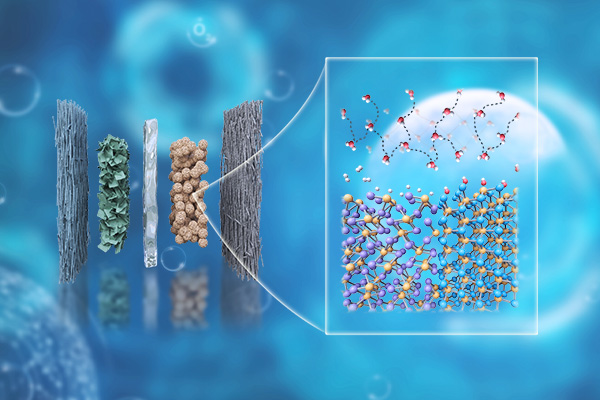
A team of researchers led by Gang Wu, professor of energy, environmental & chemical engineering in the McKelvey School of Engineering at Washington University in St. Louis is working to change that by creating a heterostructure catalyst for an anion-exchange membrane water electrolyzer (AEMWE) that splits water into hydrogen and oxygen using electricity from renewable sources. They created the catalyst with two phosphides that gave them an efficient method to extract hydrogen, a valuable yet low-cost source of zero-emissions fuel.
Wu’s team has been looking for alternatives to catalysts that use expensive platinum group metals. In this research, their idea began with using sunlight, wind or water to create electricity that they could then use in the process to separate hydrogen from water.
“Going from water to hydrogen is a very desirable way we are able to store energy for different applications,” Wu said. “Hydrogen itself can be used as an energy carrier and is useful for different chemical industries and manufacturing.”
By combining rhenium phosphide (Re2P) and molybdenum phosphide (MoP), the team created a synergistic composite that boosted the catalytic activity in the extraction process. The rhenium is ideal for hydrogen adsorption or desorption, while molybdenum can speed up how fast the water split to supply protons in the alkaline electrolyte.
When the team integrated the catalyst with a nickel iron anode, their cathode outperformed a state-of-the-art cathode made with different materials as well as a PGM benchmark. In addition, they found it could operate at industry-level current densities of 1 and 2 amperes per square centimeter for more than 1,000 hours, making it one of the most durable PGM-free cathodes for anion-exchange membrane water electrolyzers, Wu said.
“Our findings allowed us to rationalize the critical role of engineering the hydrogen-bond network at the catalyst/electrolyte interface in designing high-efficiency, low-cost AEMWEs,” Wu said. “Our catalyst showed the lowest resistance across the studied potential range, which suggests the fastest hydrogen adsorption kinetics among the studied catalysts. This newly achieved performance and durability metrics make our catalyst one of the most promising membrane electrode assemblies for practical anion-exchange membrane water electrolyzers.”
While the team’s experiments were done on a lab scale, they plan to investigate the feasibility of using the cathode at industrial scale.
Liang J, Li Y, Chang C-W, Qiao M, Feng Z, Dun C, Li W-L, Wu G. Designing a dry cathode via hydrogen-bond network regulation at phosphide heterostructure/electrolyte interfaces for alkaline water electrolysis. Journal of the American Chemical Society, published online April 7, 2026, DOI: 10.1021/jacs.6c02768.
This work was financially supported by G. Wu’s startup fund at Washington University in St. Louis.
Click on the topics below for more stories in those areas
Back to NewsFaculty in this story