WashU partners with St. Louis to expand CLEAN STL tornado recovery project
Jay Turner's lab to monitor air quality amid tornado cleanup efforts in St. Louis
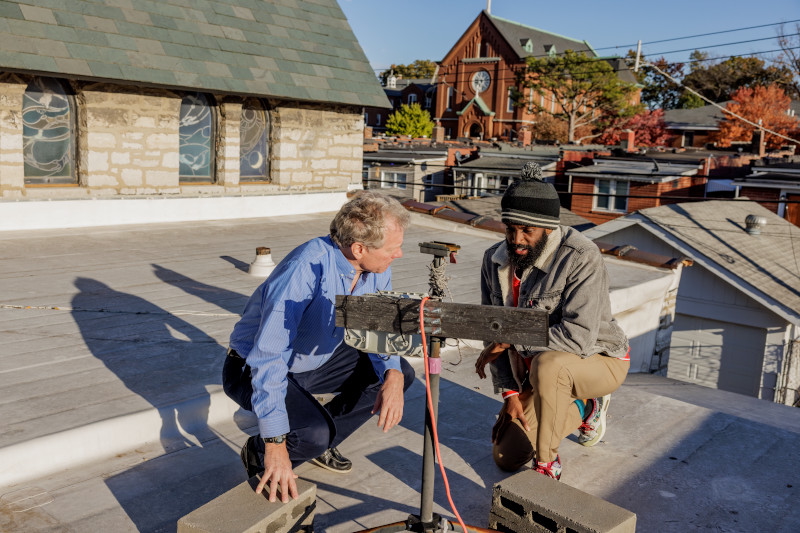
Washington University in St. Louis is formally partnering with St. Louis to expand environmental monitoring and public health research in city neighborhoods affected by the devastating May 16, 2025, tornado.
“This partnership demonstrates WashU’s ‘In St. Louis, For St. Louis’ commitment to our region in concrete and tangible terms,” Chancellor Andrew D. Martin said. “Under the leadership of Dean Dorian Traube and her team in the Brown School, the Public Exchange and the researchers leading CLEAN STL are creating a model for connecting academic expertise with local leaders to effect real change.”
The agreement formalizes and expands CLEAN STL — Contaminant Level Evaluation and Analysis for Neighborhoods — a multidisciplinary initiative launched in fall 2025 to provide residents and city leaders with accurate air and soil data to support long-term recovery efforts. The project began as a pilot developed in partnership with community organizations Better Family Life, Love the Lou and 4theVille and is now growing into a multiyear collaboration with the city.
The expanded initiative represents a significant investment of university resources, with WashU committing more than $500,000 over the next two years to support the project’s first phase of growth.
The signees on the partnership were St. Louis Mayor Cara Spencer; Julian Nicks, chief recovery officer for the city; Victoria Anwuri, St. Louis health commissioner; and Dorian Traube, the Neidorff Family and Centene Corporation Dean of the WashU Brown School.
It brings together the resources of the WashU Public Exchange with the city’s Recovery Office and Department of Health to safeguard community health during demolition and rebuilding and to give residents direct visibility into the conditions in their neighborhoods.
Led through the WashU Public Exchange initiative, CLEAN STL brings together expertise from WashU’s Brown School, Arts & Sciences, McKelvey Engineering, Sam Fox School and School of Law.
“St. Louis is moving into the next chapter of recovery, and that work has to be grounded in trust, transparency and good science,” Spencer said. “This partnership puts real-time information in the city’s and residents’ hands, brings world-class expertise to the neighborhoods that have waited too long for it, and shows that the rebuilding of north St. Louis is going to be done in a community-centric way.”
Read the full story here.
Click on the topics below for more stories in those areas
Back to NewsFaculty in this story