

What a locust can teach us about how neuromodulators alter odor processing
Barani Raman’s lab finds how two neuromodulators amplify or dampen neural and behavioral responses to odorants
When you walk into a bakery and smell fresh cookies, the enticing smell draws you in. After you eat a handful of cookies, though, the same smell likely doesn’t send you back for more. Researchers in the McKelvey School of Engineering at Washington University in St. Louis sought to determine the biological mechanisms in the brain that controllably alters odor-evoked behavior by using an unlikely model — a locust.
Barani Raman, the Dennis & Barbara Kessler Professor in the Department of Biomedical Engineering, along with students in his lab, studied how two neuromodulators with opposite effects, dopamine and octopamine, changed how locusts smelled and reacted to odors. Results of their research were published in the Journal of Neuroscience Sept. 14, 2026.
Dopamine is involved in the brain’s reward system, or a rush after doing things well. When the locusts’ brains were exposed to dopamine, the olfactory neural networks became highly sensitive to the odors presented, which included what to humans smell like grass, lemon or citrus, rose, almond and a spicy floral scent. The locusts increased the neural responses to all odorants, and an appetitive behavior response, which involved opening their sensory appendages close to mouth parts called palps that grab or touch the food.
The team also exposed the locusts to octopamine, an organic chemical behind the "fight-or-flight" neuromodulator in insects and positive learning, then presented the same odors. They found that the locusts’ odor-related brain activity and their behavioral response were reduced. Raman said the behavior differences were not random.
“This was a patterned increase and decrease in neural responses evoked by odorants presented that still maintained the identity of the stimulus,” Raman said. “The cookie still smells like a cookie, but maybe the response is stronger or lesser, depending on which neuromodulator is released.”
It is normal for an organism to change its behavior based on its environment: if there is a food scarcity, it will look for food more than when food is plentiful. But in this case, nothing in its environment changed — only the way the brain processed the odors changed, Raman said.
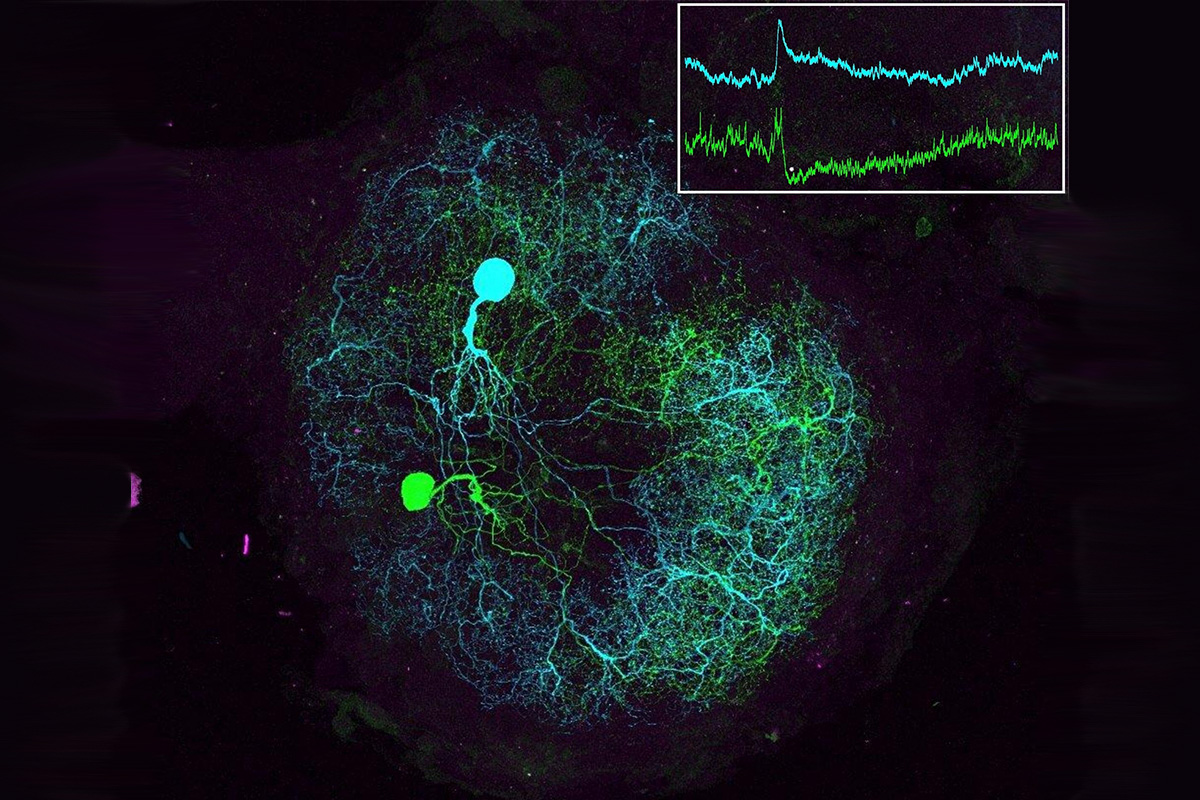
The team went in search of the mechanism behind the behavior responses. They looked at a subset of neurons called local neurons that are GABAergic, or neurons that produce their effects through the GABA neurotransmitter, an inhibitory chemical messenger in the central nervous system. These local neurons modulate the overall activity of the antennal lobe neural network that processes sensory input from the insect antenna.
“What we found was that octopamine did not affect the activity of local neurons at all,” Raman said. “But dopamine, on the other hand, suppressed one subpopulation of local neurons. It released the circuit from inhibition to get that boost in the neural network output. Octopamine did not do that.”
Locusts can exist as solitary organisms or transition into a highly gregarious ones that form destructive swarms. Serotonin is a neuromodulator that is considered to trigger this transformation.
“Gregarious locusts are much more active than a solitary one, so those changes in behavior have to be sustained, and I think different neuromodulators can play a role,” Raman said.
In addition, the researchers combined changes in the physiology and behavior they observed in the locusts following exposure to dopamine and octopamine with previous research that showed that serotonin can increase or decrease palp-opening responses depending on the odor identity — food-related or not food-related.
“The simplest antennal lobe network model that integrated all our results required two groups of neurons: one subgroup to increase the behavioral response and a second group to reduce or suppress the same behavioral output,” Raman said.
They noted that while dopamine influenced the level of inhibition in one group of local neurons, serotonin and octopamine must have putatively influenced the excitability of the projection neurons. They plan further study into this effect.
Bessonova Y, Clark I, Sumida R, Kelley J, Alva I, Raman B. Distinct mechanisms mediate dopamine-octopamine opponency in an insect model of olfaction. Journal of Neuroscience, Sept. 14, 2026. https://doi.org/10.1523/JNEUROSCI.2338-25.2026
This research was supported by the National Science Foundation (2021795 and 2319060); the Air Force Office of Scientific Research (FA95502310461); and the Office of Naval Research (N00014-21-1-2343).
Click on the topics below for more stories in those areas
Back to NewsFaculty in this story