

A unique solution for bioelectronics: collagen and cacao butter
Alexandra Rutz’s lab creates additive manufacturing method for bioelectronics
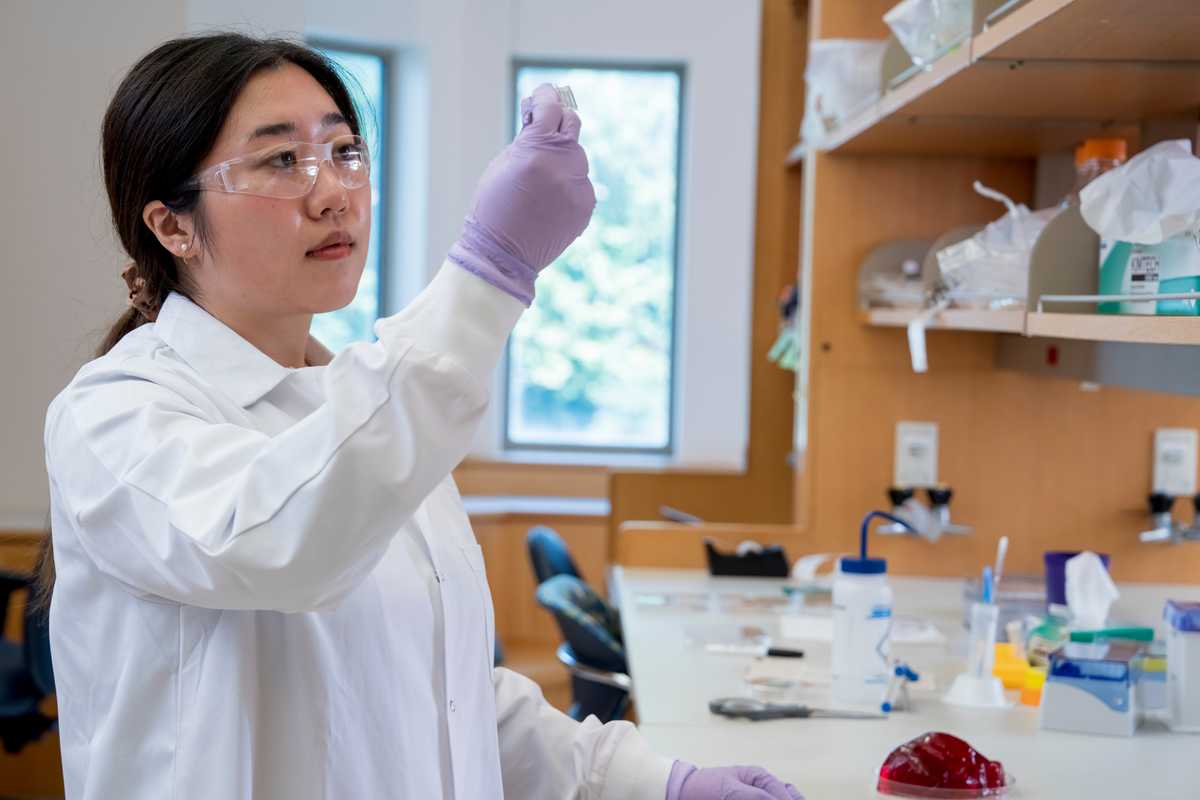
Collagen is the most abundant protein in the human body, making up about 30% of total protein and providing structure, strength and elasticity to skin, bones and soft tissues. A team of engineers in the McKelvey School of Engineering at Washington University in St. Louis is taking advantage of that abundance by creating bioelectronic devices with collagen so that the devices can interact with cells in tissues more easily.
Tianran Liu, a doctoral student in the lab of Alexandra Rutz, assistant professor of biomedical engineering, created an additive manufacturing method using a 3D printer that builds bioelectronic materials from collagen and a polymer that can carry electrical signals. The collagen-based material is expected to be more compatible with living tissues than materials typically used in biomedical devices, such as glass, metals and silicon. This could help lead to better medical implants, lab-grown tissue models and bioelectronic devices that interact more naturally with the body. Results of their research were published in ACS Applied Materials & Interfaces Aug. 19, 2026.
Liu began with PEDOT:PSS, an electrical conducting polymer, then added PEGDE, a chemical compound that helps PEDOT:PSS gel at room temperature, to make an ink. She then used a 3D printer to print the resulting ink onto a collagen substrate rather than glass or plastic. She found that the resulting material does not wash away with water. In fact, when water is added to the material, it creates a hydrated film similar to the stiffness of soft tissue. Liu found that cells attached well to the material, stayed alive and grew over time.
“This kind of material can easily wrap around very small diameters and can be handled with forceps, so it has high surgical potential,” Rutz said. “The main benefit of collagen is bioactivity, besides those nice mechanical properties that are tissue-like. We've been thinking about applications that leverage that, such as seeding cells directly onto the device, or when implanting it, the host cells can interact with it.”
Rutz said the fabrication method could be used for in vitro or in vivo applications, such as an impedance sensor or a nerve stimulator.
In addition, Liu used the technique using cacao butter, a vegetable fat extracted from cacao beans, as a sacrificial material, or a temporary material that is shaped into a specific design, embedded or coated, and later dissolved or removed to leave behind a patterned layer. When researching sacrificial materials in the literature, Liu said, she found that a lot of them required high temperatures to remove them, which would cause their collagen substrate to get “cooked,” Liu said.
“We wanted a material that we could remove at a mild temperature but also retain its shape during evaporation, so we came up with the idea to use ingredients commonly seen in chocolate,” Liu said. “We saw videos of people 3D printing chocolate for food, and we knew that we could print the cacao butter into the 3D pillars that could be easily removed with warm water and maintain its shape while drying.”
Liu said the next steps are to work on the sensing part of the bioelectronic device.
“What we're learning for this kind of technology is to be able to use this kind of bioelectric material to support a tissue model, while also trying to monitor them in their native state,” she said. “The long-term idea is to be able to combine the two aspects — to be able to sense the functional aspect of tissue models while they're situated in this soft and bioelectronic material.”
Liu T, Park J, Okafor SS, Montgomery SK, Goestenkors AP, Semar BA, Alvarez RM, O’Hare CP, Wu Y, Yu JS, Vargas Espinoza CJ, Rutz AL. Additive manufacturing of PEDOT:PSS electrodes on collagen substrates for soft and bioactive electronics. ACS Applied Materials & Interfaces, published online Aug. 19, 2026. DOI: https://doi.org/10.1021/acsami.6c09421
This research was supported with funding from the National Science Foundation (CBET #2443128 and CISE #2319060 to Rutz); CMMI #15-48571 to the Center for Engineering MechanoBiology; and Washington University in St. Louis through the Women’s Health Technologies Collaboration Initiation Grant, Center for Regenerative Medicine Seed Grant, Ovarian Cancer Research Innovation Fund Award, and the McDonnell Center for Cellular and Molecular Neurobiology Small Grant.
Liu and A. Rutz are inventors on a U.S. patent application that covers the additive manufacturing of extracellular matrix encapsulated conducting polymer electrodes.