Activating glass for next generation semiconductor substrates
Sang-Hoon Bae plans to use glass to grow 2D crystals with NSF CAREER Award
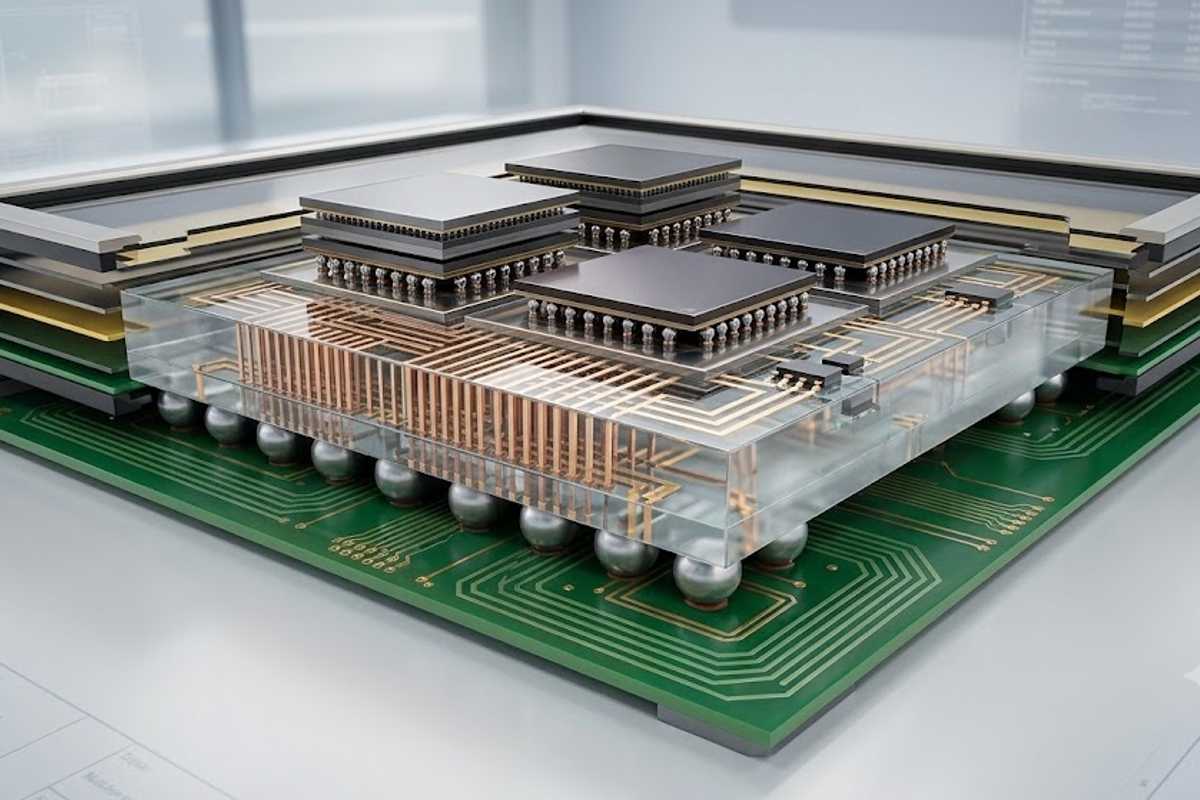
While glass is a stable and inexpensive material often used in electronics, its structure lacks the properties needed to grow crystals for semiconductor materials in high demand for computers, memory and sensing applications.
With a five-year, $700,000 CAREER Award from the National Science Foundation, Sang-Hoon Bae, assistant professor of mechanical engineering & materials science in the McKelvey School of Engineering at Washington University in St. Louis, plans to transform glass from a passive support into an active platform to create high-performing electronic materials that could be used to make devices faster and more energy-efficient and improve communications systems.
CAREER awards support junior faculty who model the role of teacher-scholar through outstanding research, excellence in education and the integration of education and research within the context of the mission of their organization. At least one-third of current McKelvey Engineering faculty have received the award.
Traditional methods to create advanced computer chips use silicon electrical interfaces to connect various parts of the semiconductor. Though effective, they are expensive, limited in size, and may lose signal or overheat when combined with other materials. Glass is less expensive to make, stable at high temperatures and is good for high frequency signals but lacks the crystalline structure needed to grow single-crystal semiconductors.
“Instead of relying on the traditional crystal-to-crystal matching method, we will try to control how atoms move, assemble and grow into ordered structures on glass, leading first-generation active glass interposer,” said Bae, an expert in materials science.
The research builds on Bae’s work, published in Nature in 2023, creating a method to grow semiconductor materials, known as transition metal dichalcogenides (TMD), would make devices faster and use less power. It also leverages his 2024 Science study on interfacial phenomena, providing the fundamental understanding of physical coupling across heterogeneous interfaces needed to realize active glass interposers incorporating high-quality semiconductor materials directly on glass substrates.
“Glass represents an entirely different physical regime, where the absence of thermal conductivity, surface energy contrast and structural differences fundamentally alter the growth dynamics,” Bae said. “As a result, single-crystal growth on glass requires developing an entirely new kinetic framework tailored to its nature.”
If successful, Bae said, their work would yield the first framework for single-crystal semiconductor growth on glass and lay the scientific foundation for “active glass” platforms where glass supports mechanical and thermal functions and integrates embedded functions such as logic, memory and sensing.
Ultimately, Bae expects to establish a framework for crystallization on glass and to add new information about nucleation and growth while creating new possibilities for glass-based electronic integration and semiconductor manufacturing.
In addition to the research, Bae plans to launch a K-12 outreach initiative, Crystals in Chaos, that will feature experiments that demonstrate crystal growth principles. He also plans to create a Disorder-to-Order Studio as a learning platform that translates real-time crystallization data into interactive educational tools. In addition, he plans to integrate the research into his classes in McKelvey Engineering to prepare students for the workforce and in workshops for those in industry.
Click on the topics below for more stories in those areas
Back to NewsFaculty in this story